
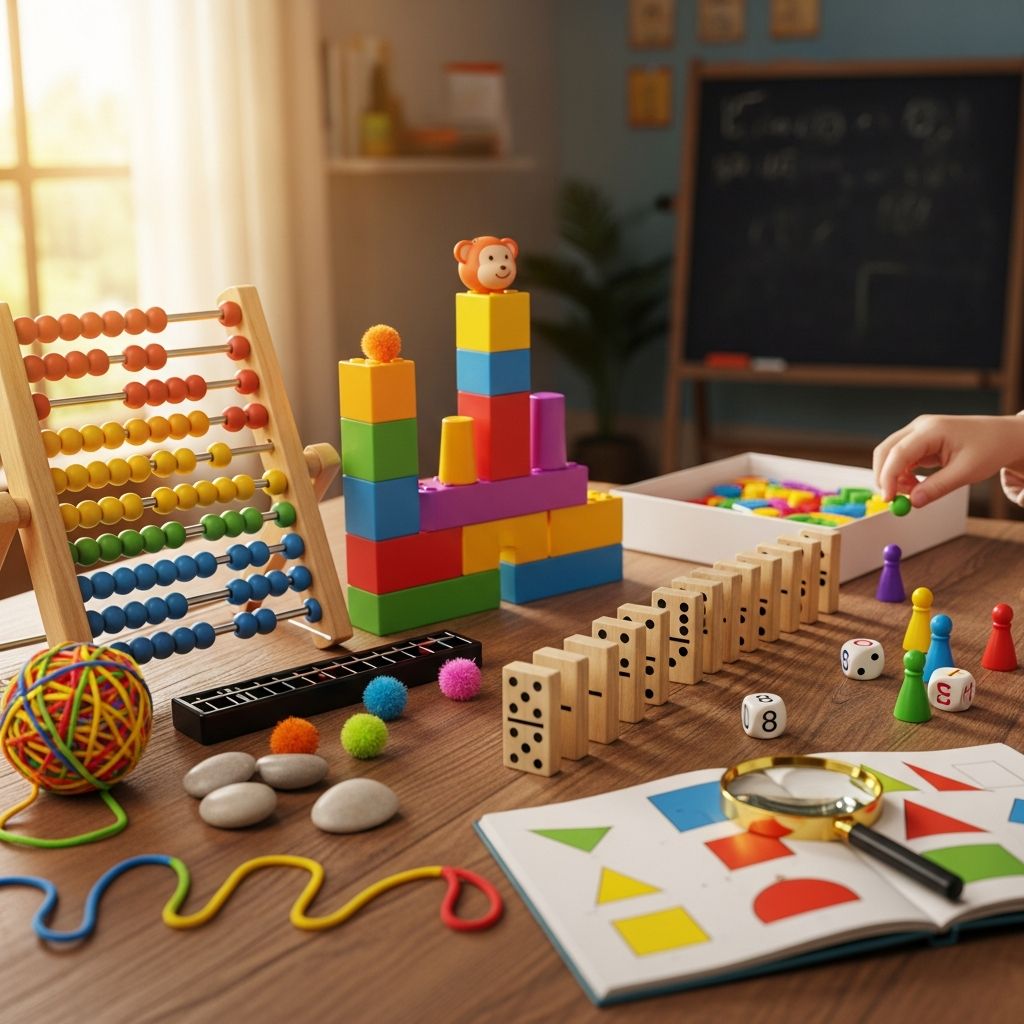
Mathematics often carries a reputation for being dry and challenging, yet it holds immense potential for excitement when taught creatively. By integrating playful elements into lessons, educators and parents can shift students’ perceptions, fostering enthusiasm and deeper comprehension. This article outlines eight effective approaches drawn from educational research and practice, designed to captivate young minds and build lasting skills.
Harness the Power of Physical Manipulatives
Concrete objects bring abstract numbers to life, allowing learners to grasp operations through touch and sight. Items like beads, blocks, or everyday household goods serve as gateways to understanding addition, subtraction, multiplication, and division. For example, grouping dried beans into sets visually demonstrates multiplication, while removing portions illustrates subtraction, helping students internalize quantities and patterns.
Research supports this tactile method, showing it enhances number sense and retention. Teachers can set up stations with varied manipulatives for exploration during lessons, encouraging independent discovery in small groups or individually. This multisensory engagement not only clarifies concepts but also accommodates diverse learning styles, making math accessible to visual, kinesthetic, and even struggling students.
- Use colorful cubes to construct shapes and explore geometry, linking builds to measurements like area and perimeter.
- Employ beads or cereal for operations, physically combining or dividing to solve problems.
- Incorporate tiles for pattern recognition, stacking them to reveal sequences like 2, 4, 6, extending to higher terms.
Incorporate Movement and Body-Based Learning
Static desks limit energy; infusing physical activity revitalizes math sessions. Activities that involve motion help solidify concepts while burning off excess energy, particularly beneficial for younger or active learners. Students might represent angles by twisting their bodies or hop to count multiples on a playground grid.
One dynamic exercise involves marking numbers on a ball—whole numbers, fractions, or decimals—and tossing it around. Catchers perform operations on the numbers under their hands, blending coordination with computation. Such methods promote retention through kinesthetic reinforcement and create joyful, memorable experiences. Outdoors, measuring jumps or pacing distances ties math to real movement, boosting motivation via environmental change.
Turn Lessons into Competitive Games
Competition sparks intrinsic motivation, transforming routine practice into thrilling challenges. Classic games like bingo adapted for math facts or card-based drills encourage peer interaction and quick recall. Board games focused on arithmetic keep small groups engaged, while custom challenges elevate the fun.
Educators can repurpose textbook problems into escape rooms or gallery walks, where teams collaborate to ‘break out’ by solving puzzles. Digital platforms amplify this with leaderboards and adaptive difficulty, ensuring each player progresses at their pace. Studies indicate game users, especially those behind grade level, achieve significantly higher gains—up to 56% more in scale scores—compared to traditional methods.
| Game Type | Skills Targeted | Best For |
|---|---|---|
| Bingo & Cards | Fact Fluency | Elementary |
| Board Games | Strategy & Operations | All Ages |
| Digital Quizzes (e.g., Kahoot) | Quick Review | Middle School |
Leverage Digital Tools and Gamification
Technology opens doors to immersive worlds where math feels like play. Adaptive programs like those simulating alien adventures or fraction missions adjust challenges to individual needs, maintaining optimal engagement. Features such as progress trackers, certificates, and class competitions build community and accountability.
Interactive videos and slide-based lessons with quizzes provide immediate feedback, while virtual manipulatives simulate hands-on work online. An ESSA Level II study found significant math score improvements with such tools across demographics. Parents can extend this at home via apps that gamify homework, turning evenings into achievement quests.
Connect Math to Real-World Scenarios
Abstract problems gain relevance when linked to daily life. Cooking measurements teach fractions, budgeting introduces decimals, and sports stats cover data analysis. Project-based tasks, like planning a class party with resource allocation, demonstrate practical utility, answering the perennial ‘when will I use this?’
Encourage students to devise their own problems from interests—designing game scores or garden layouts. This ownership deepens connections and critical thinking. Concrete-Representational-Abstract (CRA) progression supports this: start with objects, move to drawings, then symbols for layered understanding.
Promote Collaborative Problem-Solving
Group work fosters discussion, exposing varied strategies and building communication skills. Number talks—short, student-led chats on problems—encourage sharing solutions and critiquing peers, honing numeracy without worksheets. Rotate roles like presenter or questioner to ensure participation.
In centers, diverse activities cater to needs: puzzles for logic, games for fun. This setup suits elementary brain breaks and middle school challenges alike, with tech for visuals.
Offer Choices and Personalized Pathways
Empowerment through options combats monotony. Choice boards present themed problem sets—sports, animals—letting students select paths. Differentiate assessments by allowing models, drawings, or writings over rote answers.
Early finishers thrive with extension menus, while adaptive tech personalizes pace. This autonomy boosts confidence and caters to styles.
Draw and Visualize for Deeper Insight
Sketching bridges concrete to abstract. After manipulatives, drawing groups of objects—like apples for multiplication—solidifies thinking. Graph paper arrays visualize area, preparing for symbolic equations.
Open-ended prompts invite explanations: ‘Justify your answer’ or ‘Plan your steps.’ This metacognition elevates math beyond computation.
Frequently Asked Questions
How can parents make math fun at home?
Use kitchen items for measuring, board games for evenings, or free apps for daily practice. Tie chores to counting for seamless integration.
Are digital math games effective?
Yes, research shows adaptive games yield substantial gains, especially for at-risk students.
What age groups benefit most from manipulatives?
Primarily elementary, but visuals aid all ages in building foundations.
How do I start number talks in class?
Pose a problem, give think time, then facilitate sharing. Keep to 10 minutes.
Can these strategies help struggling learners?
Absolutely—CRA, games, and multisensory approaches excel for diverse needs.
References
- 6 Strategies to Make Math Fun and Engaging — Reflex by ExploreLearning. 2023. https://reflex.explorelearning.com/resources/insights/math-engagement-strategies
- 10 Multisensory Techniques for Teaching Math — Understood.org. 2023. https://www.understood.org/en/articles/10-multisensory-techniques-for-teaching-math
- Math Strategies: How To Make Math Fun For All Students — Accelerate Learning. 2023. https://info.acceleratelearning.com/math-strategies-how-to-make-math-fun-for-all-students
- 8 Engaging Strategies for Teaching Math in Any Classroom — Nearpod Blog. 2023. https://nearpod.com/blog/7-tips-for-teaching-math-in-any-classroom-with-nearpod/

- Integrated M.A. in Applied Linguistics, University of Hyderabad
- 5+ years in editorial, instructional, SEO, and research-based writing
Sneha is a relationships and lifestyle writer with a strong foundation in applied linguistics and certified training in relationship coaching. She brings over five years of writing experience to theskillvault, crafting thoughtful, research-driven content that empowers readers to build healthier relationships, boost emotional well-being, and embrace holistic living. Her writing and insights reflect the belief that beauty, happiness, and wellness…