
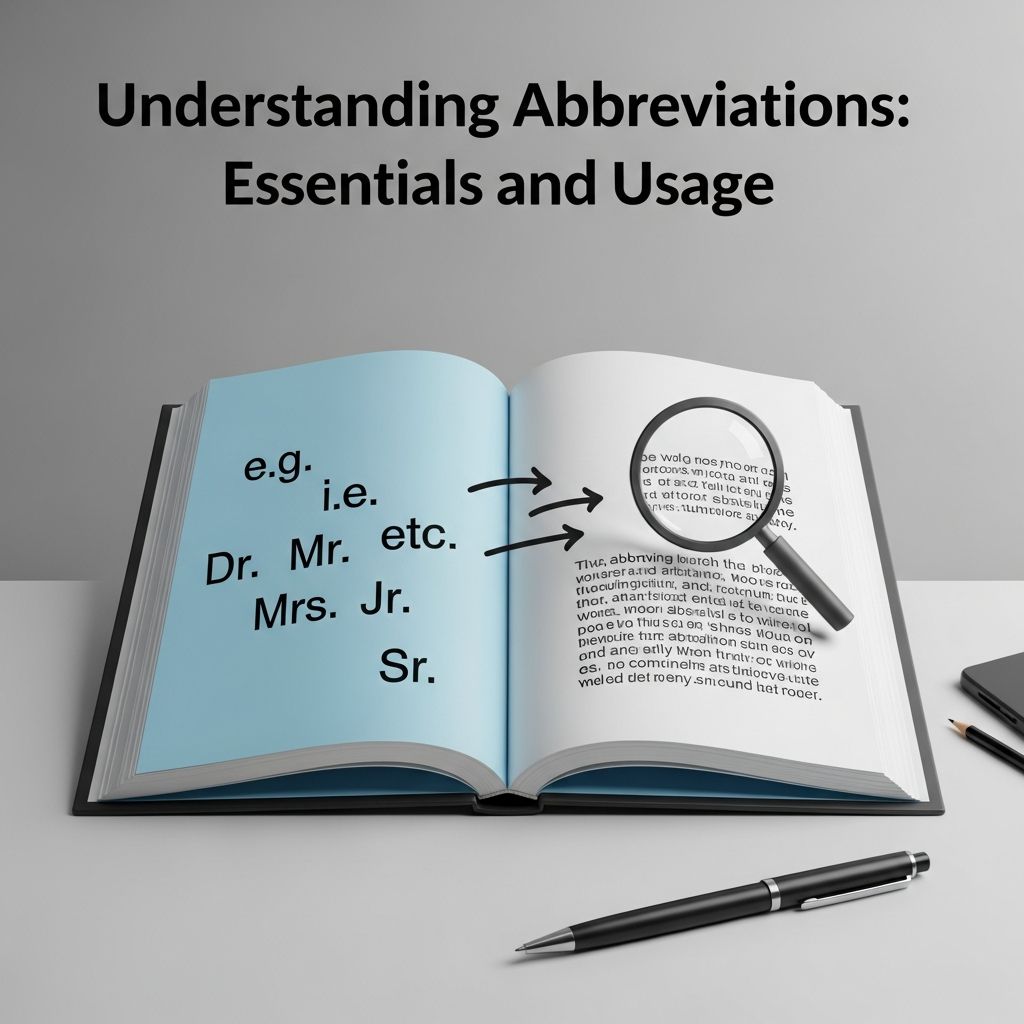
Abbreviations serve as vital tools in language, condensing lengthy words or phrases into compact forms to streamline communication. Derived from the Latin term meaning ‘short,’ they appear everywhere from casual texts to formal documents, saving time and space while preserving meaning.
The Core Concept of Language Shortcuts
At their heart, abbreviations represent shortened versions of words or expressions, enabling quicker expression without losing clarity. For instance, ‘Dr.’ stands for ‘Doctor,’ and ‘Ave.’ for ‘Avenue.’ This practice dates back centuries, evolving with language needs in business, science, and daily life.
These shortcuts boost efficiency, particularly in writing where brevity matters. They reduce typing or printing demands and help readers process information faster. However, misuse can confuse audiences, underscoring the need for context-aware application.
Primary Categories of Abbreviations
Abbreviations fall into distinct categories based on formation methods. Recognizing these helps in selecting the right one and understanding pronunciation.
- Clipping or Truncation: Involves cutting off parts of a word, often the end. Examples include ‘phone’ from ‘telephone’ and ‘prof’ from ‘professor.’ This type is informal and common in spoken English.
- Contractions: Merge words by omitting letters and inserting an apostrophe, like ‘can’t’ for ‘cannot’ or ‘it’s’ for ‘it is.’ They mimic natural speech patterns.
- Initialisms: Use initial letters pronounced separately, such as ‘USA’ (U-S-A) or ‘FAQ’ (F-A-Q). They maintain the sequence’s identity without forming a new word.
- Acronyms: Initial letters blend into pronounceable words, like ‘NASA’ or ‘SCUBA.’ These often become standalone terms over time.
- Syllabic Forms: Combine syllables from multiple words, e.g., ‘television’ as ‘TV’ or ‘international’ in ‘Interpol.’ Less common but effective for brands.
Distinguishing Acronyms from Initialisms
A frequent point of confusion lies between acronyms and initialisms. Acronyms are spoken as words (e.g., ‘laser’ for light amplification by stimulated emission of radiation), while initialisms are letter-by-letter (e.g., ‘FBI’). This distinction affects usage in sentences and style guides.
| Type | Pronunciation | Examples |
|---|---|---|
| Acronym | As a word | NASA, radar, ASAP |
| Initialism | Letter by letter | USA, BBC, BTW |
Style guides like APA or Chicago may capitalize both in all caps, but context dictates lowercase for widespread acronyms like ‘laser.’
Historical Development and Evolution
Abbreviations trace to ancient scripts where scribes shortened texts for efficiency. Latin phrases like ‘e.g.’ (exempli gratia, meaning ‘for example’) persist today. The printing press amplified their use, standardizing forms in English by the 19th century.
In modern times, digital communication birthed ‘textese’—slang like ‘LOL’ (laughing out loud) or ‘BRB’ (be right back). These blend numbers and symbols for speed, though they risk formality in professional settings.
Rules for Punctuation and Formatting
Proper punctuation enhances readability. Traditional truncations often end with periods: ‘Mr.’ or ‘etc.’ Contractions use apostrophes exclusively. Acronyms and initialisms typically omit periods in contemporary usage, e.g., ‘NASA’ not ‘N.A.S.A.’
- Use periods for single-word shorts like ‘Mon.’ (Monday).
- Omit for multi-word uppercase forms unless specified by a style guide.
- Pluralize by adding ‘s’: ‘CDs’ or ‘Ph.D.s.’
Always spell out on first use in formal writing, followed by the abbreviation in parentheses: ‘Federal Bureau of Investigation (FBI).’
Contextual Applications Across Fields
Everyday and Business Communication
In emails and memos, abbreviations like ‘FYI’ (for your information) or ‘ASAP’ expedite exchanges. Yet, over-reliance can alienate non-native speakers or novices.
Scientific and Technical Writing
Fields like medicine (‘Rx’ for prescription) and engineering (‘Hz’ for hertz) standardize abbreviations for precision. Journals mandate glossaries for obscure ones.
Digital and Social Media
Platforms favor brevity: ‘OMG’ (oh my god), ‘TBH’ (to be honest). These evolve rapidly, demanding awareness of generational differences.
Common Mistakes and How to Avoid Them
Missteps include inconsistent capitalization, omitting expansions, or using informal shorts in formal contexts. For example, ‘u’ for ‘you’ suits texts but not reports.
- Verify audience familiarity.
- Consult dictionaries like Merriam-Webster for standards.
- Avoid ambiguity: ‘MT’ could mean ‘Montana’ or ’empty.’
Proofread to ensure abbreviations align with intended meaning, preventing miscommunication.
Global Perspectives on Abbreviations
English borrows from Latin and French, but other languages have parallels: French ‘M.’ for ‘Monsieur,’ Spanish ‘Sr.’ for ‘Señor.’ International bodies like the UN standardize terms like ‘NGO’ (non-governmental organization).
Cultural adaptations occur; British English favors ‘Ltd.’ for ‘Limited,’ while American uses ‘Inc.’
Future Trends in Linguistic Shortening
AI and voice tech may spawn new forms, prioritizing phonetic efficiency. Emojis and symbols increasingly supplement traditional abbreviations in global chats.
Frequently Asked Questions (FAQs)
What is the difference between an abbreviation and an acronym?
An abbreviation is any shortened form, while an acronym specifically forms a pronounceable word from initial letters, like ‘NASA.’
Do abbreviations always need periods?
No, modern usage often drops periods for initialisms and acronyms, but single-word truncations like ‘Dr.’ retain them.
Can I use text abbreviations in professional emails?
Use sparingly and only if the recipient is familiar; spell out for clarity in formal correspondence.
How do I pluralize abbreviations?
Add ‘s’ without apostrophe: ‘DVDs’ or ‘URLs.’ Apostrophes denote possession, not plurals.
Are abbreviations acceptable in academic papers?
Yes, after first full spelling, but follow style guide rules like APA or MLA.
References
- Abbreviation – Wikipedia — Wikipedia contributors. 2023-10-15. https://en.wikipedia.org/wiki/Abbreviation
- The 5 Types of Abbreviations, With Examples — Grammarly. 2023-05-12. https://www.grammarly.com/blog/acronyms-abbreviations/types-abbreviations/
- Video: Abbreviation | Definition, Types & Purpose — Study.com. 2024-01-20. https://study.com/academy/lesson/video/what-are-abbreviations-meaning-types-examples.html
- Abbreviation: Definition and Examples — Grammarly. 2023-08-07. https://www.grammarly.com/blog/acronyms-abbreviations/abbreviations/
- ABBREVIATION Definition & Meaning — Merriam-Webster. 2024-02-28. https://www.merriam-webster.com/dictionary/abbreviation
- ABBREVIATION definition — Cambridge Dictionary. 2024-03-10. https://dictionary.cambridge.org/us/dictionary/english/abbreviation
- Abbreviation vs. Acronym vs. Initialism (Grammar Rules) — Writer’s Digest. 2022-11-05. https://www.writersdigest.com/write-better-fiction/abbreviation-vs-acronym-vs-initialism-grammar-rules

- Integrated M.A. in Applied Linguistics, University of Hyderabad
- 5+ years in editorial, instructional, SEO, and research-based writing
Sneha is a relationships and lifestyle writer with a strong foundation in applied linguistics and certified training in relationship coaching. She brings over five years of writing experience to theskillvault, crafting thoughtful, research-driven content that empowers readers to build healthier relationships, boost emotional well-being, and embrace holistic living. Her writing and insights reflect the belief that beauty, happiness, and wellness…