
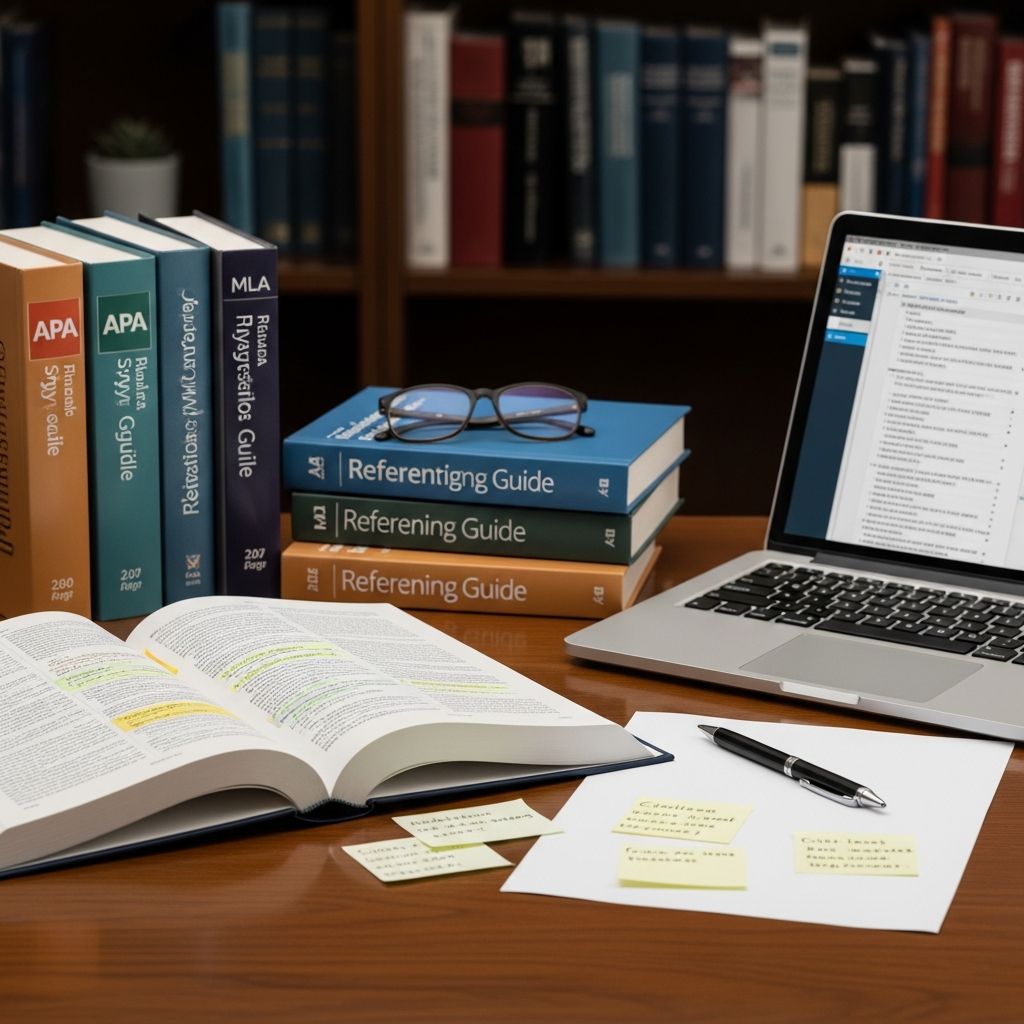
Academic referencing forms the backbone of credible scholarly communication, enabling writers to attribute ideas, data, and findings to their original creators. This practice not only upholds intellectual honesty but also allows readers to trace sources for further exploration. In higher education and research, proper referencing distinguishes rigorous work from unsubstantiated claims, fostering trust in academic discourse.
Why Referencing Matters in Scholarship
Referencing serves multiple critical functions in academic writing. Primarily, it prevents plagiarism by clearly delineating between original thoughts and borrowed content. Beyond ethics, it builds a foundation of evidence-based arguments, strengthening the validity of your analysis. Readers benefit from a roadmap to primary sources, facilitating deeper investigation or verification.
- Ethical Imperative: Acknowledging sources respects intellectual property rights and avoids misrepresentation.
- Academic Integrity: Institutions enforce strict policies; improper referencing can lead to penalties ranging from grade deductions to expulsion.
- Enhancing Credibility: Citations from reputable sources elevate the perceived quality of your work.
- Contextual Depth: References situate your research within broader conversations, showing awareness of existing knowledge.
Failure to reference correctly undermines your authority and risks accusations of academic misconduct. Consistent practice integrates seamlessly into writing, becoming second nature over time.
Overview of Major Referencing Systems
Numerous styles exist, each tailored to specific disciplines. The choice depends on institutional guidelines, journal requirements, or field conventions. Common systems include APA for social sciences, MLA for humanities, Chicago for history, and Harvard for various fields.
| Style | Primary Use | Key Features |
|---|---|---|
| APA | Social Sciences, Psychology | Author-date in-text; alphabetical reference list; DOIs emphasized. |
| Harvard | Business, Law, Humanities | Author-date; flexible for online sources with access dates. |
| MLA | Literature, Arts | Author-page in-text; works cited list. |
| Chicago | History, Fine Arts | Notes-bibliography or author-date variants. |
Consult your course handbook or supervisor to confirm the required style, as variations like APA 7th edition introduce specific updates.
Fundamentals of In-Text Citations
In-text citations briefly identify sources within the body of your text, directing readers to full details in the reference list. They typically include author names and publication years, placed at the end of sentences or integrated into narrative flow.
For APA style, the format is (Author, Year). Multiple authors use ‘et al.’ after the first: (Harris et al., 2018). Organizations abbreviate after first use: (Centers for Disease Control and Prevention [CDC], 2019), then (CDC, 2019).
Harvard follows a similar author-date approach: (Surname, Year). For direct quotes, add page numbers: (Becket, 1974). Paraphrasing prioritizes main ideas without quotes, preferred in most styles for fluid prose.
- Direct Quote: Integrate with quotation marks and precise location, e.g., (The Qur’an, 2015, 20:26).
- Paraphrase: Summarize in your words while citing origin.
- Multiple Sources: Separate by semicolons, e.g., (Smith, 2020; Jones, 2021).
Block quotes for lengthy excerpts (over 40 words in APA) use indented formatting without quotes.
Building a Comprehensive Reference List
The reference list compiles full source details alphabetically by author surname, using hanging indents for readability. Each entry must enable precise source location.
Books and E-Books
Standard book: Surname, Initial. (Year) Title. Publisher. E-book: Add ‘Available at: URL (Accessed: Date).’ Example: Adams, D. (1979) The hitchhiker’s guide to the galaxy. Available at: http://www.amazon.co.uk/kindle-ebooks (Accessed: 23 June 2021).
Journal Articles
Print: Surname, Initial. (Year) ‘Article title’, Journal Title, volume(issue), pp. pages. Online: Include DOI or URL if no pages: Sridhar, S. (2025) ‘Constructive peer review made practical: a guide to the EMPATHY framework’, Journal of Marketing, 89(3), pp. 1-12.
Articles without pagination use article numbers: Frontiers in Immunology, 11, article number 563362.
Chapters in Edited Volumes
Author of chapter. (Year) ‘Chapter title’, in Editor (ed.) Book Title. Publisher, pp. pages. Example: Franklin, A.W. (2012) ‘Management of the problem’, in S.M. Smith (ed.) The maltreatment of children. MTP, pp. 83–95.
Online and Multimedia Sources
Websites: Author. (Year) Title. Available at: URL (Accessed: Date). Videos or module materials follow similar patterns, prioritizing original publications over extracts.
Secondary citations reference only the source consulted: (Weingart et al., 2018, cited in Moise et al., 2020).
Navigating Special Cases and Exceptions
Certain sources demand adapted formats. Personal communications (e.g., emails, interviews) cite in-text only: (Becket, 1974). No entry in reference list due to unavailability.
Tables and figures require captions with citations: ‘Table 1: Data adapted from [Source].’ Prefer Method 1 (citation in title) for simplicity.
Module materials like Blackboard posts cite as original if permitted, but prioritize published sources. Religious texts: (The Qur’an, 2015, 20:26).
- No Author: Use title or organization.
- No Date: (n.d.).
- Multiple Works: Add letters, e.g., (Smith, 2020a).
Tools and Software for Efficient Referencing
Reference managers like Mendeley, Zotero, or EndNote automate formatting, saving time and reducing errors. Input details once; generate bibliographies in any style. Browser extensions capture webpage metadata instantly.
University libguides offer quick examples: APA 7th at CSUDH details in-text and lists. Purdue OWL provides APA basics for journals.
Preventing Plagiarism Through Referencing
Plagiarism encompasses direct copying, mosaic plagiarism (patching phrases), and self-plagiarism (reusing own work without citation). Tools like Turnitin detect similarities, but understanding principles is key.
Strategies: Quote sparingly, paraphrase effectively, cite all non-original ideas. Common pitfalls include forgetting common knowledge boundaries—facts like ‘water boils at 100°C’ need no citation, but specific studies do.
Best Practices for Consistent Referencing
Maintain a single style throughout. Proofread citations against style guides. Use checklists:
- Verify all in-text match reference list.
- Ensure alphabetical order and formatting.
- Double-check DOIs/URLs for accuracy.
Practice with sample papers from official manuals: APA’s 100+ examples.
Frequently Asked Questions (FAQs)
What is the difference between citing and referencing?
Citing occurs in-text; referencing provides full details in the list.
Do I need to cite my own ideas?
No, only external sources.
How do I cite AI-generated content?
Treat as personal communication or consult latest style updates (e.g., APA guidelines).
Is a DOI always required?
Preferred for journals; use URL if unavailable.
What if my source has no page numbers?
Omit or use paragraph numbers, section headings.
References
- APA 7th Ed. – Citation – LibGuides at CSUDH — California State University Dominguez Hills Library. 2023. https://libguides.csudh.edu/citation/apa-7
- Quick guide to Harvard referencing (Cite Them Right) — Open University Library. 2025-02-12. https://university.open.ac.uk/library/referencing-and-plagiarism/quick-guide-to-harvard-referencing-cite-them-right
- Reference examples (Harvard style) – Citing references — University of Reading Library. 2025. https://libguides.reading.ac.uk/citing-references/citationexamples
- Reference examples – APA Style — American Psychological Association. 2023. https://apastyle.apa.org/style-grammar-guidelines/references/examples
- Reference List: Basic Rules – Purdue OWL — Purdue University. 2023. https://owl.purdue.edu/owl/research_and_citation/apa_style/apa_formatting_and_style_guide/reference_list_basic_rules.html

- Integrated M.A. in Applied Linguistics, University of Hyderabad
- 5+ years in editorial, instructional, SEO, and research-based writing
Sneha is a relationships and lifestyle writer with a strong foundation in applied linguistics and certified training in relationship coaching. She brings over five years of writing experience to theskillvault, crafting thoughtful, research-driven content that empowers readers to build healthier relationships, boost emotional well-being, and embrace holistic living. Her writing and insights reflect the belief that beauty, happiness, and wellness…