
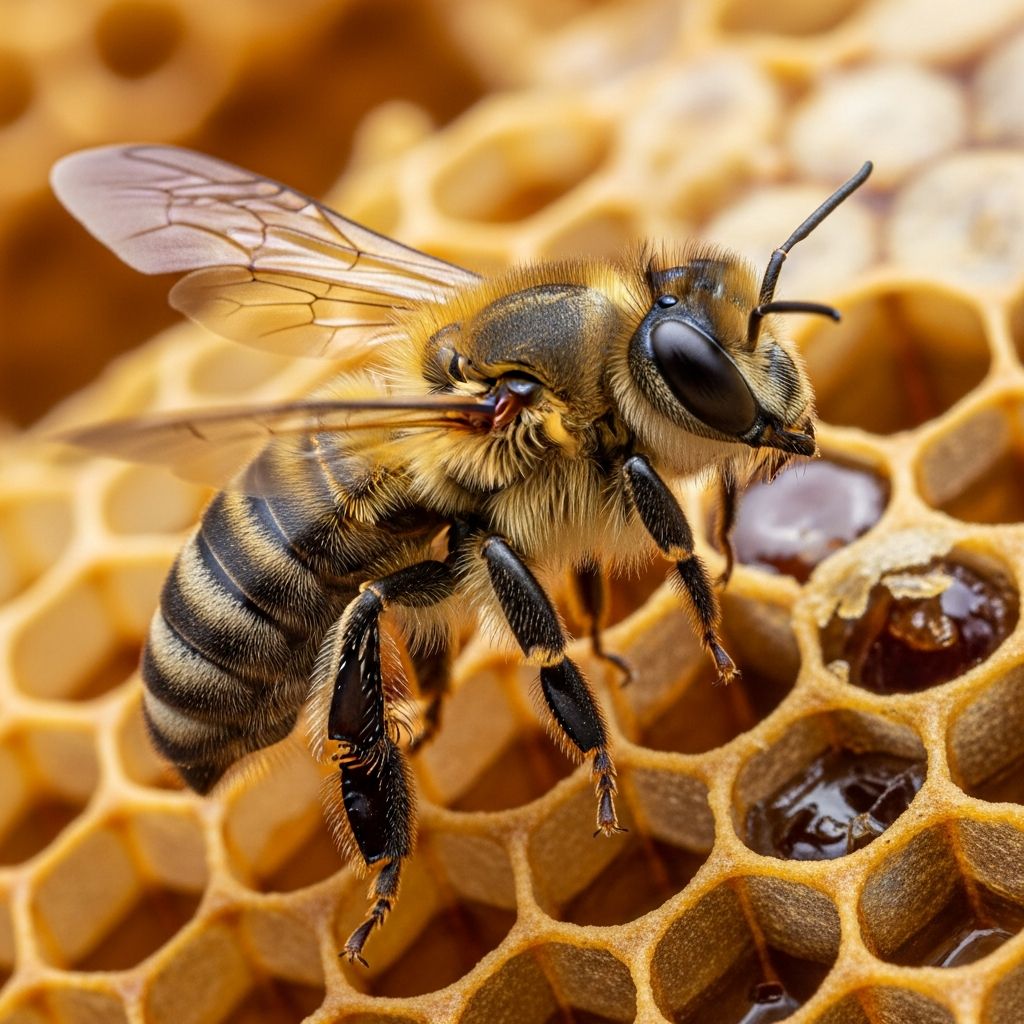
Africanized honey bees, commonly known as killer bees, possess a physical appearance nearly identical to that of standard European honey bees, making visual identification impossible without laboratory analysis. Their notoriety stems from extreme defensiveness rather than size or venom potency.
Physical Characteristics of Africanized Honey Bees
These bees measure approximately 3/4 to 1 inch (1.9-2.5 cm) in length, matching the dimensions of typical honey bees. Covered in fine fuzz, their bodies exhibit a brownish hue accented by black stripes that lack the sharp contrast seen in wasps or hornets.
Their anatomy includes a robust thorax—the central body segment—to which four transparent wings and six legs attach. The abdomen, larger than the thorax, terminates in a stinger, while the head remains comparatively smaller. Workers feature pollen baskets (corbiculae) on their hind legs, formed by interwoven hairs for transporting pollen.
- Body color: Brownish with diffuse black bands, slightly darker than some European variants.
- Wings: Clear and colorless, spanning from the thorax.
- Head: Heart-shaped and hairy, aiding in sensory functions.
- Size variation: Minimal differences; queens, workers, and drones vary slightly by role, age, and subspecies.
Drones lack pollen baskets and possess larger, bulbous eyes for mate location. Despite these traits, no naked-eye feature reliably separates Africanized bees from European ones.
Distinguishing Africanized Bees from Other Insects
Africanized bees resemble European honey bees closely but differ from wasps and hornets through fuzzier bodies and less defined stripes. Wasps appear smoother and more vividly striped, while hornets are larger with white markings.
| Feature | Africanized Bee | European Honey Bee | Yellow Jacket Wasp | Bald-Faced Hornet |
|---|---|---|---|---|
| Size | ¾-1 inch | ¾-1 inch | ½-1 inch | ¾-1 inch |
| Body Texture | Fuzzy | Fuzzy | Smooth | Smooth, white markings |
| Stripes | Brown/black, diffuse | Amber/black | Yellow/black, sharp | White/black |
| Wings | Clear | Clear | Clear | Clear, smoky |
| Sting | Once, dies after | Once, dies after | Multiple | Multiple |
This table highlights key visual cues for differentiation in the field.
Origins and Spread of the Africanized Bee
Africanized bees originated from hybridization between African honey bees (Apis mellifera scutellata) and European strains in Brazil during the 1950s. Intended to boost tropical honey production, the aggressive African genetics dominated, leading to swarms escaping northward.
By the 1990s, they reached the U.S., first documented in Texas and Arizona. Today, they thrive in southern states like Texas, Florida, Arizona, and California, adapting to hot climates and outcompeting native bees through rapid reproduction and swarming.
Genetic dominance allows Africanized traits to prevail in mixed colonies, making them prevalent in Central and South America for beekeeping despite challenges.
Aggressive Defense Mechanisms
The defining trait of Africanized bees is their hyper-defensiveness. They react faster to threats, deploying larger numbers—up to 10% or more of the hive—and pursue intruders up to 400 meters (1,300 feet), far exceeding European bees’ range.
Unlike European bees, which calm within 20 minutes, Africanized swarms remain agitated for hours. They attack unprovoked near hives, even in rain or at dawn/dusk when others stay sheltered. Triggers include vibrations, shadows, or proximity within 50 feet.
Each sting delivers equivalent venom to a honey bee’s, but mass attacks (hundreds to thousands) overwhelm victims. Pheromones from initial stings rally the colony, turning defense into a lethal swarm. Over 1,000 human fatalities worldwide underscore their danger, alongside livestock losses.
Hive Structure and Social Organization
Africanized colonies mirror honey bee castes: one queen lays eggs, female workers forage and defend, and male drones mate. Hives favor cavities like trees, walls, or chimneys, often smaller than European ones due to frequent swarming.
High swarming rates—absconding entire hives—aid survival in harsh conditions. They produce honey efficiently, valued in some regions, but aggression deters management.
Ecological Role and Human Impact
Despite risks, Africanized bees pollinate crops effectively and yield honey. Their adaptability bolsters populations in declining bee landscapes, though they displace gentler strains.
Fatal U.S. incidents began in 2011, prompting awareness campaigns. They pose greatest threat to vulnerable groups: children, elderly, allergic individuals, and pets.
Safety Protocols for Encounters
Prevention is key: maintain 50-foot distance from potential nests, avoid mowing tall grass or using power tools nearby. If attacked, run linearly (not zigzag), seek shelter, cover face/mouth, and use water to disrupt flight.
- Scan for nests in eaves, ground voids, or water meters.
- Report swarms to professionals; do not disturb.
- Wash stings promptly; monitor for anaphylaxis.
- In endemic areas, train pets/livestock to flee.
Frequently Asked Questions (FAQs)
Can you identify killer bees by sight alone?
No, Africanized bees are visually indistinguishable from European honey bees without genetic testing.
Is their venom deadlier?
No, venom potency matches regular honey bees; danger arises from attack volume.
Do they sting repeatedly?
No, like all honey bees, they sting once and die, barbs lodging in skin.
How far will they chase?
Up to 400 meters, persisting longer than European bees.
Are they beneficial despite aggression?
Yes, excellent pollinators and honey producers in tropical zones.
Management and Research Advances
Authorities like USDA monitor spread via traps and DNA sampling. Beekeepers select calmer strains, while research explores genetic dilution. Public education reduces incidents.
In summary, understanding these bees’ unremarkable appearance belies their potent threat, emphasizing behavioral vigilance over visual hunts.
References
- Africanized killer bee | Zoology | Research Starters — EBSCO. Accessed 2026. https://www.ebsco.com/research-starters/zoology/africanized-killer-bee
- Bees – Brownsville, TX — City of Brownsville. Accessed 2026. https://www.brownsvilletx.gov/733/Bee-Information
- Honey & Killer Bees — Wild Bees of Texas. Accessed 2026. https://www.wildbeestexas.com/honey-and-killer-bees
- Killer Bees for Kids | Learn all about these Africanized honey bees — Learn Bright (YouTube). Accessed 2026. https://www.youtube.com/watch?v=XtRlNC05rFs
- Africanized Honey Bee Facts & Identification — Florida Pest Control. Accessed 2026. https://www.flapest.com/pest-info/bees-wasps-and-hornets/africanized-honey-bee/
- Africanized bee — Wikipedia (informational, primary sources referenced). Accessed 2026. https://en.wikipedia.org/wiki/Africanized_bee
- Killer Bees Explained — Keeping Backyard Bees. Accessed 2026. https://www.keepingbackyardbees.com/killer-bees-explained-zbwz1811zsau/

Medha Deb is an editor with a master's degree in Applied Linguistics from the University of Hyderabad. She believes that her qualification has helped her develop a deep understanding of language and its application in various contexts. Medha specializes in the areas of beauty, health, sports, and wellness and is committed to ensuring that the content on the website is…