
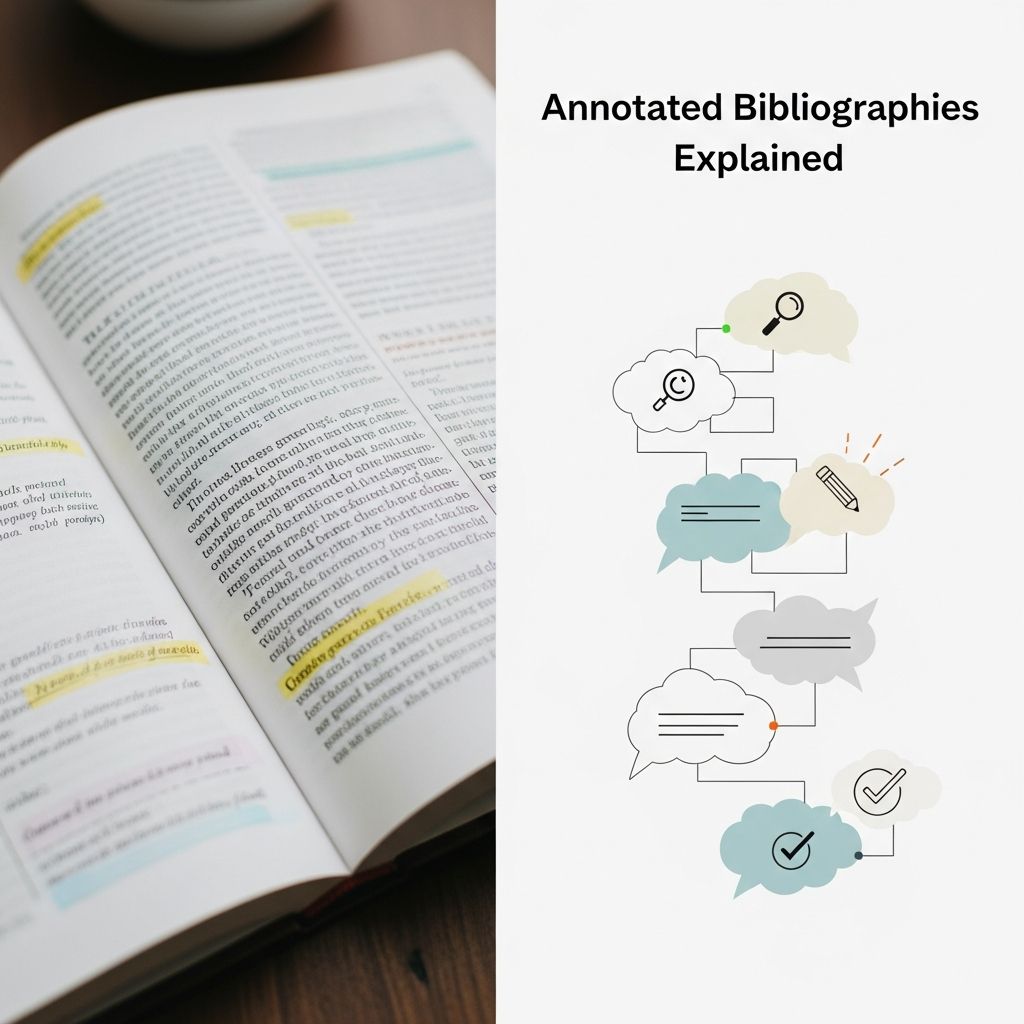
Annotated bibliographies serve as powerful tools in academic research, combining standard citations with insightful commentary on sources. They help researchers organize information, critically evaluate materials, and demonstrate the relevance of their references to a specific project.
Defining the Annotated Bibliography
An annotated bibliography is fundamentally a curated list of research sources where each entry includes not only the bibliographic details but also a concise annotation. This annotation typically offers a summary of the source’s content, an assessment of its quality and reliability, and a reflection on its usefulness for the research at hand.
Unlike a plain bibliography, which merely lists sources, the annotated version adds depth by requiring active engagement with each work. Researchers must read, analyze, and synthesize key ideas, making it an exercise in critical thinking. Common in humanities, social sciences, and other fields, these bibliographies are often assigned to prepare students for larger papers or theses.
Core Components of Every Annotation
Each annotation in a bibliography follows a structured approach to ensure completeness and clarity. Breaking it down reveals three primary elements that form the backbone of effective annotations.
- Citation: The full reference in a chosen style like APA, MLA, or Chicago, providing all necessary details for locating the source.
- Summary: A neutral overview of the source’s main arguments, methods, findings, and conclusions, usually 2-4 sentences long.
- Evaluation: A critical appraisal covering credibility, biases, strengths, weaknesses, and comparisons to other works.
- Reflection: An explanation of how the source fits into the researcher’s project and supports their thesis or inquiry.
These components ensure annotations are both descriptive and analytical, transforming a simple list into a roadmap for research. Length varies, but 100-200 words per entry is standard unless specified otherwise.
Step-by-Step Guide to Building Your Annotated Bibliography
Creating an annotated bibliography demands systematic effort. Follow these steps to produce a professional result.
- Research and Select Sources: Identify 5-20 relevant, high-quality materials on your topic, prioritizing peer-reviewed articles, books, and credible websites.
- Record Citations: Note full bibliographic information immediately to avoid errors later.
- Read Actively: Skim for structure, then read deeply, highlighting key points, arguments, and evidence.
- Draft the Annotation: Write the summary first, followed by evaluation and reflection. Aim for objectivity in summaries and insightfulness in critiques.
- Organize Entries: Arrange alphabetically by author’s last name or chronologically if thematic grouping applies.
- Revise and Format: Proofread for consistency, adhere to style guidelines, and ensure annotations flow logically.
This process hones library research skills and encourages succinct writing. Tools like Zotero or EndNote can streamline citation management.
Popular Citation Styles for Annotated Bibliographies
Different disciplines favor specific formats. Here’s how annotations integrate into major styles.
| Style | Hanging Indent? | Annotation Placement | Common Use |
|---|---|---|---|
| APA | Yes | New paragraph, no extra space | Social Sciences |
| MLA | Yes | Double-spaced, following citation | Humanities |
| Chicago | Yes | Single-spaced block, half-inch indent | History, Literature |
In APA, for instance, the citation uses a hanging indent, and the annotation starts on a new line without indenting further. Always consult official guides for nuances.
Real-World Examples Across Disciplines
To illustrate, consider these original sample annotations tailored to different fields.
APA Example (Psychology):
Smith, J. A. (2023). Cognitive impacts of social media. Journal of Behavioral Studies, 45(2), 112-130. https://doi.org/10.1234/jbs.2023.45.2.112
This article examines how daily social media use affects attention spans in young adults through surveys and experiments. Smith finds a correlation between platform engagement and reduced focus, supported by statistical analysis.
The study is reliable due to its large sample and peer-reviewed status, though it lacks longitudinal data. It strengthens arguments on digital wellness by providing empirical evidence.
MLA Example (Literature):
Johnson, Emily. “Gothic Elements in Modern Fiction.” Studies in Literature, vol. 12, no. 3, 2024, pp. 45-67.
Johnson analyzes recurring gothic motifs in contemporary novels, arguing they reflect societal anxieties. Key examples include shadowy narratives and unreliable narrators.
Credible for its close textual analysis, this source compares favorably to older critiques. It aids my thesis on evolving horror genres.
These demonstrate concise yet informative annotations.
Common Pitfalls and How to Avoid Them
Even experienced researchers stumble. Steer clear of these errors.
- Overly long annotations that stray into full reviews.
- Neglecting critical evaluation in favor of mere description.
- Inconsistent formatting across entries.
- Ignoring instructor guidelines on length or focus.
- Using biased language; maintain scholarly tone.
Proofreading twice and peer-reviewing help mitigate issues.
Benefits Beyond the Assignment
An annotated bibliography offers lasting value. It organizes research, reveals gaps in literature, refines thesis statements, and prepares for literature reviews. Professionally, it showcases analytical skills to employers or grant reviewers. Students report improved critical reading after compiling one.
Frequently Asked Questions (FAQs)
What exactly makes an annotation different from a summary?
An annotation extends beyond summarizing by including evaluation and relevance to your work, fostering deeper analysis.
How long should each annotation be?
Typically 100-200 words, but confirm with your instructor as requirements vary.
Do I need to include all types of sources?
Focus on credible, relevant ones; mix books, articles, and primary sources for diversity.
Can I use software for this?
Yes, citation managers like Mendeley assist, but write annotations manually for authenticity.
Is alphabetical order always required?
Usually yes, by author’s last name, unless thematic organization is specified.
Advanced Strategies for Excellence
For standout bibliographies, incorporate comparative notes across entries, note evolving scholarship, and link sources to theoretical frameworks. In interdisciplinary work, highlight cross-field connections. Digital tools like Hypothesis for collaborative annotation add modern flair.
Practice builds mastery; start with 5 sources and scale up. This method not only fulfills assignments but elevates overall research proficiency.
References
- What is an annotated bibliography? — Ivy Tech LibAnswers. 2023. https://ivytech.libanswers.com/allstate/faq/269746
- FAQ: What is an annotated bibliography and how do I write one? — SNHU LibAnswers. 2024-01-15. https://libanswers.snhu.edu/faq/8744
- A Guide to Annotated Bibliographies — George Mason University Writing Center. 2023-05-10. https://writingcenter.gmu.edu/writing-resources/research-based-writing/a-guide-to-annotated-bibliographies
- How to Prepare an Annotated Bibliography — Cornell University Library. 2024. https://guides.library.cornell.edu/annotatedbibliography
- Annotated Bibliographies — Purdue OWL. 2024-03-20. https://owl.purdue.edu/owl/general_writing/common_writing_assignments/annotated_bibliographies/index.html
- Q. What is an annotated bibliography? — Berkeley College Library. 2023. https://chat.library.berkeleycollege.edu/faq/48865

- Integrated M.A. in Applied Linguistics, University of Hyderabad
- 5+ years in editorial, instructional, SEO, and research-based writing
Sneha is a relationships and lifestyle writer with a strong foundation in applied linguistics and certified training in relationship coaching. She brings over five years of writing experience to theskillvault, crafting thoughtful, research-driven content that empowers readers to build healthier relationships, boost emotional well-being, and embrace holistic living. Her writing and insights reflect the belief that beauty, happiness, and wellness…