
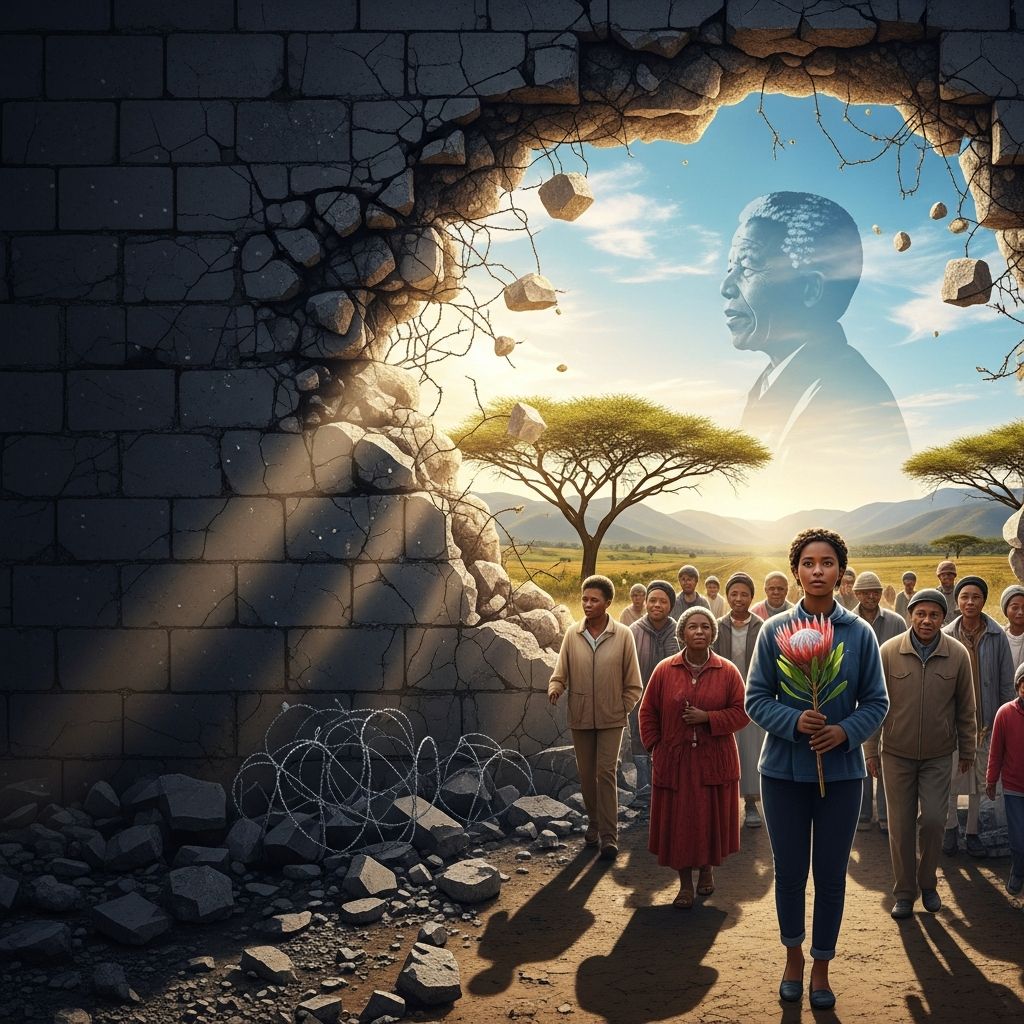
Apartheid, a system of institutionalized racial segregation and discrimination, defined South African society for over four decades. Implemented by the National Party after their 1948 election victory, it enforced strict separation between racial groups, privileging whites while oppressing the Black majority and other non-white populations. This article explores the system’s foundations, the mounting resistance it provoked, the pivotal negotiations that dismantled it, and the democratic dawn that followed, marking a profound transformation in global history.
Foundations of a Divided Nation
The roots of apartheid stretched back to colonial times, but it crystallized as official policy in 1948 when the National Party won power on a platform of ‘apartness.’ This ideology mandated separate living areas, education, healthcare, and public facilities for whites, Blacks, Coloureds, and Indians. Key legislation in the 1950s, such as the Population Registration Act and the Group Areas Act, classified citizens by race at birth and relocated millions to designated zones, often forcibly uprooting communities.
By the 1960s, the regime intensified control. The creation of ‘bantustans’—supposed homelands for Black ethnic groups—stripped millions of South African citizenship, confining them to impoverished reserves comprising just 13% of the land despite Blacks forming 70% of the population. Between 1960 and 1983, approximately 3.5 million people were displaced in one of history’s largest mass evictions.
- Racial Classification: Every citizen registered by race, dictating life opportunities.
- Pass Laws: Blacks required permits to enter ‘white’ areas, leading to widespread arrests.
- Bantustan Policy: Nominal independence for homelands to justify disenfranchisement.
Economically, apartheid fueled white prosperity through cheap Black labor in mines and farms, while denying political rights. This imbalance sowed seeds of resentment that would erupt into sustained opposition.
Sparks of Resistance Ignite
Opposition began early but escalated dramatically. In 1960, the Sharpeville Massacre saw police kill 69 unarmed protesters demonstrating against pass laws, galvanizing global outrage. The African National Congress (ANC) and Pan-Africanist Congress (PAC) were banned, forcing them underground.
Nelson Mandela, co-founder of the ANC’s armed wing Umkhonto we Sizwe, emerged as a central figure. Arrested in 1962 and sentenced to life imprisonment in 1964 for sabotage, his Rivonia Trial speech declared readiness to die for freedom. From Robben Island, Mandela symbolized defiance.
| Key Protest Events | Date | Impact |
|---|---|---|
| Sharpeville Massacre | 1960 | 69 killed; international condemnation; ANC banned |
| Soweto Uprising | 1976 | Hundreds dead protesting Afrikaans education; youth radicalized |
| Steve Biko’s Death | 1977 | Black Consciousness leader dies in custody, sparking riots |
The 1976 Soweto student uprising against imposed Afrikaans in schools left over 600 dead, amplifying internal unrest. Activists like Steve Biko promoted Black Consciousness, empowering communities despite brutal crackdowns.
Global Solidarity and Isolation
Internationally, apartheid faced mounting pressure. The UN condemned it as a crime against humanity. South Africa was expelled from the Commonwealth in 1961 and faced sports boycotts, cultural isolations, and economic sanctions. By the 1980s, U.S. and European divestment campaigns crippled the economy, with GDP stagnating amid unrest.
- Sports Bans: No Olympics or cricket tours for decades.
- Economic Sanctions: Banks withdrew loans; trade restricted.
- Cultural Boycotts: Artists like Paul Simon navigated ‘township tours’ controversies.
These measures, combined with internal strikes and township violence, rendered the system unsustainable. President P.W. Botha attempted cosmetic reforms in 1984, like repealing mixed-marriage bans, but riots persisted.
The Turning Point: Reforms and Release
In 1989, F.W. de Klerk succeeded Botha as president, inheriting a nation on the brink. Recognizing apartheid’s collapse, de Klerk unbanned the ANC, SACP, and other groups on February 2, 1990, and freed Mandela on February 11 after 27 years in prison. Mandela’s release electrified the world, symbolizing hope.
1991 saw the repeal of all apartheid laws, including the Population Registration Act. Power-sharing talks commenced via the Convention for a Democratic South Africa (CODESA), navigating violence from Inkatha Freedom Party clashes and right-wing threats.
“I apologize for the apartheid of the past, which inflicted enormous suffering and damage to the people of South Africa.” – F.W. de Klerk, 1993
Negotiations Amid Turmoil
Talks were fraught. Assassinations, like that of ANC leader Chris Hani in 1993, nearly derailed progress, but Mandela’s call for calm prevailed. The 1993 Interim Constitution enshrined universal suffrage, paving the way for elections.
Multi-party negotiations balanced ANC demands for majority rule with white fears of retribution, establishing safeguards like property rights protections.
April 1994: Dawn of Democracy
On April 27, 1994, South Africa held its first non-racial elections. Despite logistical chaos and intimidation, over 16 million voted, with the ANC securing 62.65% of the vote. Mandela was inaugurated as president on May 10, partnering with de Klerk as deputy—a ‘Rainbow Nation’ born.
The Truth and Reconciliation Commission (TRC), chaired by Desmond Tutu, followed in 1995, offering amnesty for truth-telling about atrocities, fostering national healing over vengeance.
Legacy and Persistent Shadows
Apartheid’s end was miraculous, avoiding civil war through negotiation. Yet, inequalities linger: land ownership remains skewed, unemployment ravages Black communities, and racial tensions simmer. The ANC’s governance has faced corruption scandals, but democratic institutions endure, with peaceful power transitions.
Mandela’s presidency (1994-1999) focused on reconciliation, HIV/AIDS response, and economic reform via GEAR policy. Successors like Thabo Mbeki and Cyril Ramaphosa grappled with apartheid’s socioeconomic scars.
| Achievements Post-1994 | Challenges |
|---|---|
| Universal suffrage; TRC healing | Economic inequality; Gini coefficient ~0.63 |
| Constitutional rights protections | Land reform delays; high crime |
| Infrastructure growth | Corruption; youth unemployment |
Frequently Asked Questions (FAQs)
What exactly was apartheid?
Apartheid was a legal framework of racial segregation in South Africa from 1948 to 1994, enforcing separation in all life aspects and denying non-whites voting rights.
Who were the main figures in ending apartheid?
Nelson Mandela led the ANC resistance; F.W. de Klerk initiated reforms; Desmond Tutu championed reconciliation.
Did apartheid end abruptly or gradually?
It ended gradually: laws repealed 1991, constitution 1993, full democracy via 1994 elections.
What role did international pressure play?
Sanctions, boycotts, and isolation economically strained the regime, forcing negotiations.
Is South Africa fully free from apartheid’s effects?
Politically yes, but economic disparities and social divides persist.
References
- Apartheid timeline: Key dates in the end of white rule in South Africa — The Irish Times. 2022-11-18. https://www.irishtimes.com/news/world/africa/apartheid-timeline-key-dates-in-the-end-of-white-rule-in-south-africa-1.4725824
- Apartheid | South Africa, Laws, Definition, Facts, History — Encyclopædia Britannica. 2024-01-15. https://www.britannica.com/topic/apartheid
- The End of Apartheid in South Africa — HeinOnline Blog. 2025-03-01. https://home.heinonline.org/blog/2025/03/the-end-of-apartheid-in-south-africa/
- Timeline of Apartheid — Stanford University. 2004-09-19. https://web.stanford.edu/~jbaugh/saw/Ajani_Apartheid.html
- Apartheid: A Short History — Anti-Apartheid Legacy. N/A. https://antiapartheidlegacy.org.uk/heritage-arts-culture/history/apartheid-a-short-history/
- The End of Apartheid South Africa: New Beginnings and Lingering Challenges — NC Humanities. N/A. https://ncheteach.org/resource/complex-world-the-end-of-apartheid-south-africa-new-beginnings-and-lingering-challenges/
- Apartheid — Wikipedia (for background; primary sources cited inline). 2026-04-01. https://en.wikipedia.org/wiki/Apartheid

- Integrated M.A. in Applied Linguistics, University of Hyderabad
- 5+ years in editorial, instructional, SEO, and research-based writing
Sneha is a relationships and lifestyle writer with a strong foundation in applied linguistics and certified training in relationship coaching. She brings over five years of writing experience to theskillvault, crafting thoughtful, research-driven content that empowers readers to build healthier relationships, boost emotional well-being, and embrace holistic living. Her writing and insights reflect the belief that beauty, happiness, and wellness…