
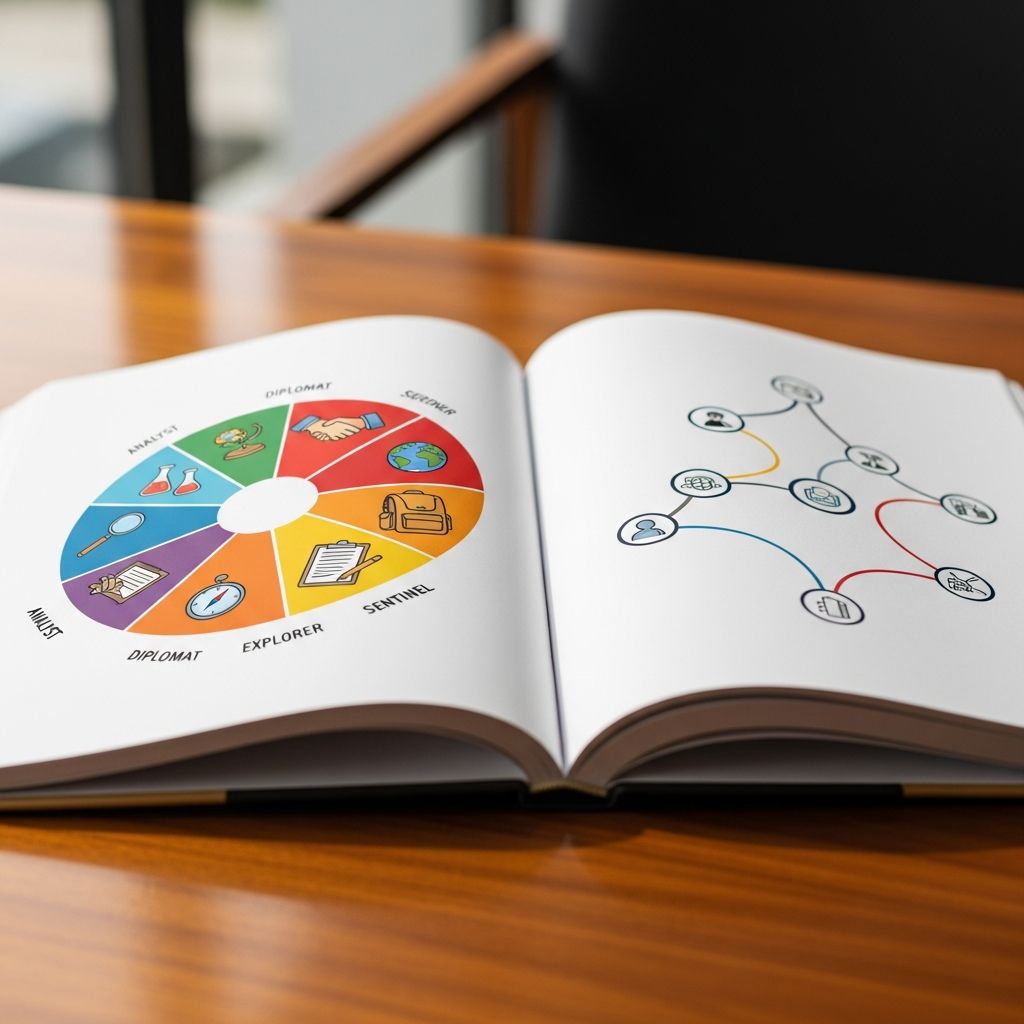
Choosing a career that aligns with your innate personality traits can significantly enhance job satisfaction, productivity, and long-term success. Research from John Holland’s RIASEC theory demonstrates that individuals thrive in work environments that match their dominant personality types, leading to higher engagement and reduced turnover. This article delves into the six core personality categories—Realistic, Investigative, Artistic, Social, Enterprising, and Conventional—offering tailored career suggestions, workplace preferences, and evidence-based insights to guide your professional journey.
Understanding Personality-Driven Career Fit
Personality profoundly influences career outcomes. According to Holland’s framework, people seek environments congruent with their traits, fostering satisfaction and performance. For instance, those with matching personalities in a team create harmonious dynamics, amplifying collective success. Studies also link Big Five traits like Conscientiousness and Agreeableness to positive job satisfaction across pay, security, and workload. Mismatches, however, breed dissatisfaction—Neuroticism consistently correlates negatively with all job facets.
Recent analyses of thousands across 250 occupations reveal stark trait differences: Extraversion and Openness vary most by role, with creatives scoring high on imagination and leaders on organization. Leveraging assessments like Career Key or similar tools helps identify your top types, often a blend (e.g., Realistic-Investigative), broadening viable paths.
Realistic Personalities: Hands-On Builders
Realistic types, often called ‘Doers,’ excel in practical, physical tasks involving tools, machines, or nature. They prefer structured, tangible work over abstract theorizing, thriving in solitary or like-minded groups.
Key Traits:
- Practical and mechanically inclined
- Prefer independent or small-team settings
- Compatible with Investigative or Conventional environments
These individuals shine in roles demanding precision and problem-solving with real-world applications. Compatibility with Investigative types allows analytical depth, while Conventional pairings emphasize order.
| Career Examples | Why It Fits | Average Salary Insight |
|---|---|---|
| Carpenter | Hands-on construction and craftsmanship | Competitive in trades |
| Electrician | Technical wiring and troubleshooting | High demand |
| Pilot | Operating complex machinery | Well-compensated |
| Engineer (Mechanical) | Designing functional systems | Strong growth |
| Mechanic | Repair and maintenance | Essential service |
Realistic workers report higher satisfaction in these fields due to direct impact and autonomy.
Investigative Personalities: Analytical Thinkers
Investigative types are intellectual explorers who dissect problems scientifically. They favor independent research over social bustle, best in quiet, focused spaces.
Key Traits:
- Curious and data-driven
- Excel alone or with fellow thinkers
- Compatible with Realistic or Artistic
Openness to ideas, a Big Five trait prominent here, fuels innovation in STEM fields.
| Career Examples | Why It Fits | Key Skills |
|---|---|---|
| Biologist | Lab-based experimentation | Research analysis |
| Mathematician | Theoretical modeling | Problem-solving |
| Computer Programmer | Coding algorithms | Logical thinking |
| Pharmacist | Drug interaction studies | Precision |
| Surveyor | Field data collection | Technical measurement |
These careers align with self-regulation traits like Conscientiousness, boosting fulfillment.
Artistic Personalities: Creative Visionaries
Artistic individuals channel imagination into unique expressions, shunning rigid structures for fluid, expressive teams.
Key Traits:
- Imaginative and unconventional
- Thrive in unstructured groups
- Compatible with Investigative or Social
High Openness distinguishes them, ideal for roles valuing originality.
- Graphic Designer: Visual storytelling
- Musician: Performance and composition
- Interior Decorator: Aesthetic innovation
- Writer: Narrative crafting
- Photographer: Capturing essence
Collaborative spaces enhance their output, per workplace design research.
Social Personalities: Empathetic Helpers
Social types, the ‘Helpers,’ prioritize people, offering support in dynamic teams where they’re valued. Agreeableness drives their satisfaction.
Key Traits:
- Trustworthy and cooperative
- Best in helping roles
- Compatible with Artistic or Enterprising
| Career Examples | Impact Area |
|---|---|
| Counselor | Mental health support |
| Nurse | Patient care |
| Teacher | Educational guidance |
| Social Worker | Community aid |
| Physical Therapist | Rehabilitation |
Enterprising Personalities: Bold Leaders
Enterprising ‘Persuaders’ lead with charisma, excelling in persuasive, high-energy groups. Extraversion shines here.
Key Traits:
- Ambitious and influential
- Leadership-oriented
- Compatible with Social or Conventional
- Sales Manager: Driving revenue
- Attorney: Advocacy
- Entrepreneur: Business launch
- Public Relations Specialist: Brand influence
- Event Planner: Coordination
Conventional Personalities: Organized Executors
Conventional ‘Organizers’ manage data and routines meticulously, preferring defined duties in structured settings.
Key Traits:
- Detail-focused and reliable
- Systematic teams
- Compatible with Enterprising or Realistic
| Career Examples | Core Duties |
|---|---|
| Accountant | Financial records |
| Administrative Assistant | Office management |
| Bank Teller | Transactions |
| HR Specialist | Compliance |
| Logistics Coordinator | Scheduling |
Combining Personality Types for Broader Options
Most people blend 2-3 types, like Artistic-Social for teaching arts. Inconsistent pairs (e.g., Realistic-Social) require compromise jobs. Tools aid in mapping these.
Personality and Job Satisfaction: Research Insights
Person-environment fit predicts satisfaction; mismatches erode it. Conscientious types excel universally, while Extraverts may undervalue pay. Competitive traits suit managers; decision-ease fits pilots.
How to Assess Your Personality Type
Free tools like Holland-based quizzes reveal codes. Reflect on preferences: Do you build, analyze, create, help, lead, or organize?
Frequently Asked Questions
What are the six Holland personality types?
Realistic (Doer), Investigative (Thinker), Artistic (Creator), Social (Helper), Enterprising (Persuader), Conventional (Organizer).
Can I succeed in a job not matching my type?
Possible with effort, but satisfaction drops; blends offer flexibility.
How does personality affect team dynamics?
Similar types harmonize; diverse ones need balanced spaces.
Is there a best type for leadership?
Enterprising with Conscientiousness and low Neuroticism.
Do personality traits change careers?
They shape and adapt to roles over time.
References
- Holland’s Theory of Career Choice — Career Key. Accessed 2026. https://www.careerkey.org/fit/personality/hollands-theory-of-career-choice
- Personality-based productivity: How to match workplaces to types — Eptura. Accessed 2026. https://eptura.com/discover-more/blog/six-personality-types-how-they-impact-your-career-choice/
- Associations between Personality Traits and Areas of Job Satisfaction — PMC (NCBI). 2023-06-12. https://pmc.ncbi.nlm.nih.gov/articles/PMC10295380/
- Personality traits that typify job roles revealed in study — University of Edinburgh. 2024-01-15. https://www.ed.ac.uk/news/2024/personality-traits-that-typify-job-roles-revealed
- Leveraging Personality Assessments for Effective Career Planning — University of Arizona Grad Center. Accessed 2026. https://gradcenter.arizona.edu/news/leveraging-personality-assessments-effective-career-planning

Medha Deb is an editor with a master's degree in Applied Linguistics from the University of Hyderabad. She believes that her qualification has helped her develop a deep understanding of language and its application in various contexts. Medha specializes in the areas of beauty, health, sports, and wellness and is committed to ensuring that the content on the website is…