
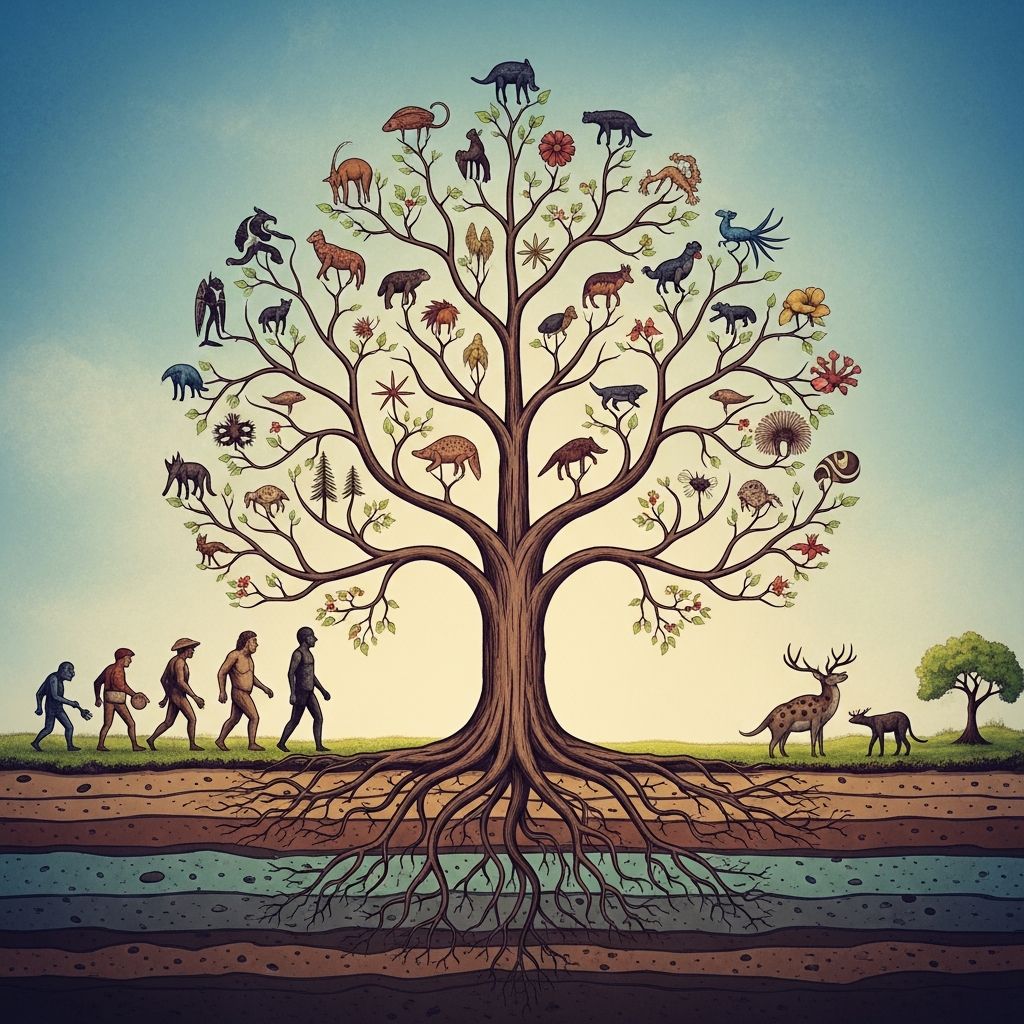
Biological evolution represents the fundamental process by which populations of organisms change their inherited characteristics across generations, driven by mechanisms like natural selection and genetic variation. This dynamic framework explains the incredible diversity of life on Earth, from microscopic bacteria to complex mammals.
The Core Concept of Evolution
At its essence, evolution is defined as the alteration in heritable traits within biological populations over successive generations. These changes occur through processes acting on genetic variation, leading to adaptations that enhance survival and reproduction in specific environments.
Unlike popular misconceptions, evolution does not imply progress toward perfection but rather adaptation to changing conditions. It operates on populations, not individuals, and encompasses both minor shifts in gene frequencies and the emergence of entirely new species.
Mechanisms Driving Evolutionary Change
Several key mechanisms propel evolution, each contributing uniquely to genetic diversity and adaptation.
- Natural Selection: Proposed by Charles Darwin, this process favors individuals with traits best suited to their environment, increasing the prevalence of advantageous genes over time.
- Genetic Drift: Random fluctuations in gene frequencies, particularly impactful in small populations, can lead to significant evolutionary shifts unrelated to fitness.
- Mutation: Spontaneous changes in DNA sequences introduce new genetic variation, serving as the raw material for evolution.
- Gene Flow: The transfer of genes between populations through migration prevents isolation and homogenizes genetic pools.
These mechanisms interact; for instance, mutations provide variation upon which natural selection acts, while drift can amplify or diminish selected traits.
Natural Selection in Action
Natural selection occurs when individuals with favorable traits survive and reproduce more successfully, passing those traits to offspring. Observable facts underpin this: organisms produce more offspring than can survive, traits vary, some confer reproductive advantages, and traits are heritable.
Consider antibiotic resistance in bacteria: mutations enable survival against drugs, leading to resistant populations dominating after treatment. This micro-scale example illustrates macro-evolutionary patterns.
| Environmental Pressure | Advantageous Trait | Outcome |
|---|---|---|
| Predator presence | Camouflage coloration | Increased survival in moths like Biston betularia |
| Disease exposure | Immune gene variants | Higher reproduction in resistant individuals |
| Resource scarcity | Efficient metabolism | Population shift toward leaner body types |
This table highlights how selection pressures shape populations predictably.
The Role of Genetic Variation and Genomics
Evolution fundamentally operates at the genomic level, where changes in DNA sequences alter gene expression and phenotypes. Mutations, recombinations, and genomic rearrangements generate variation.
Genomes encode our evolutionary history; comparing DNA across species reveals relatedness. Humans share about 98-99% of DNA with chimpanzees, reflecting a common ancestor roughly 6-7 million years ago.
High-throughput sequencing has revolutionized this field, allowing precise tracking of evolutionary divergence. For example, pseudogenes—non-functional gene remnants—provide snapshots of ancestral functions.
Types of Evolutionary Patterns
Evolution manifests in diverse patterns, each responding to unique selective forces.
- Divergent Evolution: Related species develop distinct traits, like Darwin’s finches adapting different beak shapes for food sources.
- Convergent Evolution: Unrelated species evolve similar traits independently, such as wings in birds, bats, and insects.
- Parallel Evolution: Closely related species evolve similarly under shared pressures, e.g., saber-tooth adaptations in multiple cat lineages.
- Coevolution: Mutual evolutionary changes between interacting species, like pollinators and flowers.
These patterns underscore evolution’s flexibility in generating biodiversity.
Evidence Supporting Evolution
Overwhelming evidence from multiple disciplines confirms evolution’s validity.
- Fossil Record: Transitional forms, like Archaeopteryx linking reptiles and birds, document gradual change.
- Comparative Anatomy: Homologous structures, such as forelimbs in whales, bats, and humans, indicate shared ancestry.
- Molecular Biology: Universal genetic code and sequence similarities across life forms.
- Biogeography: Species distributions align with evolutionary history, e.g., marsupials in Australia.
- Observed Evolution: Real-time examples like peppered moths or Galápagos finches.
Genetics provides the strongest modern evidence: all organisms use DNA/RNA for heredity, with phylogenetic trees matching predicted relationships.
Evolution as Both Fact and Theory
Evolution is a fact—organisms have changed over time—and a theory explaining how, via testable mechanisms like selection and drift. This dual nature mirrors gravity: undeniable occurrence with mechanistic explanation.
Theory in science means a well-substantiated framework, not mere hypothesis. Evolution synthesizes fossils, genetics, and biogeography into a cohesive narrative.
Addressing Common Misconceptions
Myths persist despite evidence. Here’s a clarification table:
| Misconception | Reality |
|---|---|
| Evolution is ‘just a theory’ | A scientific theory is robustly tested, like germ theory |
| Individuals evolve | Populations evolve via differential reproduction |
| Evolution explains life’s origin | It addresses diversification post-origin |
| No transitional fossils exist | Many exist, e.g., Tiktaalik for fish-tetrapods |
| Complexity implies design | Natural processes suffice, as in bacterial flagella |
These clarifications highlight evolution’s empirical foundation.
Evolutionary History: From Origins to Today
Life began ~3.5-4 billion years ago from simple prokaryotes. Key milestones include eukaryote emergence (~2 billion years), Cambrian explosion (~540 million years), land colonization (~400 million years), and mammal radiation post-dinosaurs (~65 million years).
Humans fit within this tree: primates ~65 million years ago, hominins ~7 million, Homo sapiens ~300,000 years. Shared ancestry unites all life.
Implications for Modern Science and Society
Evolution informs medicine (antibiotic resistance, cancer evolution), agriculture (crop breeding), and conservation (adapting to climate change). Understanding it combats pseudoscience and fosters appreciation for biodiversity.
In genomics era, personalized medicine leverages evolutionary insights into genetic diseases.
Frequently Asked Questions (FAQs)
What is the primary mechanism of evolution?
Natural selection, where advantageous traits increase in frequency due to better survival and reproduction.
Does evolution occur in humans?
Yes, ongoing via selection on traits like lactose tolerance or disease resistance.
How long does evolution take?
Varies: bacteria evolve in days; speciation often millions of years.
Is evolution random?
Mutation is random, but selection is directional toward fitness.
Can evolution produce complex structures like the eye?
Yes, incrementally: evidence shows stepwise eye evolution across species.
References
- What is evolution? — YourGenome.org. 2023. https://www.yourgenome.org/theme/what-is-evolution/
- Evolution — National Human Genome Research Institute (genome.gov). 2023-10-26. https://www.genome.gov/genetics-glossary/Evolution
- An introduction to evolution — University of California, Berkeley (evolution.berkeley.edu). 2023. https://evolution.berkeley.edu/evolution-101/an-introduction-to-evolution/
- Evolution — Encyclopædia Britannica. 2026-01-15. https://www.britannica.com/science/evolution-scientific-theory
- What is Evolution? — BioLogos. 2023. https://biologos.org/common-questions/what-is-evolution
- Evolution | Definition, History, Types, & Examples — Encyclopædia Britannica. 2026-01-15. https://www.britannica.com/science/evolution-scientific-theory
- Evolution: Fact and Theory — National Center for Science Education (NCSE). 2023. https://ncse.ngo/evolution-fact-and-theory

- Integrated M.A. in Applied Linguistics, University of Hyderabad
- 5+ years in editorial, instructional, SEO, and research-based writing
Sneha is a relationships and lifestyle writer with a strong foundation in applied linguistics and certified training in relationship coaching. She brings over five years of writing experience to theskillvault, crafting thoughtful, research-driven content that empowers readers to build healthier relationships, boost emotional well-being, and embrace holistic living. Her writing and insights reflect the belief that beauty, happiness, and wellness…