
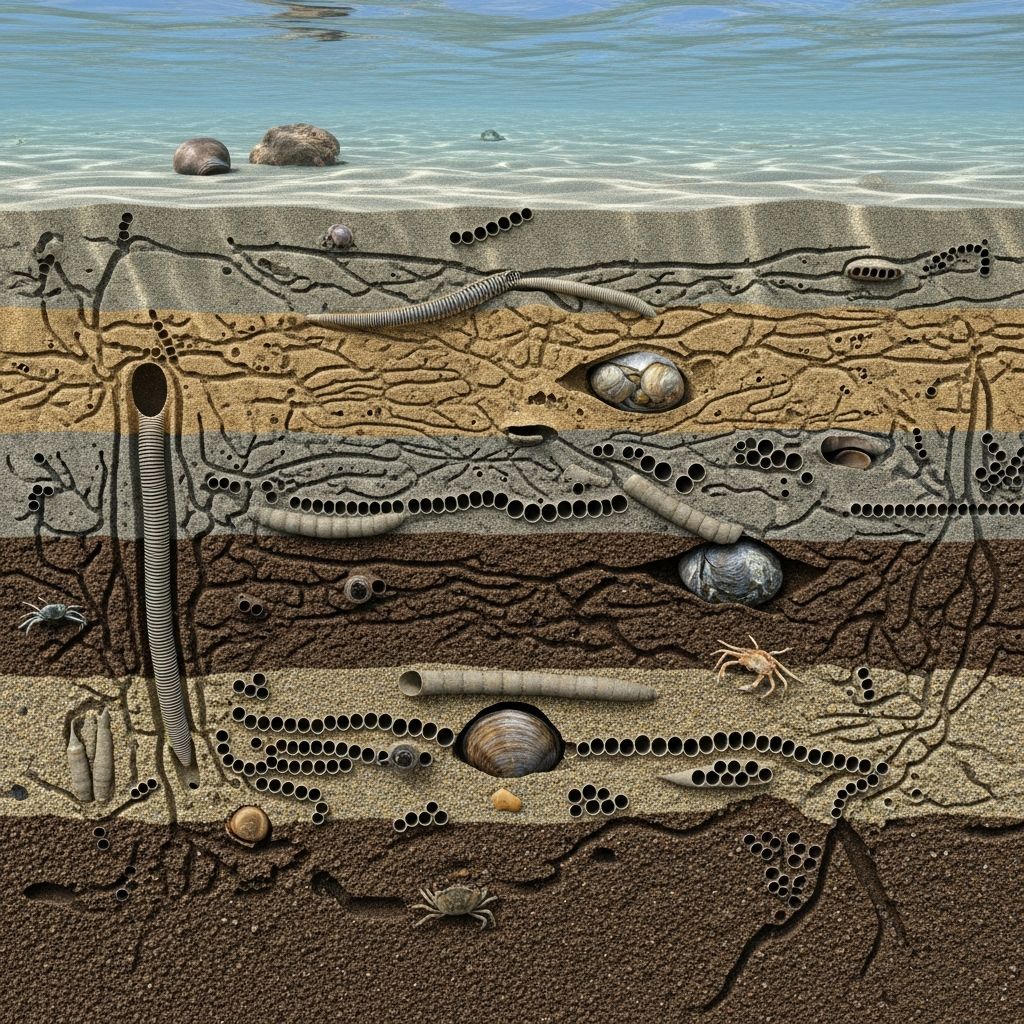
Organisms have long been recognized as key players in shaping Earth’s landscapes, but their role in physically altering sediments through everyday activities remains a fascinating area of study. This phenomenon, known as bioturbation, involves the disruption and mixing of sediments by plants, animals, and microbes. Far from mere background noise in ecosystems, bioturbation fundamentally influences soil development, water quality, carbon storage, and even pollutant dispersal. Across terrestrial soils, freshwater lakes, coastal marshes, and deep ocean beds, these biological engineers rework vast quantities of material, driving biogeochemical cycles that sustain life.
Defining Bioturbation and Its Mechanisms
Bioturbation encompasses all biological activities that rearrange sediments, including burrowing, root growth, feeding, and locomotion. These actions displace particles, alter sediment texture, and create pathways for fluids and gases. In marine settings, it often pairs with bioirrigation, where organisms pump water through burrows, oxygenating sediments and facilitating chemical exchanges. On land, tree roots and burrowing mammals churn upper soil layers, transporting weathered materials upward while incorporating organic matter downward.
The intensity of bioturbation varies by organism type and environment. Downward conveyors, like certain worms, pull surface particles into deeper layers. Upward conveyors, such as some clams, eject deeper sediments to the surface. Gallery-diffusors create diffuse mixing via numerous small burrows, while regenerators rework sediment in place through feeding. These behaviors not only mix solids but also redistribute microorganisms, nutrients, and contaminants, amplifying ecological impacts.
Impacts on Terrestrial Ecosystems
In soils, bioturbation accelerates formation and evolution. Plants and animals disturb surface layers, enhancing aeration and water infiltration. Tree roots penetrate deep, delivering organic matter upon decay and creating voids that reduce soil density. Uprooting events displace large soil volumes, forming mounds that mix horizons and promote downslope transport. This activity boosts soil production by exposing fresh material to weathering and increases organic content, vital for fertility.
Earthworms, ants, and rodents exemplify terrestrial bioturbators. Earthworm castings can rework entire topsoils annually in fertile regions, improving structure and nutrient availability. Such mixing prevents layering, fosters microbial diversity, and aids carbon burial by incorporating plant debris. However, excessive disturbance, like from invasive species, can erode soils or homogenize profiles, altering habitats.
Aquatic Environments: Lakes, Rivers, and Ponds
Freshwater sediments teem with organic matter, and bioturbation releases bound nutrients like nitrogen and phosphorus into overlying waters, fueling algal growth and primary production. In lakes, small invertebrates like chironomid larvae burrow and bioirrigate, aerating anoxic depths. This shifts sediments from anaerobic to aerobic conditions, enhancing mineralization but also complicating nutrient fluxes. For instance, increased oxygen promotes phosphorus adsorption to iron oxides, potentially curbing its release.
Rivers experience dramatic bioturbation from spawning fish, such as salmon constructing redds. These nests dislodge benthic algae, reducing primary production while mobilizing organic carbon for respiration, flipping ecosystems from autotrophic to heterotrophic. Such events underscore bioturbation’s role in dynamic fluvial systems, influencing food webs and water chemistry seasonally.
| Organism Type | Activity | Key Impact |
|---|---|---|
| Chironomids | Burrowing & Bioirrigation | Oxygenates sediments, boosts denitrification |
| Salmon | Redd construction | Mobilizes carbon, reduces algae |
| Oligochaetes | Surface deposit feeding | Releases nutrients to water column |
Coastal and Marine Realms
Estuaries and coastal zones accumulate detritus, making bioturbation crucial for decomposition. Burrowers increase oxygenated sediment surface area, enhancing respiration and nutrient cycling. Nitrogen dynamics benefit most: bioturbation couples nitrification (aerobic) and denitrification (anaerobic), removing bioavailable forms and curbing eutrophication. Burrows host nitrogen-fixing bacteria, further balancing cycles.
In tidal marshes, bioturbators like crabs and polychaetes stabilize or destabilize sediments, affecting accretion and erosion. This influences carbon sequestration, as reworked sediments bury organic matter more effectively. Deep-sea floors rely on bioturbation for habitability; infaunal organisms cycle manganese and nitrogen, preventing stagnation. Reduced bioturbation during past mass extinctions delayed ecosystem recovery by locking nutrients in sediments.
Biogeochemical Cycles Transformed
Bioturbation is a biogeochemical powerhouse. It disperses particles, altering diagenesis—the transformation of organic remains into fossils or sediments. By mixing aerated and anoxic zones, it accelerates redox reactions, releasing or binding elements like iron, sulfur, and carbon. In oceans, it promotes particle incorporation into food webs, aiding sequestration by burying particulate organic carbon.
Carbon cycling exemplifies this: terrestrial mixing enhances soil storage, while aquatic activities shuttle it between sediments and water, influencing atmospheric CO2. Phosphorus and nitrogen fluxes support productivity but risk eutrophication if unchecked. These processes position bioturbators as ecosystem engineers, akin to Darwin’s observations on earthworms.
Contaminant Dynamics and Environmental Risks
Bioturbation mobilizes pollutants from sediments, historically the dirtiest compartments. Active burrowers oxygenate layers, reducing acid volatile sulfides that bind metals, increasing bioavailability. This heightens exposure for the organisms themselves and the broader community, explaining sensitivities in species like midges.
In polluted freshwater, high bioturbation rates cascade to greater toxicant release across benthic-pelagic boundaries. Trait-based models predict community responses, highlighting active mixers’ vulnerability. Coastal management must account for this, as bioturbators can remobilize legacy contaminants like heavy metals or organics.
- Key Risks: Enhanced metal bioavailability via oxygenation.
- Ecotoxicology Insight: Bioturbators face amplified exposure.
- Mitigation: Monitor species traits for sediment risk assessment.
Climate Change and Future Trajectories
Warming drives species migrations, reshaping bioturbation patterns. In marshes, shifting faunas could alter carbon burial, critical for blue carbon ecosystems. Ocean deoxygenation may suppress deep-sea mixing, mimicking extinction aftermaths and stalling recovery. Terrestrial shifts, like expanding burrowing mammals, could accelerate soil turnover amid droughts.
Projections suggest intensified coastal erosion or stabilization based on invader traits. Understanding these changes is vital for conservation, as bioturbation underpins resilience in dynamic habitats.
Frequently Asked Questions
What organisms drive bioturbation?
Primarily invertebrates like worms, crustaceans, and insects; vertebrates such as fish and mammals; and plant roots in soils.
How does bioturbation affect water quality?
It releases nutrients, potentially causing eutrophication, but also enhances denitrification to remove nitrogen.
Is bioturbation always beneficial?
No; it can mobilize contaminants or destabilize sediments, though it generally promotes ecosystem health.
Can humans influence bioturbation?
Yes, via habitat restoration, invasive control, or pollution reduction to modulate its intensity.
What is bioirrigation?
Water pumping through burrows by organisms, complementing particle mixing with chemical exchanges.
References
- Bioturbation – Wikipedia — Wikipedia Contributors. 2023-10-15. https://en.wikipedia.org/wiki/Bioturbation
- Benthic Invertebrate Bioturbation Activity Determines Species Sensitivity — Frontiers in Environmental Science. 2017-12-20. https://www.frontiersin.org/journals/environmental-science/articles/10.3389/fenvs.2017.00083/full
- Reviews and syntheses: Bioturbation impacts on sediment accretion and erosion in tidal marshes — EGUsphere. 2025-01-01. https://egusphere.copernicus.org/preprints/2025/egusphere-2025-4749/
- As the world churns: How bioturbation has shaped ocean floors — Phys.org. 2025-08-01. https://phys.org/news/2025-08-world-churns-bioturbation-ocean-floors.html
- Bioturbators as ecosystem engineers in space and time — Palaeontology (Wiley). 2024-01-01. https://onlinelibrary.wiley.com/doi/10.1111/pala.12732
- Bioturbation: a fresh look at Darwin’s last idea — Shape of Life. 2010-01-01. https://www.shapeoflife.org/sites/default/files/global/annelid-bioturbation-darwin.pdf

- Integrated M.A. in Applied Linguistics, University of Hyderabad
- 5+ years in editorial, instructional, SEO, and research-based writing
Sneha is a relationships and lifestyle writer with a strong foundation in applied linguistics and certified training in relationship coaching. She brings over five years of writing experience to theskillvault, crafting thoughtful, research-driven content that empowers readers to build healthier relationships, boost emotional well-being, and embrace holistic living. Her writing and insights reflect the belief that beauty, happiness, and wellness…