
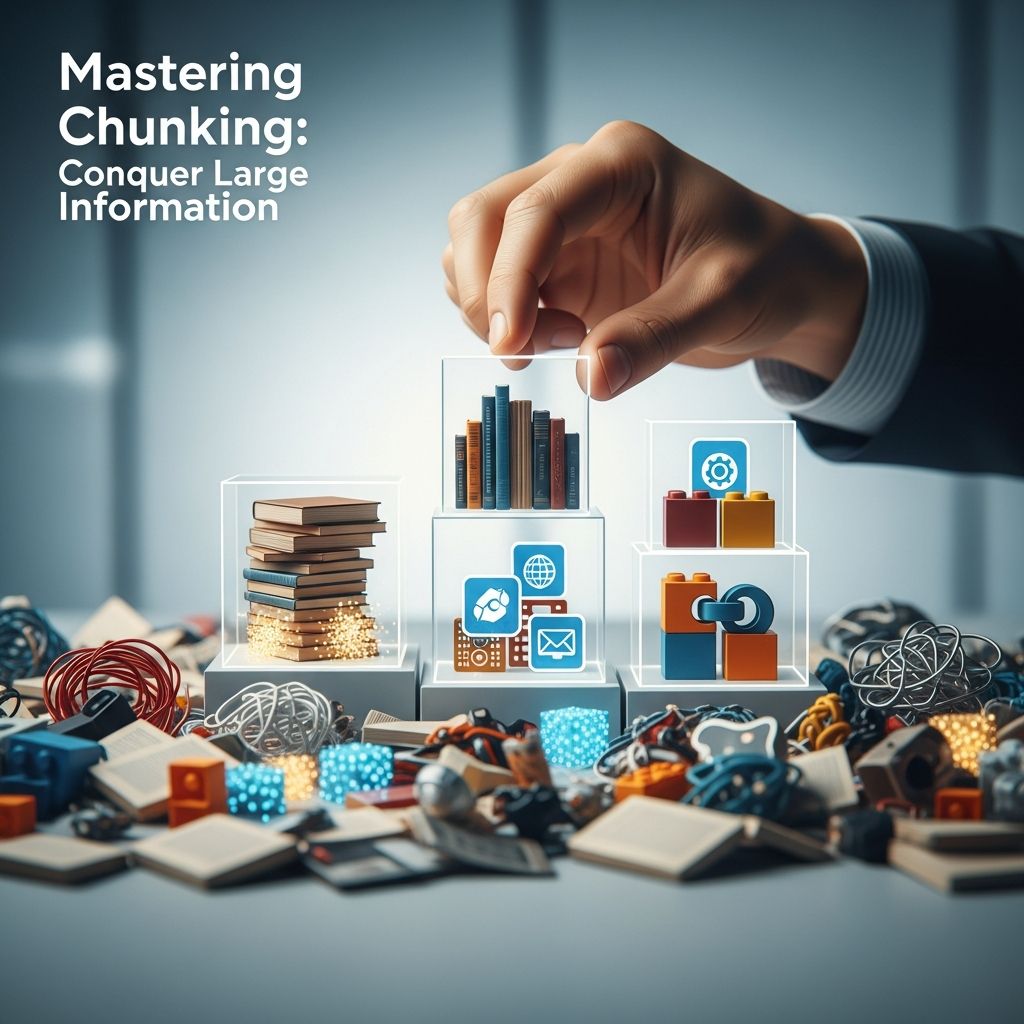
Chunking revolutionizes how we handle vast amounts of data by dividing it into smaller, meaningful groups, making retention and comprehension far more achievable. This cognitive strategy leverages the brain’s natural processing limits to enhance learning outcomes across academic, professional, and personal contexts.
The Science of Chunking Explained
At its essence, chunking involves recoding smaller bits of data into larger, familiar units that the brain can process more efficiently. This technique directly addresses the constraints of working memory, which research shows can typically hold only about seven items at once. By grouping related elements, chunking expands effective capacity without overwhelming mental resources.
Cognitive psychology underscores that chunking reduces the load on working memory by allowing retrieval of compact representations from long-term memory. For instance, experiments demonstrate that chunked information not only aids recall of grouped items but also frees space for ungrouped material held simultaneously. This benefit persists even under conditions like articulatory suppression, confirming it’s not merely due to rehearsal time.
Key principles include pattern recognition, where the brain identifies and exploits familiar structures, and meaningful associations that link chunks to existing knowledge. Cognitive load theory further supports this: breaking complex ideas into digestible portions prevents overload, facilitating smoother transfer to long-term storage.
Why Your Brain Needs Chunking for Overloaded Learning
Modern education and work bombard us with information far exceeding working memory limits, leading to fatigue, disengagement, and poor retention. Without chunking, learners face cognitive fatigue as they struggle to process unbroken streams of data.
Chunking counters this by aligning with how short-term memory functions—optimally handling 5-9 chunks. It minimizes extraneous load, allowing focus on essential understanding. Studies show this approach enhances both immediate recall and long-term learning by strengthening neural connections through repetition and association.
- Reduces overwhelm: Smaller units feel less intimidating.
- Boosts efficiency: Faster processing means more time for application.
- Improves accuracy: Fewer errors in recall due to organized storage.
Practical Steps to Implement Chunking in Study Routines
Start by surveying the material to pinpoint core themes. Isolate high-priority facts, then group them logically—by category, sequence, or hierarchy. Use visuals like diagrams to reinforce these groupings, as they aid pattern recognition.
Sequence chunks progressively: begin with basics and layer complexity. Incorporate spaced repetition, revisiting groups at intervals to solidify memory. For daily integration, apply to notes, flashcards, or presentations by clustering related points.
- Scan content for main ideas.
- Group into 3-7 chunks per session.
- Label each with a mnemonic or image.
- Practice recall actively.
- Review and refine groupings.
Chunking Across Disciplines: Tailored Applications
In mathematics, chunk formulas into steps: e.g., break quadratic equations into identify coefficients, apply formula, solve roots. History students chunk timelines by eras, linking events thematically. Language learners group vocabulary by themes like food or travel.
Professionals use it for reports: segment data into executive summary, findings, recommendations. In coding, chunk algorithms into functions with clear inputs/outputs. This adaptability makes chunking versatile for any field.
| Discipline | Chunking Example | Benefit |
|---|---|---|
| Science | Organ systems (e.g., digestive: mouth, stomach, intestines) | Holistic understanding |
| History | Eras (Renaissance: art, invention, exploration) | Contextual recall |
| Business | SWOT analysis quadrants | Strategic clarity |
| Languages | Theme clusters (colors, numbers) | Conversational fluency |
Advanced Chunking: Beyond Basics for Mastery
Elevate chunking by nesting: create super-chunks from sub-chunks, like hierarchies in mind maps. Combine with active recall—quiz on chunks without notes. Use acronyms or stories to encode: e.g., for planets, ‘My Very Educated Mother Just Served Us Noodles’ chunks the solar system.
Experiment with chunk size: benefits hold for unique-element groups but adjust for overlaps. Position chunks early in sessions for maximum carryover effect on other material. Track progress with journals to optimize personal strategies.
For long-term gains, integrate dual coding: pair verbal chunks with visuals. This dual pathway reinforces encoding, per cognitive research.
Real-World Examples of Chunking Success
Students tackling textbooks chunk chapters into summaries, key terms, examples—doubling retention rates. Experts like chess masters chunk board patterns into familiar configurations, enabling rapid decisions. Phone numbers (area code, prefix, line) exemplify everyday use.
In classrooms, teachers present lessons in 10-15 minute chunks with activities, reducing disengagement. Corporate training modules chunk skills into micro-lessons, improving completion and application.
Common Pitfalls and Fixes in Chunking Practice
Avoid over-chunking: too few, large groups strain memory; too many tiny ones fragment context. Fix by testing recall limits per session. Don’t ignore sequence—random groups hinder flow; always link logically.
Over-reliance on visuals without verbal rehearsal weakens transfer. Balance both. For overlapping data, use distinct labels to prevent confusion. Regularly reassess chunks as mastery grows.
- Pitfall: Ignoring individual differences—adapt chunk size to learner capacity.
- Fix: Pilot test with small sets.
Frequently Asked Questions (FAQs)
What exactly is chunking in learning?
Chunking is grouping small information units into larger, meaningful clusters to ease processing and boost memory retention.
How many chunks can working memory handle?
Typically 5-9 chunks, varying by individual and familiarity, per classic cognitive studies.
Does chunking work for all subjects?
Yes, it’s versatile across math, languages, sciences, and more, by tailoring groups to content logic.
Can chunking improve exam performance?
Absolutely—structured review reduces anxiety and enhances recall under pressure.
What’s the best way to start chunking today?
Pick one overwhelming topic, break into 3-5 groups, visualize, and quiz yourself immediately.
Tools and Resources to Supercharge Chunking
Leverage apps like Anki for spaced chunk repetition, MindMeister for visual maps, or Notion for hierarchical notes. Free worksheets online guide beginners. Combine with Pomodoro: 25-minute chunk-focused sessions.
Build habits: daily 15-minute chunking drills on news articles or flashcards. Join study groups to share custom chunks, accelerating collective mastery.
References
- Unlocking the power of chunking: Reducing cognitive load — Pearson. 2023. https://www.pearson.com/en-au/schools/insights-news/unlocking-the-power-of-chunking-reducing-cognitive-load/
- How does chunking help working memory? — PubMed (Psychological Science). 2018-05-01. https://pubmed.ncbi.nlm.nih.gov/29698045/
- Unlocking Learning Potential: The Power of Chunking in Education — Engineering Management Institute. 2023. https://engineeringmanagementinstitute.org/unlocking-learning-potential-the-power-of-chunking-in-education/
- Chunking Memory Strategy: What It Is & How to Use It — TalentCards. 2023. https://www.talentcards.com/blog/chunking-memory/
- How Chunking Helps Content Processing — Nielsen Norman Group. 2023. https://www.nngroup.com/articles/chunking/
- How to Use Chunking in the Classroom — Edutopia. 2023. https://www.edutopia.org/article/chunking-content-classroom/

Medha Deb is an editor with a master's degree in Applied Linguistics from the University of Hyderabad. She believes that her qualification has helped her develop a deep understanding of language and its application in various contexts. Medha specializes in the areas of beauty, health, sports, and wellness and is committed to ensuring that the content on the website is…