
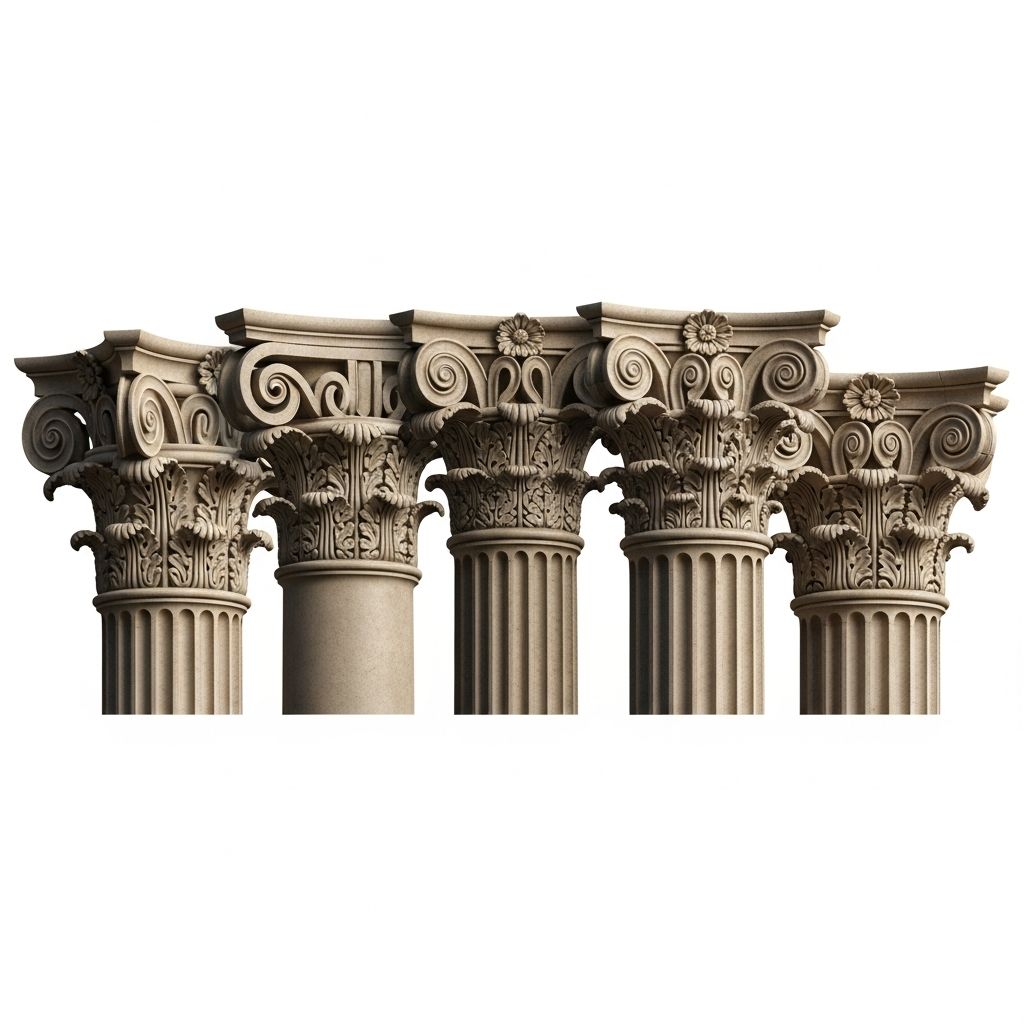
The classical orders represent the cornerstone of Western architectural design, originating in ancient Greece and refined by the Romans. These standardized systems define the relationship between columns, capitals, and entablatures, creating harmonious and structurally sound buildings that have influenced architecture for millennia.
Defining the Architectural Order
An architectural order is a complete system comprising a column—consisting of base, shaft, and capital—and the entablature it supports, which includes the architrave, frieze, and cornice. This assembly follows strict proportional rules, ensuring aesthetic balance and structural integrity.
Developed during the Classical period, these orders embody principles of beauty, utility, and durability, as articulated by ancient theorists like Vitruvius. They serve not just as structural elements but as a visual language conveying hierarchy, strength, and elegance in temples, public buildings, and civic structures.
Historical Development of the Orders
The three primary Greek orders—Doric, Ionic, and Corinthian—emerged between the 7th and 4th centuries BCE, reflecting evolving tastes from simplicity to ornamentation. The Romans adapted these, adding the Tuscan for rustic simplicity and the Composite for lavish decoration, resulting in five canonical orders.
In multi-story buildings, orders were often superposed: heavier Doric at the base for stability, progressing to lighter Corinthian at the top, as seen in Rome’s Colosseum. Renaissance architects revived these orders, codifying them in treatises and applying them to colossal scales spanning multiple stories.
The Doric Order: Strength and Simplicity
The Doric order, the oldest and most robust, symbolizes masculine strength and emerged around 650 BCE in mainland Greece. Greek Doric columns lack a base, resting directly on a stylobate, with a stout shaft featuring 20 shallow flutes and a plain, rounded capital.
Roman Doric introduced a simpler base and deeper flutes, enhancing durability for practical structures. Proportions typically measure 7 diameters in height, with the entablature about one-quarter of the column height, emphasizing mass over finesse.
- Key Features: Fluted shaft (no base in Greek version), simple echinus and abacus capital, triglyph-metope frieze.
- Iconic Examples: Parthenon (Athens), Temple of Hera (Olympia).
The Ionic Order: Graceful Elegance
Originating in the 6th century BCE on Ionian islands and coasts, the Ionic order introduces refined proportions and scroll-like volutes on the capital, evoking feminine grace. Columns stand taller at 9 diameters, with a molded base, 24 sharper flutes, and an entablature featuring a continuous frieze.
Roman Ionic softened the volutes for a more fluid appearance, widely used in theaters and libraries. This order balances strength with decoration, its height lending verticality to middle stories in superposed designs.
- Key Features: Volute capitals, beveled echinus, dentil-under-cornice entablature.
- Iconic Examples: Temple of Athena Nikê (Athens), Erechtheion (Acropolis).
The Corinthian Order: Opulent Refinement
The most ornate Greek order, Corinthian dates to the 5th century BCE, legendarily inspired by an acanthus plant wrapping a basket. Its capital bursts with inverted acanthus leaves and scrolls, atop columns 10 diameters high with 24 flutes and a decorative base.
Favored by Romans for grand monuments, it features a modillioned cornice and was reserved for upper stories. Its complexity demanded skilled craftsmanship, signifying imperial wealth and sophistication.
- Key Features: Acanthus leaf capital, elaborate bell-shaped form, pulvinates and modillions.
- Iconic Examples: Pantheon (Rome), Temple of Mars Ultor.
The Tuscan Order: Roman Simplicity
A Roman innovation simplifying Doric for utilitarian needs, Tuscan columns are 7 diameters tall with a smooth, un-fluted shaft, plain base, and unadorned capital. Its entablature is straightforward, ideal for fortifications and rustic buildings.
Vitruvius praised its structural purity, likening it to military robustness. Though less decorative, its clean lines influenced Etruscan-derived temples and later neoclassical revivals.
The Composite Order: Fusion of Elegance
Developed in the 1st century CE, Composite merges Ionic volutes with Corinthian acanthus, creating the tallest and most extravagant order at 10 diameters. Used in triumphal arches and imperial forums, it epitomizes Roman eclecticism.
This order’s bold capitals and rich entablature made it perfect for celebratory architecture, blending Greek finesse with Roman grandeur.
Proportions and Modules in Classical Orders
Orders are governed by modules—the column diameter at the base—dictating all dimensions for harmony. Below is a comparative table:
| Order | Column Height (Diameters) | Shaft Flutes | Capital Style | Primary Use |
|---|---|---|---|---|
| Doric | 4-8 | 20 | Plain echinus | Ground floor |
| Ionic | 9 | 24 | Volutes | Middle stories |
| Corinthian | 10 | 24 | Acanthus leaves | Upper stories |
| Tuscan | 7 | 0 (smooth) | Simple | Utilitarian |
| Composite | 10 | 24 | Volutes + acanthus | Monuments |
These ratios ensure visual rhythm, with entablatures scaled to column height (e.g., Doric: 1/4 column).
Classical Orders in Iconic Structures
The Colosseum exemplifies superposition: Tuscan/Doric ground floor for load-bearing, Ionic pilasters midway, Corinthian above for visual lift. The Parthenon employs pure Doric externally, showcasing optical refinements like entasis (shaft curvature) to counter illusions of concavity.
Renaissance masters like Palladio scaled orders colossally, as in St. Peter’s Basilica, blending them innovatively.
Revival and Modern Applications
From the 15th-century Renaissance to 19th-century Neoclassicism, orders shaped capitols, banks, and museums worldwide. Today, they inspire minimalist facades, postmodern eclecticism, and digital reconstructions, underscoring timeless principles of proportion.
In sustainable design, simplified Tuscan-like forms promote efficiency, while Corinthian motifs add cultural resonance to public spaces.
Frequently Asked Questions (FAQs)
What is the difference between Greek and Roman Doric orders?
Greek Doric omits the base and uses shallower flutes; Roman adds a base for stability and deeper channeling.
Which order is the tallest and most decorative?
Corinthian and Composite, both around 10 diameters, with Composite adding Ionic volutes to acanthus foliage.
Why were orders superposed in multi-story buildings?
To create hierarchy: sturdy bases support lighter, more ornate uppers, enhancing stability and aesthetics.
Can classical orders be used in contemporary architecture?
Yes, abstracted forms appear in neoclassical revivals, government buildings, and modern interpretations for symbolic depth.
What role did Vitruvius play in defining the orders?
His De Architectura codified Doric, Ionic, Corinthian, and Tuscan, influencing Renaissance standardization.
References
- The Five Noble Orders of Architecture — Mariners Lodge No 67. 2023. https://www.mariners67.org/post/the-five-noble-orders-of-architecture
- Order | Design Principles & Benefits — Encyclopædia Britannica. 2024-01-15. https://www.britannica.com/technology/order-architecture
- Classical order — Wikipedia (sourced from primary texts). 2024. https://en.wikipedia.org/wiki/Classical_order
- The Roman Orders of Architecture Explained — A Touch of Rome. 2022. https://atouchofrome.com/roman_orders.html
- 5 MAIN ORDERS IN CLASSICAL ARCHITECTURE — Pikark. 2023. https://pikark.com/en/listing/english-kolonat-e-arkitektures-klasike/
- The 3 Orders of Ancient Greek Architecture — Buildner. 2023. https://architecturecompetitions.com/the-3-orders-of-ancient-greek-architecture

- Integrated M.A. in Applied Linguistics, University of Hyderabad
- 5+ years in editorial, instructional, SEO, and research-based writing
Sneha is a relationships and lifestyle writer with a strong foundation in applied linguistics and certified training in relationship coaching. She brings over five years of writing experience to theskillvault, crafting thoughtful, research-driven content that empowers readers to build healthier relationships, boost emotional well-being, and embrace holistic living. Her writing and insights reflect the belief that beauty, happiness, and wellness…