
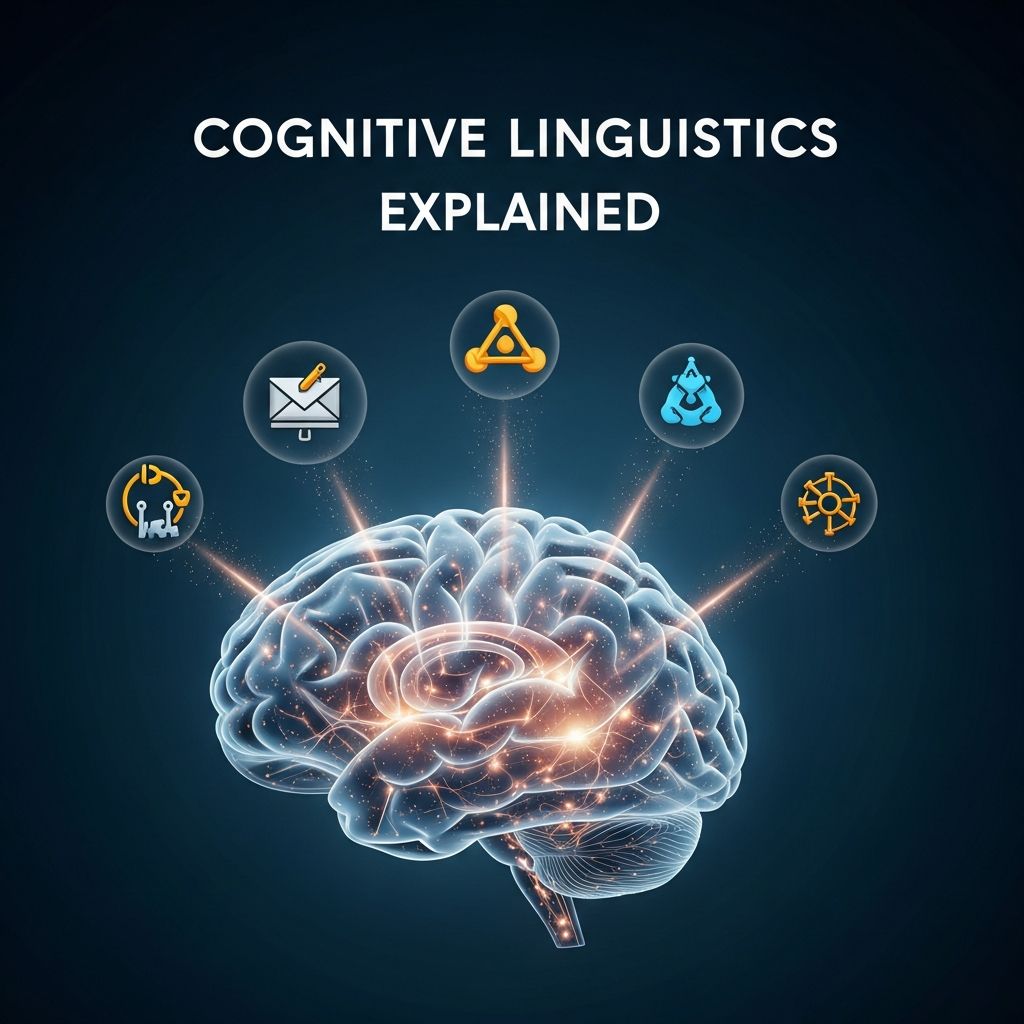
Cognitive linguistics represents a transformative paradigm in the study of language, viewing it not as an isolated modular system but as deeply intertwined with broader human cognition. This field posits that linguistic structures emerge from general cognitive abilities like categorization, perception, and conceptualization, offering fresh insights into how we think and communicate.
Foundational Principles of Cognitive Linguistics
At its core, cognitive linguistics is guided by two pivotal commitments that distinguish it from other linguistic traditions. The generalization commitment asserts that universal principles govern all facets of language, from sounds to syntax, rather than treating phonology, morphology, semantics, and pragmatics as disconnected silos. This unified approach recognizes that language’s primary role is meaning conveyance, implicating every level in semantic processes.
The cognitive commitment further insists that linguistic theories must align with established findings from cognitive science, psychology, and neuroscience, rejecting the notion of language-specific modules in favor of domain-general mechanisms such as analogy, attention, and memory. These principles challenge generative grammar’s innate universal grammar hypothesis, proposing instead that language arises from experiential and embodied cognition.
Historical Evolution and Key Milestones
Cognitive linguistics coalesced in the late 1970s and early 1980s amid dissatisfaction with formalist models like those from Noam Chomsky, which emphasized autonomous syntax and innate linguistic competence. Pioneers such as George Lakoff, Ronald Langacker, and Leonard Talmy laid the groundwork by integrating insights from philosophy, psychology, and anthropology.
By the mid-1980s, contributions from Gilles Fauconnier on mental spaces and blending theory enriched the framework, solidifying its empiricist, non-modular stance. This period marked the ‘second cognitive revolution,’ contrasting with the 1950s computational focus by prioritizing experiential grounding. Today, the field thrives through organizations like the International Cognitive Linguistics Association, fostering global research.
Language as Embodied and Experiential
A hallmark of cognitive linguistics is its view of meaning as non-autonomous, perspectival, experiential, and dynamic. Unlike truth-conditional semantics, which ties meaning to external reality’s truth values, cognitive approaches see it as rooted in human embodiment and interaction with the world.
For instance, metaphors like ‘argument is war’ (‘He attacked my position’) reflect conceptual mappings from bodily experiences to abstract domains, shaping how we reason. Language thus mirrors cognitive organization, with semantics taking primacy over syntax—syntax itself conveys meaning through constructions.
- Encyclopedic semantics: Word meanings are not fixed dictionaries but rich, context-dependent knowledge networks drawn from experience.
- Perspectival nature: The same event can be described differently based on viewpoint, e.g., ‘The window was broken by the ball’ vs. ‘The ball broke the window.’
Core Theories and Frameworks
Conceptual Metaphor Theory
Developed by Lakoff and Johnson, this theory argues that abstract concepts are understood via mappings from concrete domains, pervasively structuring thought and language. Examples include ‘time is money’ (spending time) or ‘love is a journey’ (relationship progress), empirically supported by psychological experiments.
Cognitive Grammar
Ronald Langacker’s Cognitive Grammar treats grammar as meaningful, with constructions symbolizing conceptualizations. Nouns profile things, verbs processes; syntax emerges from content-neutral symbolic structures.
Construction Grammar
This framework views language as an inventory of form-meaning pairings, from words to complex sentences like ‘What’s X doing Y?’ which conveys improbability. It bridges syntax and semantics via usage-based learning.
Blending Theory
Fauconnier’s model explains novel meanings through integrating mental spaces, as in ‘riddle of the Sphinx’ blending human-lion elements for hybrid concepts.
| Theory | Key Proponent | Core Idea | Example |
|---|---|---|---|
| Conceptual Metaphor | Lakoff & Johnson | Abstract via concrete mappings | Ideas are food (digest an argument) |
| Cognitive Grammar | Langacker | Grammar as symbolism | Verb profiling motion |
| Construction Grammar | Goldberg et al. | Form-meaning pairs | Let alone construction |
| Blending | Fauconnier & Turner | Space integration | 9/11 as ‘war’ |
Usage-Based and Emergent Perspectives
Cognitive linguistics is inherently usage-based: linguistic knowledge derives from exposure and generalization, not innate rules. Frequency shapes grammar; idioms like ‘kick the bucket’ are learned holistically. This aligns with corpus linguistics, analyzing real-language data to uncover patterns.
Embodied cognition emphasizes sensorimotor grounding—’grasp an idea’ draws from physical grasping simulations in the brain. Cross-linguistic studies reveal universals tempered by cultural experience, addressing linguistic relativity nuancedly.
Applications Across Disciplines
Beyond theory, cognitive linguistics informs diverse fields:
- Education: Enhances language teaching by focusing on conceptual metaphors and prototypes.
- AI and NLP: Improves machine understanding via realistic meaning models.
- Psychology: Probes thought via language, validating metaphors experimentally.
- Translation and Literature: Analyzes perspectival shifts and blending in creative texts.
- Clinical Linguistics: Aids aphasia therapy by targeting conceptual deficits.
In second language acquisition, recognizing polysemy (e.g., ‘run a business’ from motion schemas) accelerates learning.
Challenges and Future Directions
Critics argue cognitive linguistics lacks formal rigor or predictive power compared to generative models. Yet, its interdisciplinary nature—integrating neuroscience (e.g., mirror neurons in metaphor processing)—strengthens empirical grounding.
Future research explores digital corpora for big data insights, neurocognitive imaging for embodiment validation, and cross-cultural universals vs. relativism. Climate discourse analysis via metaphor (e.g., ‘global warming as enemy’) exemplifies timely applications.
Frequently Asked Questions (FAQs)
What differentiates cognitive linguistics from generative grammar?
Cognitive linguistics views language as emerging from general cognition, rejecting innate modules, while generative grammar posits autonomous syntax and universal grammar.
Is cognitive linguistics a single theory?
No, it’s a framework encompassing theories like conceptual metaphor and cognitive grammar, united by generalization and cognitive commitments.
How does embodiment factor into meaning?
Meaning is grounded in bodily experience; e.g., spatial language reflects perceptual-motor systems.
Can cognitive linguistics explain idioms?
Yes, idioms are motivated by conceptual mappings, learned through usage, not arbitrary.
What role does culture play?
Culture shapes conceptualizations, but universals from embodiment provide common ground.
References
- Cognitive linguistics – Wikipedia — Wikipedia Contributors. 2023-10-01. https://en.wikipedia.org/wiki/Cognitive_linguistics
- About Cognitive linguistics — International Cognitive Linguistics Association. 2023-01-15. https://www.cognitivelinguistics.org/en/about-cognitive-linguistics
- What Is Cognitive Linguistics? — Psychology Today. 2019-07-12. https://www.psychologytoday.com/us/blog/language-in-the-mind/201907/what-is-cognitive-linguistics
- Cognitive linguistics — EBSCO Research Starters. 2022-05-20. https://www.ebsco.com/research-starters/language-and-linguistics/cognitive-linguistics
- 1 Introducing Cognitive Linguistics — Oxford Academic. 2019-06-01. https://academic.oup.com/edited-volume/34552/chapter/293149659
- COGNITIVE LINGUISTICS: A BRIEF INTRODUCTION — IJRSSH. 2021-03-15. https://www.ijrssh.com/admin/upload/03%20Kanhaiya%20Kumar%20Sinha.pdf
- Cognitive linguistics — Wiley Interdisciplinary Reviews. 2012-01-01. https://wires.onlinelibrary.wiley.com/doi/10.1002/wcs.1163

- Integrated M.A. in Applied Linguistics, University of Hyderabad
- 5+ years in editorial, instructional, SEO, and research-based writing
Sneha is a relationships and lifestyle writer with a strong foundation in applied linguistics and certified training in relationship coaching. She brings over five years of writing experience to theskillvault, crafting thoughtful, research-driven content that empowers readers to build healthier relationships, boost emotional well-being, and embrace holistic living. Her writing and insights reflect the belief that beauty, happiness, and wellness…