
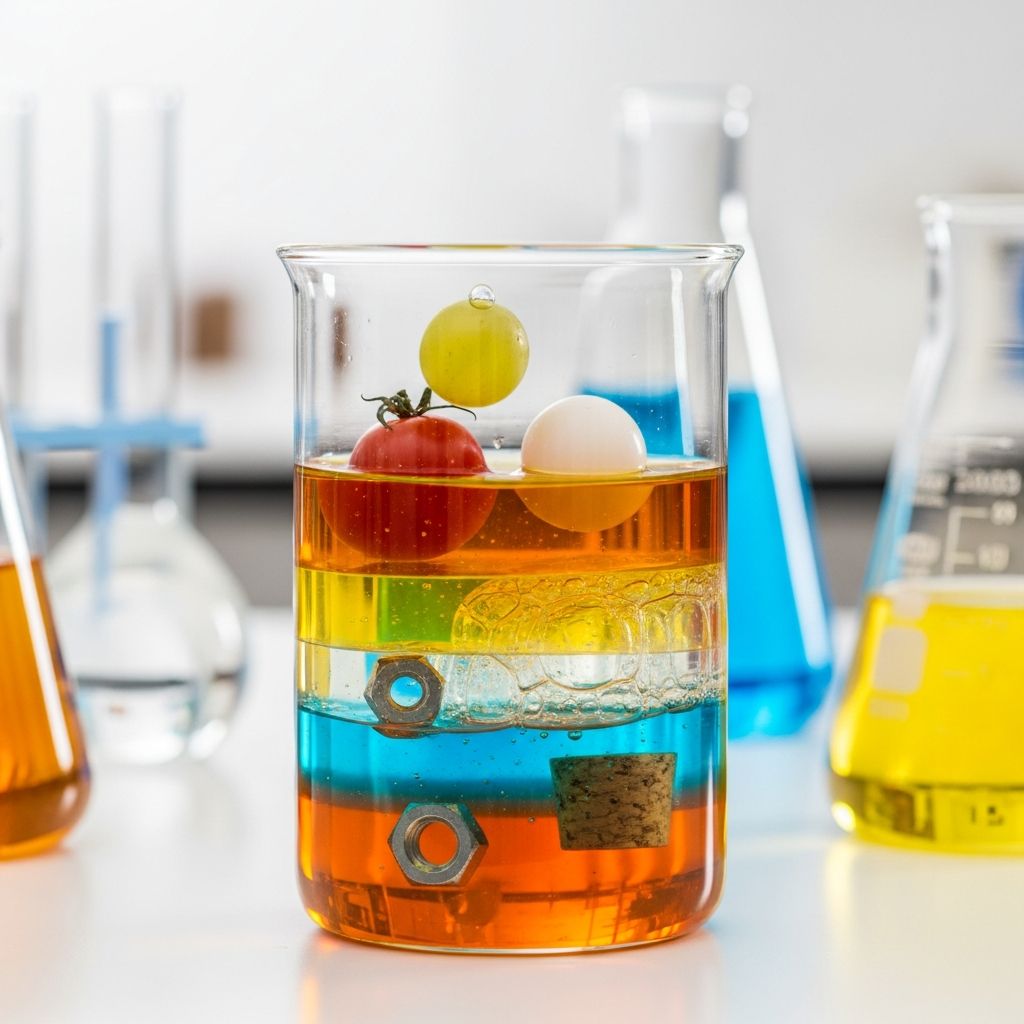
Density governs everyday phenomena, from why ships stay afloat to how oil spills behave in oceans. Defined as mass per unit volume, it determines whether substances layer or mix. These experiments use common materials to demonstrate this principle interactively, fostering scientific inquiry in young learners.
Mastering the Basics of Density
Understanding density starts with its formula: density = mass / volume. Water, for instance, has a density of 1 g/mL at standard conditions, serving as a reference point. Objects denser than water sink; less dense ones float. Experiments reveal these interactions vividly.
- Mass: Amount of matter in an object, measured in grams.
- Volume: Space occupied, often in milliliters for liquids.
- Buoyancy: Upward force enabling flotation, tied directly to density differences.
Real-world ties include ocean currents driven by temperature-altered density and Earth’s layered structure from core to crust.
Building a Spectacular Layered Liquid Column
Create a mesmerizing tower of liquids that stack without mixing, showcasing density gradients. Gather honey, dish soap, water, vegetable oil, rubbing alcohol, and food coloring. Pour slowly into a tall glass: honey at bottom (densest), followed by soap, colored water, oil, and alcohol (least dense).
Observe layers form due to varying molecular packing—honey’s sugars pack tightly, alcohol spreads loosely. Test by dropping objects like beads or fruit; they halt at matching density layers. This visual aid proves density dictates position.
| Liquid | Approximate Density (g/mL) | Position in Tower |
|---|---|---|
| Honey | 1.42 | Bottom |
| Dish Soap | 1.03 | Lower Middle |
| Water | 1.00 | Middle |
| Vegetable Oil | 0.92 | Upper Middle |
| Rubbing Alcohol | 0.79 | Top |
Extend by weighing equal volumes on a scale; heavier liquids confirm higher density.
Investigating Sink-or-Float with Everyday Objects
Test predictions: fill beakers with water, corn syrup, and oil. Drop items like pennies, corks, raisins, or paperclips. Predict based on intuition, then observe.
Raisins may sink in oil but float in syrup, revealing relative densities. Corn syrup (1.38 g/mL) supports more than water; oil (0.92 g/mL) less so. Discuss: why does a cork float atop all? Its wood density undercuts even oil.
- Challenge: Hypothesize an object’s behavior across liquids before testing.
- Insight: Objects find equilibrium where their density matches the liquid’s.
Altering Density: Salt Solutions and Floating Surprises
Dissolve varying salt amounts in water cups (e.g., 1 tbsp, 2 tbsp, 3 tbsp per 100 mL). Denser solutions sink beneath fresher ones, mimicking ocean layers.
Float an egg in freshwater (sinks), then add salt until it suspends—saturated brine reaches 1.2 g/mL, exceeding egg’s 1.05 g/mL. Reverse with grapes: dense in tap water, buoyant in syrup.
Another twist: wrap a sinking lemon in bubble wrap to reduce effective density, making it float. These show density manipulation via solutes or air pockets.
Dynamic Density: Dancing Raisins and Spaghetti
In soda, raisins “dance”—CO2 bubbles attach, decreasing density for ascent; bursting increases it for descent. Same with uncooked spaghetti in Sprite.
Materials: clear soda, tall glass, raisins. Watch cycles reveal gas-liquid interactions. Ice in rubbing alcohol sinks (alcohol 0.79 g/mL vs. ice 0.92 g/mL), but floats in water—perfect hook for discussions.
Rainbow Jars and Sugar Gradients
Layer sugar solutions: 0-4 tbsp per 100 mL water, dyed differently. Pour carefully; colors stack by density, forming a rainbow without mixing.
Lava lamp variant: oil over colored salt water with Alka-Seltzer. Bubbles lift oil globs upward; coalescence drops them. Glowing version adds fluorescent dye under UV light.
Advanced Challenges: Boats, Balloons, and Blizzards
Why boats float: clay balls sink, but shaped into bowls displace water equaling their weight (Archimedes’ principle). Test hull designs.
Water balloon in saltwater floats above freshwater due to solution density. Bubbling blizzard: oil, water, glitter, Alka-Seltzer for snowy descent.
Oil-water flips: shake to emulsify, separate by density.
Real-World Connections and Safety Tips
Density explains oil spills (floats on water), Earth’s layers (dense core), black holes (extreme density). In labs, supervise glassware, avoid ingestion, use food-safe dyes.
Quantify water’s density: measure mass at 10 mL increments in graduated cylinders—always 1 g/mL.
Frequently Asked Questions
Why do layers form in density towers?
Different liquids have unique densities; denser ones stay below less dense due to gravitational stability.
Can I eat after these experiments?
Use fresh materials for consumables; discard used liquids to avoid contamination.
How does temperature affect density?
Warmer liquids expand, lowering density; cooler ones contract, increasing it.
Are these suitable for all ages?
Yes, adapt: simple sinks/floats for toddlers, towers for school-age.
What if layers mix accidentally?
Start over with slower pours and steady hands.
References
- Amazing 9 Layer Density Tower — Steve Spangler Science. 2023. https://stevespangler.com/experiments/density-tower-magic-with-science/
- Density Science Experiments — Science Fun. 2024. https://www.sciencefun.org/kidszone/experiments/density-science-experiments/
- Lab Ideas for Teaching Density — Science Lessons That Rock. 2023-01-15. https://sciencelessonsthatrock.com/7-lab-ideas-for-teaching-density-html/
- Liquid Density Experiments — Home Science Tools. 2024. https://www.homesciencetools.com/article/liquid-density-project/
- Science At Home! Water Density Experiment — North Carolina Museum of Natural Sciences. 2023-05-10. https://naturalsciences.org/calendar/news/science-at-home-water-density-experiment/

Medha Deb is an editor with a master's degree in Applied Linguistics from the University of Hyderabad. She believes that her qualification has helped her develop a deep understanding of language and its application in various contexts. Medha specializes in the areas of beauty, health, sports, and wellness and is committed to ensuring that the content on the website is…