
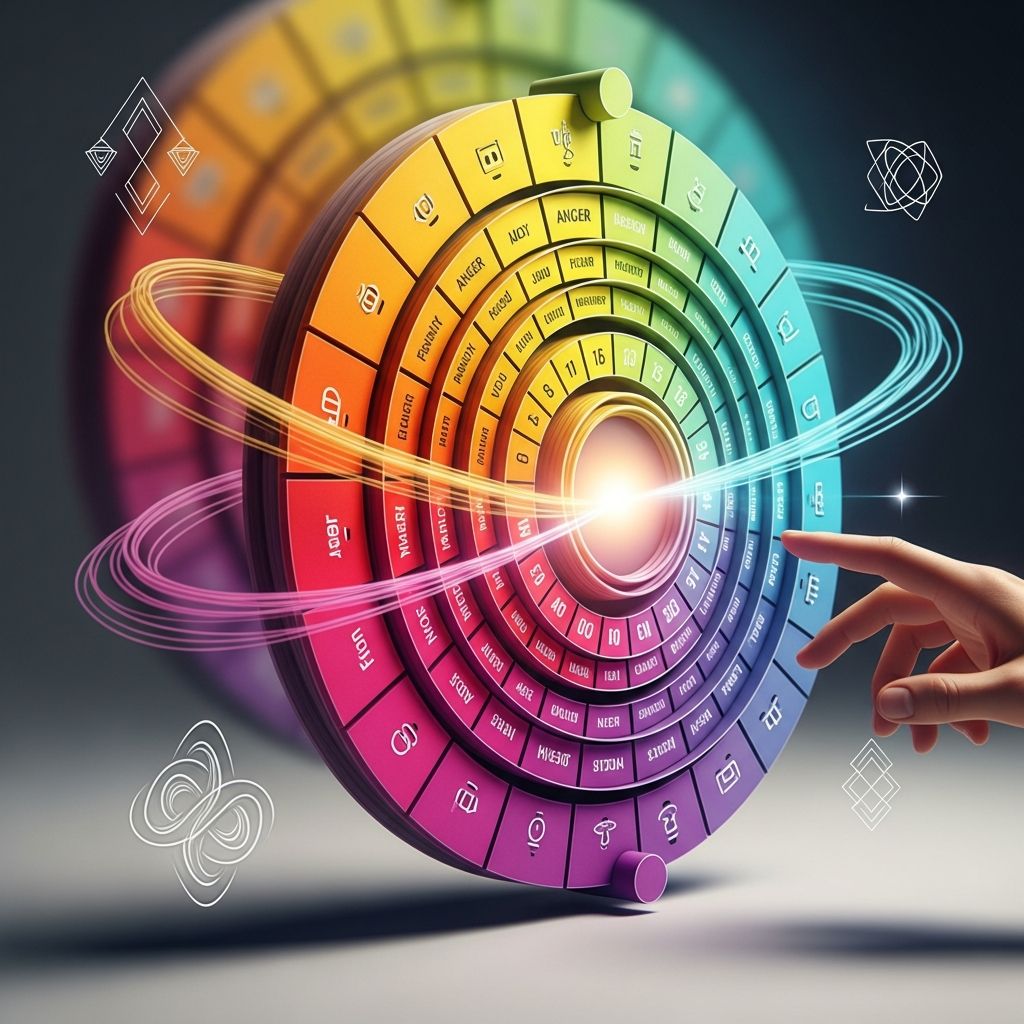
Most people can say they feel “good,” “bad,” or “stressed”—but struggle to go deeper. An emotion wheel turns vague moods into clear language, helping you recognize what you feel, why you feel it, and what to do next.
This guide explains how emotion wheels work, why they support emotional intelligence, and how to use them in everyday life, leadership, and coaching.
What Is an Emotion Wheel?
An emotion wheel is a visual map of feelings. It typically looks like a circle divided into colored segments, with broad emotions in the middle and more specific emotions toward the edges.
The core idea behind emotion wheels is supported by decades of emotion research showing that a small set of basic emotions can be combined and refined into many nuanced feelings.
Key features of most emotion wheels
- Core emotions in the center (for example: joy, sadness, anger, fear).
- Secondary emotions around them (for example: frustration, worry, contentment).
- Specific feelings at the outer edge (for example: restless, optimistic, rejected).
- Visual grouping so related emotions sit near each other.
By following the colors and labels, you can quickly move from a broad sense of feeling “off” to a precise word like “disappointed,” “overwhelmed,” or “hopeful.”
Why Naming Emotions Matters
Emotion wheels are more than attractive diagrams; they are grounded in evidence about how labeling emotions improves well-being.
The science of putting feelings into words
- Research on affect labeling shows that naming an emotion can reduce its intensity and help regulate it, partly by reducing activity in the amygdala (a brain region involved in threat and emotion) and increasing activity in frontal areas involved in control.
- Psychologists describe this skill as part of emotional awareness and emotional granularity—being able to distinguish between similar feelings such as irritation, anger, and rage.
- Better emotional granularity is associated with improved coping, less impulsive behavior, and better mental health.
Benefits of building emotional vocabulary
- Clarity: You stop saying “I’m fine” when you’re actually anxious, jealous, or discouraged.
- Choice: Once you know what you feel, you can choose what to do about it instead of reacting automatically.
- Connection: Specific emotion words improve communication in relationships, teams, and families.
- Self-knowledge: Over time you notice patterns—what triggers shame, what boosts pride, what drains your joy.
Common Types of Emotion Wheels
Different emotion wheels organize feelings in slightly different ways, but they share the goal of helping you move from broad categories to specific experiences.
| Type | Main Focus | Typical Use |
|---|---|---|
| Plutchik-style emotion wheel | Opposite pairs of basic emotions, intensity from mild to strong. | Understanding blends of emotions (e.g., joy + trust), noticing intensity shifts. |
| Feelings wheel (e.g., Willcox) | Six or more core feelings branching into 50+ specific emotions. | Daily check-ins, journaling, coaching, therapy. |
| Geneva-style wheels | Emotions arranged by pleasantness and control or arousal. | Research, education about how emotions vary in energy and valence. |
You do not need to choose the “perfect” model. Any clear, readable wheel that helps you find accurate words is good enough to start.
How Emotion Wheels Support Emotional Intelligence
Emotional intelligence (EI) involves recognizing, understanding, and managing emotions in yourself and others. Emotion wheels are simple tools that support several key EI components.
1. Self-awareness
- Slows you down long enough to ask, “What exactly am I feeling right now?”
- Helps distinguish between layered emotions—such as feeling both relieved and sad about the same event.
- Reveals repeated emotional themes over days or weeks (for example, frequent resentment, chronic fatigue, recurring enthusiasm).
2. Self-regulation
- Once you move from “I’m angry” to “I’m feeling disrespected,” you can choose a more constructive response (setting a boundary, asking for clarification).
- Labeling emotions can reduce their physiological intensity, making it easier to pause and respond thoughtfully.
3. Empathy and relationships
- Gives you language to ask, “Are you feeling more disappointed or more hurt right now?”
- Helps people feel seen because you reflect their emotions accurately instead of minimizing them.
- Supports conflict resolution by separating feelings from accusations.
4. Decision-making
- Emotions act as data. Understanding whether you feel anxious, bored, or misaligned with your values leads to better choices.
- Emotion wheels help you tell the difference between temporary mood swings and deeper, persistent feelings that may signal a need for change.
Step-by-Step: Using an Emotion Wheel in Daily Life
You can use an emotion wheel in a few minutes a day. The more often you practice, the faster and more natural it becomes.
Step 1: Pause and scan your body
- Notice physical sensations—tight shoulders, fast heartbeat, heavy chest.
- Ask: “If this sensation had a voice, what would it say?” This creates a bridge to emotion labels.
Step 2: Start with a core feeling
- Look at the center of the wheel and pick the closest match: for example, angry, sad, joyful, afraid, calm, powerful.
- Do not worry about getting it perfect; you can refine it in the next step.
Step 3: Move outward to refine
- Follow that core feeling outward along its segment.
- Notice secondary or tertiary words that resonate more accurately (for example, instead of “sad” you might land on “lonely” or “disappointed”).
- You can circle or highlight two or three words if one feels too limiting.
Step 4: Connect emotion to trigger
- Ask: “What happened just before I felt this?”
- Write one or two sentences linking event and emotion, such as: “Meeting ended without asking for my input → I felt dismissed and unimportant.”
Step 5: Choose a response
- Ask: “Given what I feel and value, what do I want to do next?”
- Possible responses:
- Take a break or use a calming technique.
- Communicate your feelings using “I” statements.
- Adjust expectations or boundaries.
Practical Ways to Use an Emotion Wheel
Emotion wheels are flexible. You can adapt them to your situation, age group, or professional context.
For personal self-reflection
- Print an emotion wheel and keep it near your workspace or bedside.
- Use it for a two-minute morning or evening emotional check-in.
- Combine with journaling—each day, circle three emotions and write one line about each.
At work and in leadership
- Optional pre-meeting check-ins where people choose one word from the wheel to describe their current state.
- Coaching conversations where managers help team members unpack stress, frustration, or disengagement using the wheel.
- Retrospectives after projects, using emotion language to explore what energized or drained the team.
In coaching and therapy
- Therapists and coaches can guide clients through the wheel when they feel overwhelmed or “numb.”
- Using the wheel, clients can learn to distinguish between primary emotions (like fear) and secondary emotions (like anger that covers fear).
- Emotion tracking over time can reveal triggers and progress in emotional regulation.
With children and teens
- Use simplified wheels with fewer categories and images or colors.
- Invite children to point to a face or word that matches how they feel before or after school.
- Model emotion language: “It looks like you might be feeling worried or frustrated. Is that right?”
Tips for Getting the Most from an Emotion Wheel
1. Treat it as a starting point, not a label for life
Emotion wheels describe current states, not permanent traits. Feeling fearful today does not make you a “fearful person.” Use the words as momentary snapshots.
2. Allow mixed and changing emotions
- It’s normal to feel excited and nervous before a big opportunity.
- Emotion wheels can help you hold contradictions without forcing a single label.
- Over time, track how one emotion tends to evolve into another (for example, irritation → resentment if unaddressed).
3. Pair emotion naming with regulation skills
- Once you have the word, take a regulating action: deep breathing, taking a walk, talking to a friend, or setting a boundary.
- Use the wheel to decide which strategy fits—calming for anxiety, problem-solving for frustration, compassion for shame.
4. Respect cultural and personal differences
- Different cultures and individuals may use different emotion words or express feelings differently.
- Invite people to adapt words on the wheel to fit their language and experience.
Example: A Five-Minute Emotion Wheel Check-In
Here is a simple routine you can adapt for yourself or your team.
- Look: Glance at the center of the wheel and pick the closest core emotion.
- Refine: Move outward and circle up to three more specific words.
- Reflect: Ask “What happened that contributed to these feelings?” and write one or two bullet points.
- Respond: Choose one small, constructive action you can take today.
- Review: At the end of the week, notice patterns—common emotions, repeated triggers, or progress in handling difficult states.
Frequently Asked Questions (FAQs)
What is the main purpose of an emotion wheel?
The main purpose is to help you identify and name emotions accurately, which supports better self-awareness, regulation, and communication.
Is an emotion wheel only for people in therapy?
No. While therapists and coaches often use emotion wheels as tools in sessions, anyone can benefit from them for personal reflection, journaling, or daily check-ins.
How is a feelings wheel different from an emotion wheel?
The terms are often used interchangeably. Many “feelings wheels” focus on everyday language (such as left out, proud, grateful), while some “emotion wheels” emphasize theoretical models of basic emotions and their intensity.
Can children use an emotion wheel?
Yes. Adapted emotion wheels with simple words and visual icons are widely used in schools to help children recognize and talk about their emotions, which is linked to better mental health and behavior at school.
What if I cannot find the exact word for how I feel?
Use the closest one as a placeholder. Emotions are complex and layered; the goal is to get closer to the truth, not to be perfect. You can always combine words (for example, “hopeful and nervous”).
References
- Emotion Wheel: What It Is and How to Use It — PsychCentral. 2021-09-27. https://psychcentral.com/health/emotion-wheel
- The Emotion Wheel — Psychology Today. 2024-11-01. https://www.psychologytoday.com/us/blog/commit/202411/the-emotion-wheel
- The Feelings Wheel: A Visual Tool for Identifying Emotions — Neurodivergent Insights. 2023-05-01. https://neurodivergentinsights.com/the-feelings-wheel/
- The Feelings Wheel: Unlock the Power of Your Emotions — Calm. 2023-08-10. https://www.calm.com/blog/the-feelings-wheel
- The Feelings Wheel by Dr. Gloria Willcox — Greater New York Hospital Association. 2020-05-01. https://www.gnyha.org/wp-content/uploads/2020/05/The-Feeling-Wheel-Positive-Psycology-Program.pdf
- Putting Feelings into Words: Affect Labeling Disrupts Amygdala Activity in Response to Affective Stimuli — Lieberman et al., Psychological Science. 2007-05-01. https://doi.org/10.1111/j.1467-9280.2007.01916.x
- Emotion wheel for children — Mentally Healthy Schools (Anna Freud National Centre for Children and Families). 2020-09-01. https://www.mentallyhealthyschools.org.uk/resources/emotion-wheel-for-children/

- Integrated M.A. in Applied Linguistics, University of Hyderabad
- 5+ years in editorial, instructional, SEO, and research-based writing
Sneha is a relationships and lifestyle writer with a strong foundation in applied linguistics and certified training in relationship coaching. She brings over five years of writing experience to theskillvault, crafting thoughtful, research-driven content that empowers readers to build healthier relationships, boost emotional well-being, and embrace holistic living. Her writing and insights reflect the belief that beauty, happiness, and wellness…