
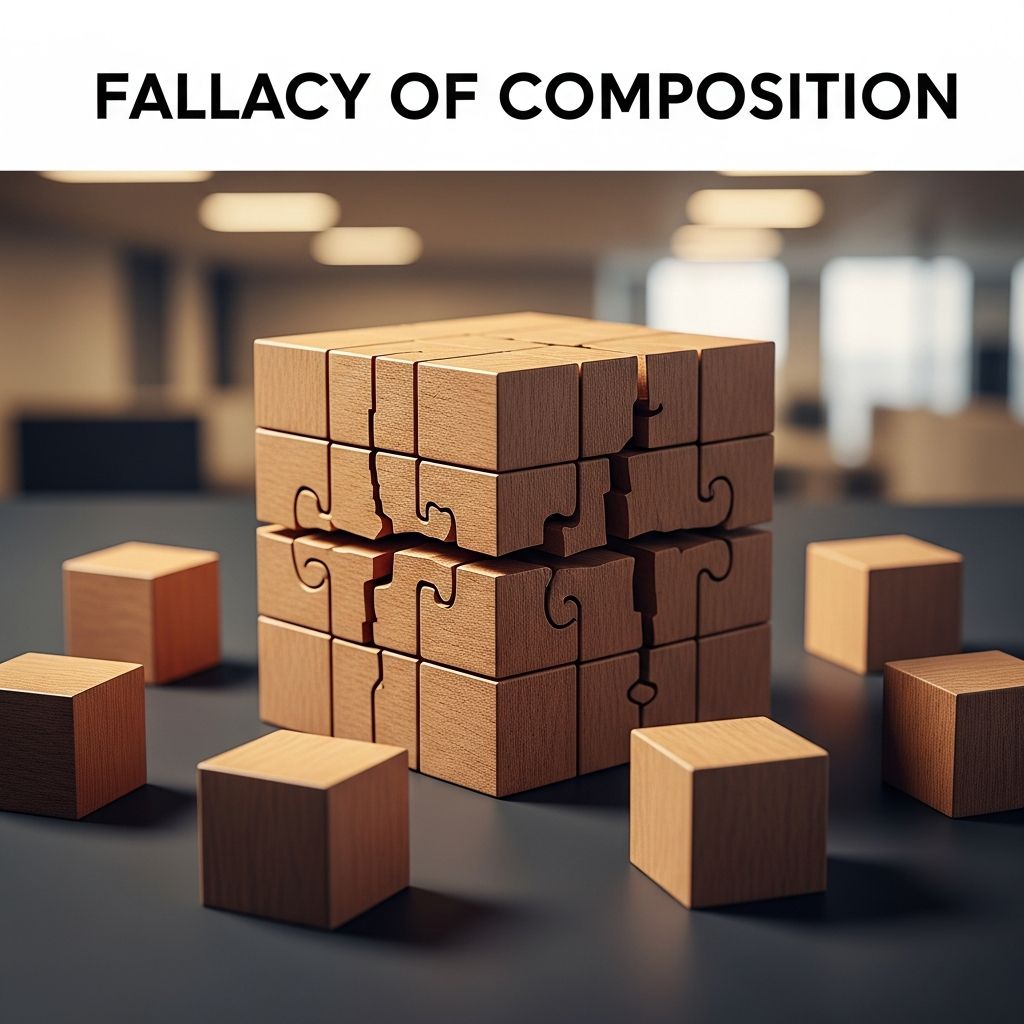
The **fallacy of composition** occurs when someone wrongly assumes that characteristics true of individual parts or members must apply to the entire group or whole. This reasoning error undermines arguments by ignoring how collections often develop unique properties beyond their components.
Defining the Core Concept
At its heart, this fallacy flips valid logic: just because each piece fits a description doesn’t mean the assembled puzzle does too. Philosophers and logicians classify it as an **informal fallacy**, where the flaw hides in content rather than strict form. Unlike formal fallacies with broken syllogisms, these depend on sneaky assumptions about wholes versus parts.
Consider properties as distributive (applying to each item separately) or collective (emerging only in unity). A single raindrop isn’t wet in isolation, yet a cloud pours rain—salt illustrates this too, as its components sodium and chlorine lack saltiness alone. Mistaking distributive for collective traits sparks the error.
Historical Roots in Logic
Ancient thinkers like Aristotle touched on such errors in induction, but modern formalization came later. In the 19th century, logicians like John Stuart Mill warned against overgeneralizing from parts. Today, it’s a staple in critical thinking curricula, countering hasty leaps in science, politics, and debate.
This fallacy pairs with its mirror: the **fallacy of division**, assuming whole traits trickle to parts (e.g., a team wins, so every player excels). Both highlight emergence—wholes behaving unlike sums of parts.
Everyday Illustrations
- Concert Crowd: Standing improves one person’s view, so everyone standing helps all. Reality: uniform height blocks sightlines.
- Team Sports: Each player is top-tier, claiming the ultimate squad. Synergy matters more; chemistry trumps talent alone.
- Building Materials: Bricks weigh little, so the structure does too. Cumulative mass defies this.
- Animals: One bird chirps softly, implying a silent flock. Group dynamics amplify noise.
These show intuitive appeal masking flaws—our brains seek patterns, often fabricating them.
Economic Misapplications
In economics, this fallacy trips policies and perceptions. If saving boosts one household, all saving spurs growth? No—reduced spending contracts economies via the **paradox of thrift**.
Labor markets echo it: one worker quitting raises vacancies beneficially? Mass exits collapse systems. Table below contrasts valid vs. fallacious economic reasoning:
| Scenario | Part-Level Truth | Whole-Level Fallacy | Reality Check |
|---|---|---|---|
| Savings | Helps individual security | Boosts national economy | Cuts demand, slows growth |
| Layoffs | Frees firm budget | Improves industry profits | Reduces consumer spending |
| Competition | One firm cuts prices to win | All cutting prices benefits market | Triggers price wars, losses |
Such errors fuel misguided policies, ignoring systemic feedbacks.
Scientific and Technical Pitfalls
Science combats this via holistic study. Atoms lack wetness; water does—emergent properties demand experiments on wholes. In biology, cells divide rapidly for health, but unchecked organism growth spells cancer.
Engineering dodges it by testing assemblies: lightweight parts yield heavy machines under load. Climate models aggregate individual emissions, revealing global crises no single source matches.
Political and Social Examples
Politics amplifies the fallacy. ‘Each citizen armed protects freedom, so more guns everywhere safer’? Data shows aggregate risks rise. Or: ‘One immigrant works hard, enriching society; unlimited influx does too.’ Capacity limits emerge collectively.
Media hypes: ‘Stars studied hard, so discipline alone guarantees success.’ Systems like networks and luck intervene.
Spotting and Avoiding the Trap
Avoidance starts with questioning: Does part logic scale? Test aggregates empirically. Use phrases like ‘individually true, collectively?’ to probe.
- Identify claim about whole from parts.
- Check for emergence or interactions.
- Seek counterexamples or data on group.
- Consider zero-sum dynamics—gains for one mean losses elsewhere.
Practice reframes thinking: ‘Each runner faster wins prize? Competition caps winners.’
Related Logical Fallacies
It neighbors **hasty generalization** (small sample to population) but focuses on wholes. Differs from **division** (whole to parts). In zero-sum games, it intensifies—individual speed doesn’t multiply prizes.
Frequently Asked Questions (FAQs)
What distinguishes fallacy of composition from division?
Composition goes part-to-whole; division reverses it. Example: ‘Light bricks mean light building’ (composition) vs. ‘Heavy building means heavy bricks’ (division).
Is it common in economics?
Yes, like assuming individual hoarding aids all—actually stifles growth via thrift paradox.
Can wholes share part traits?
Sometimes, but assumption without evidence is fallacious. Validate collectively.
How to teach this fallacy?
Use vivid examples like concerts or teams; discuss emergence in science.
Real-world impact?
Misleads policies, debates, decisions—critical thinking antidote.
Building Stronger Arguments
Mastering this elevates discourse. Demand evidence bridging parts to wholes. In debates, challenge: ‘Does individual benefit aggregate?’ Philosophy teaches: wholes surprise.
From classrooms to boardrooms, awareness prevents errors. Next argument, pause—parts whisper, wholes roar differently.
References
- Fallacy of Composition – Definition and Examples — Logical Fallacy. Accessed 2026. https://www.logical-fallacy.com/articles/fallacy-of-composition/
- Fallacy of Composition | Definition & Examples — Scribbr. 2023-10-15. https://www.scribbr.com/fallacies/fallacy-of-composition/
- Fallacy of Composition in Economics | Overview & Examples — Study.com. 2024-05-20. https://study.com/academy/lesson/the-fallacy-of-composition-in-economics-definition-examples.html
- Fallacy of Composition — Logically Fallacious. Accessed 2026. https://www.logicallyfallacious.com/logicalfallacies/Fallacy-of-Composition
- Fallacy of composition — Wikipedia. 2026-04-01. https://en.wikipedia.org/wiki/Fallacy_of_composition

Medha Deb is an editor with a master's degree in Applied Linguistics from the University of Hyderabad. She believes that her qualification has helped her develop a deep understanding of language and its application in various contexts. Medha specializes in the areas of beauty, health, sports, and wellness and is committed to ensuring that the content on the website is…