
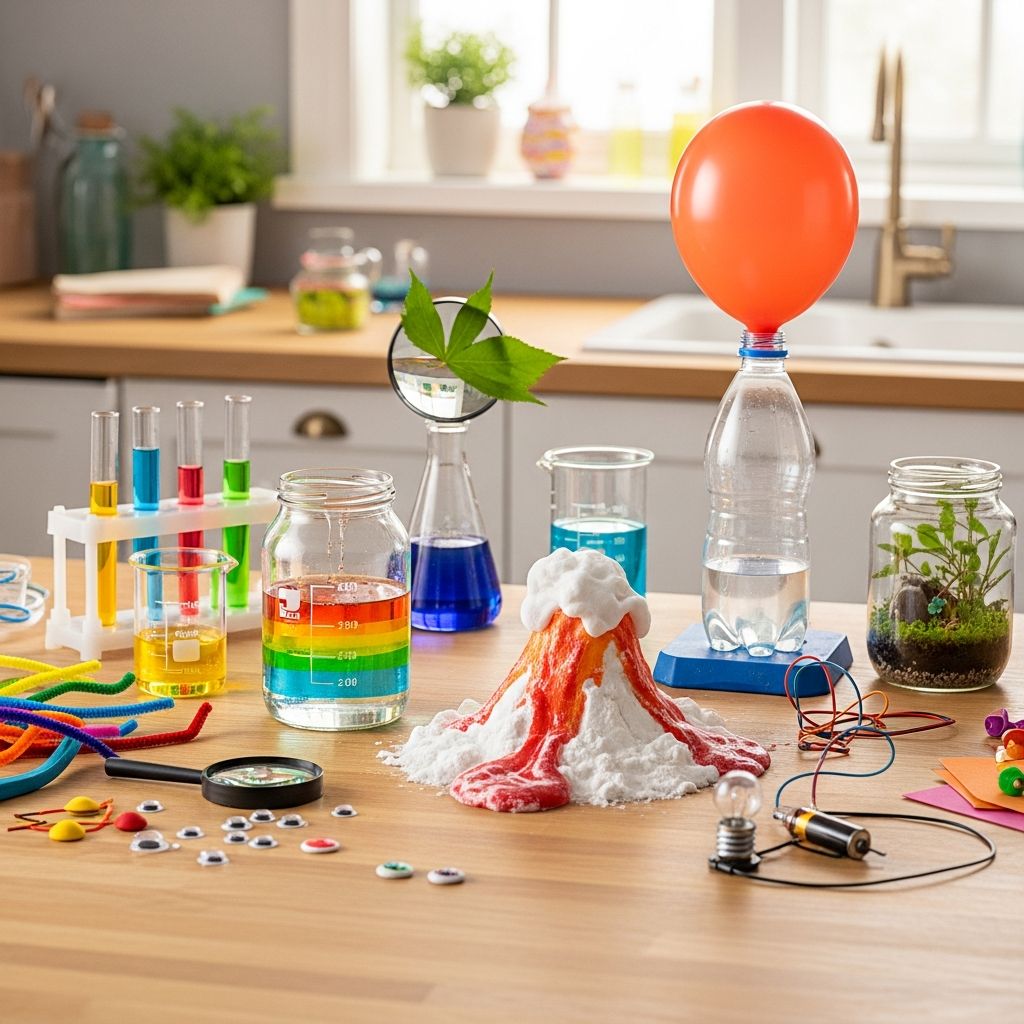
Engaging children in science doesn’t require a fancy lab or expensive equipment. With common household items, parents and educators can create memorable learning experiences that introduce key scientific principles. These activities foster curiosity, critical thinking, and problem-solving skills while keeping kids entertained for hours.
Why Hands-On Science Matters for Young Minds
Science experiments help children move beyond rote memorization to active discovery. According to early childhood education experts, hands-on activities enhance observation skills, encourage hypothesis testing, and build confidence in exploring the world. Preschoolers and elementary-aged kids particularly benefit, as these experiments align with developmental stages where sensory play drives learning.
Activities like observing buoyancy or chemical reactions teach foundational concepts in physics and chemistry without overwhelming young learners. They also promote family bonding, turning ordinary afternoons into exciting adventures.
Exploring Density and Buoyancy
Density experiments reveal why some objects float while others sink, introducing the concept of buoyancy in an accessible way.
- Sink or Float Challenge: Fill a large bowl with water and gather items like coins, wooden blocks, apples, and plastic toys. Have kids predict outcomes before testing. Discuss how denser objects displace less water and sink. This builds prediction skills and introduces Archimedes’ principle simply.
- Saltwater Egg Float: Prepare two glasses of water; add salt to one and stir until dissolved. Gently place an egg in each. The egg sinks in freshwater but floats in saltwater due to increased density. Variation: Layer colored sugar water for a density column with floating objects at different levels.
These setups use minimal supplies: water, salt, eggs, and household objects. Repeat with varied items to reinforce learning.
Chemical Reactions That Wow
Chemical reactions produce visible changes, captivating kids and demonstrating how substances interact.
- Lemon Juice Volcano: Shape modeling clay into a volcano around a small cup. Add baking soda inside, then pour in lemon juice mixed with dish soap and food coloring. Watch it erupt from the acid-base reaction producing carbon dioxide gas. Explain how citric acid in lemons reacts with baking soda (sodium bicarbonate).
- Dancing Raisins: Fill a glass with carbonated water or soda. Drop in raisins; they’ll sink then rise repeatedly as bubbles attach and lift them. This shows gas properties and buoyancy in action.
| Experiment | Key Concept | Materials Needed |
|---|---|---|
| Lemon Volcano | Acid-Base Reaction | Baking soda, lemon juice, clay, food coloring |
| Dancing Raisins | Gas Buoyancy | Soda water, raisins |
Safety tip: Supervise closely, especially with younger children, and use food-grade ingredients.
Weather and Atmospheric Wonders
Simulate natural phenomena to teach meteorology basics.
- Cloud Formation in a Jar: Warm water in a jar, spray shaving cream on top as a cloud, then add food-colored ice cubes on the cream. Watch “rain” form as warm air rises and cools. This models condensation and cloud formation.
- Tornado in a Bottle: Fill a jar halfway with water and glitter. Secure another jar upside down with duct tape to form a connected pair. Swirl vigorously to create a vortex, mimicking tornado dynamics through centrifugal force.
- DIY Rain Gauge: Use a plastic bottle cut in half; invert the top as a funnel. Mark measurements on the bottom. Place outside to track rainfall, discussing the water cycle.
These experiments connect indoor fun to outdoor weather observation.
Light, Color, and Optics Adventures
Light experiments reveal refraction, reflection, and spectrum separation.
- Rainbow Prism Magic: Use a CD or glass prism in sunlight to project rainbows on a wall. Explain how white light splits into colors via refraction. Alternative: Shine a flashlight through a glass of water with food coloring.
- Magic Milk Colors: Pour milk in a dish, add food coloring drops, then touch with dish soap on a cotton swab. Colors swirl as soap breaks surface tension, pulling pigments apart.
Encourage kids to experiment with light angles for brighter effects.
Biology and Nature Investigations
Bring the outdoors in with plant and animal life studies.
- Seed Greenhouse: In a clear plastic box, add soil and moisten. Plant bean seeds, cover with plastic wrap. Observe sprouting in a mini humid environment, teaching photosynthesis and growth needs.
- Leaf Chromatography: Crush leaves in alcohol on coffee filters. Watch pigments separate into colors, revealing hidden plant chemistry.
- Bird Seed Observer: Make a feeder from a pinecone coated in peanut butter and seeds. Hang and note visiting birds, discussing habitats.
Physics with Motion and Magnetism
Explore forces and magnetism through play.
- Homemade Compass: Magnetize a needle by stroking with a magnet, float on cork in water. It aligns north due to Earth’s magnetic field.
- Lava Lamp Effect: Oil in a jar, add water with food coloring. Drop in fizzy tablet; bubbles carry colored water up, demonstrating density layers.
Advanced Twists for Older Kids
For tweens, add complexity:
- Elephant Toothpaste: Mix yeast with warm water, add to hydrogen peroxide, dish soap, and coloring in a bottle. Massive foam from catalyzed decomposition. (Note: Use 3-6% peroxide safely.)
- Crystal Growth: Dissolve salt or sugar in hot water, suspend string, and watch crystals form over days.
Safety Guidelines for All Experiments
Always supervise children. Use eye protection for reactions. Avoid ingestion; clean spills immediately. Teach cleanup to instill responsibility.
Frequently Asked Questions (FAQs)
What age group are these experiments for?
Most suit ages 3-12, with adaptations for younger kids focusing on observation and older ones on explanations.
Do I need special supplies?
No, use kitchen staples like baking soda, vinegar, food coloring, and jars.
How can I extend learning?
Ask questions: “Why do you think that happened?” Journal predictions and results.
Are these safe for preschoolers?
Yes, with adult supervision. Avoid strong chemicals.
Can I do these in a classroom?
Absolutely; scale for groups and prepare materials ahead.
These experiments transform everyday moments into scientific discoveries, nurturing lifelong learners. Experiment freely and watch curiosity flourish!
References
- 20 Science Activities for Preschoolers — Bright Horizons. 2023. https://www.brighthorizons.com/article/education/science-for-preschoolers
- Top Science Experiments for Kids — Science Fun. 2024. https://www.sciencefun.org/kidszone/experiments/top-science-experiments-for-kids/
- Science Experiments for Kids — CuriOdyssey. 2024. https://curiodyssey.org/learn-explore/science-experiments-for-kids/
- Home Experiments — Children’s Science Center. 2024. https://www.childsci.org/home-experiments

- Integrated M.A. in Applied Linguistics, University of Hyderabad
- 5+ years in editorial, instructional, SEO, and research-based writing
Sneha is a relationships and lifestyle writer with a strong foundation in applied linguistics and certified training in relationship coaching. She brings over five years of writing experience to theskillvault, crafting thoughtful, research-driven content that empowers readers to build healthier relationships, boost emotional well-being, and embrace holistic living. Her writing and insights reflect the belief that beauty, happiness, and wellness…