
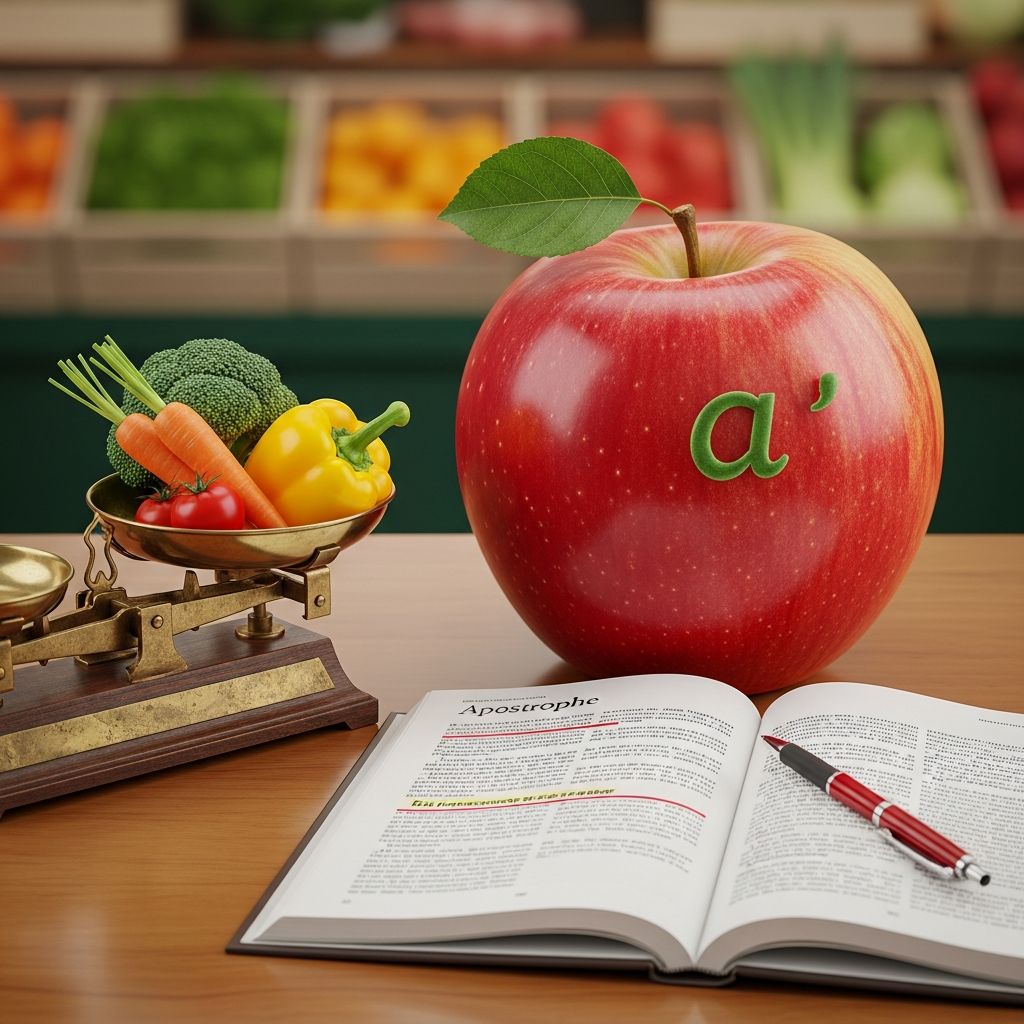
The **greengrocer’s apostrophe** refers to the frequent error of inserting an apostrophe before the ‘s’ in simple plural nouns, like writing “banana’s” instead of “bananas.” This mistake gained its name from signs in produce markets where vendors listed items such as “apple’s for sale” or “carrot’s 3 for $1,” creating confusion between plurals and possession.
Origins and Cultural Impact of the Term
Coined in British English, the term highlights how shopkeepers, particularly those selling fruits and vegetables, often misused apostrophes on handwritten price signs. Linguists note that this error became a symbol of punctuation ignorance, with writers like Keith Waterhouse humorously observing greengrocers’ generosity with apostrophes, likening them to exotic spiders arriving in fruit crates. Over time, it entered common parlance, appearing in dictionaries and grammar guides as a cautionary example.
This phenomenon isn’t limited to the UK; similar errors appear globally in informal signage, from markets to online ads. The cultural stigma has sparked debates on prescriptivism versus descriptivism in language evolution, yet it underscores the apostrophe’s role in clarity.
Core Functions of the Apostrophe in English
Apostrophes serve two primary purposes: indicating **possession** and forming **contractions**. They never mark regular plurals, which is the crux of the greengrocer’s apostrophe error.
- Possession: Shows ownership. For singular nouns, add ‘s (e.g., the dog’s bone). For plural nouns ending in s, add just the apostrophe (e.g., the dogs’ bones).
- Contractions: Replace omitted letters (e.g., it’s = it is; don’t = do not).
- Never for plurals: Write apples, not apple’s, when referring to multiple fruits.
Why the Mistake Persists: Psychological and Historical Factors
Many insert apostrophes before all ‘s’ endings due to overgeneralization from possession rules. Historically, English once used apostrophes more freely for plurals in the 18th century, but standardization by style guides like those from Oxford and Chicago eliminated this. Visually, an apostrophe makes signs stand out, appealing to advertisers despite grammatical inaccuracy.
In digital eras, autocorrect and lack of formal training exacerbate the issue. Surveys by language authorities reveal that up to 40% of public signs in urban areas misuse apostrophes, perpetuating the cycle.
Practical Examples: Spotting and Correcting Errors
Consider these common shop signs:
| Incorrect (Greengrocer’s Apostrophe) | Correct | Explanation |
|---|---|---|
| Banana’s $2/kg | Bananas $2/kg | Plural noun; no possession or contraction. |
| Tomatoe’s on special | Tomatoes on special | Standard plural form. |
| Orange’s and lemon’s | Oranges and lemons | Multiple items listed. |
| CD’s for $5 | CDs for $5 | Acronym plurals omit apostrophe. |
Beyond produce, errors appear in “80’s music” (correct: 80s music) or “folk’s welcome” (correct: folks welcome).
Advanced Rules for Tricky Cases
Plurals of irregular nouns, numbers, and letters require care:
- Children’s toys (plural possessor: children + ‘s).
- Women’s rights (plural possessor: women + ‘s).
- Three weeks’ time (possessive period).
- 1960s fashions (no apostrophe for decades).
- Mind your p’s and q’s (apostrophes aid letter plurals).
Possessive pronouns like theirs, hers, and ours never take apostrophes, as their form inherently shows ownership. For joint possession, use one apostrophe (e.g., Jane and Joe’s house).
It’s vs. Its: A Frequent Pitfall
Confusion arises with “it’s” (contraction for “it is” or “it has”) versus “its” (possessive, like the dog’s tail). Examples:
- It’s raining (it is raining).
- The company lost its profits (belonging to it).
Greengrocer-style errors might produce “it’s tail,” wrongly suggesting contraction.
Impact on Professional and Business Writing
In business, misuse erodes credibility. A sign reading “Sale on shoe’s” implies shoes own something, confusing customers and harming brand image. Legal documents or emails with errors risk misinterpretation, especially in contracts where possession matters (e.g., “the tenant’s rights” vs. “tenants rights”).
Style guides from the UK Government’s Plain English Campaign and the Associated Press emphasize apostrophe accuracy for accessibility. Training programs report 25% improvement in error rates post-education.
Global Variations and Language Comparisons
British English popularized the term, but Americans call it “apostrophe abuse.” German has “Deppenapostroph” for similar possessive misuses in plurals. French and Spanish avoid such issues with distinct plural forms. Understanding these highlights English’s reliance on apostrophes for nuance.
Strategies to Master Apostrophe Usage
- Read aloud: Does it sound like possession or contraction?
- Use tools like Grammarly, but verify manually.
- Practice with flashcards: Categorize words as plural, possessive, or contraction.
- Review signs in daily life and mentally correct them.
- Consult guides: Chicago Manual of Style or Oxford Style for edge cases.
Frequently Asked Questions (FAQs)
What exactly is a greengrocer’s apostrophe?
A: It’s the incorrect insertion of an apostrophe to form a plural, like “apple’s” for multiple apples, often seen on market signs.
Should decades like the 2020s have an apostrophe?
A: No, write 2020s, not 2020’s, as it’s a simple plural.
Should I use an apostrophe for letters or numbers?
A: Yes for clarity, e.g., mind your i’s and j’s; dot the i’s.
What’s the difference between dog’s, dogs’, and dogs?
A: Dog’s = one dog’s possession; dogs’ = multiple dogs’ possession; dogs = plural noun.
How can I teach others to avoid this error?
A: Use real-world examples from signs and provide simple rules focusing on possession and contractions.
Conclusion: Clarity Through Correct Punctuation
Eliminating the greengrocer’s apostrophe enhances readability and professionalism. By grasping its origins and rules, writers communicate precisely, avoiding the pitfalls that plague casual signage.
References
- The story of ‘greengrocer’s apostrophe’, a.k.a. ‘apostrofly’ — wordhistories.net. 2017-12-19. https://wordhistories.net/2017/12/19/greengrocers-apostrophe-apostrofly/
- greengrocer’s apostrophe — Wiktionary. Accessed 2026. https://en.wiktionary.org/wiki/greengrocer’s_apostrophe
- What Is The Greengrocer’s Apostrophe? – Lexicon Lounge — YouTube. Accessed 2026. https://www.youtube.com/watch?v=4HyL7Rr3Uz4
- THE GREENGROCERS’ APOSTROPHE’S SOLVED — helpineedapublisher.blogspot.com. 2010-03-01. http://helpineedapublisher.blogspot.com/2010/03/greengrocers-apostrophes-solved.html
- Grammar 101: The greengrocer’s apostrophe — mariealafaci.com. Accessed 2026. https://mariealafaci.com/grammar-101-the-greengrocers-apostrophe/

- Integrated M.A. in Applied Linguistics, University of Hyderabad
- 5+ years in editorial, instructional, SEO, and research-based writing
Sneha is a relationships and lifestyle writer with a strong foundation in applied linguistics and certified training in relationship coaching. She brings over five years of writing experience to theskillvault, crafting thoughtful, research-driven content that empowers readers to build healthier relationships, boost emotional well-being, and embrace holistic living. Her writing and insights reflect the belief that beauty, happiness, and wellness…