
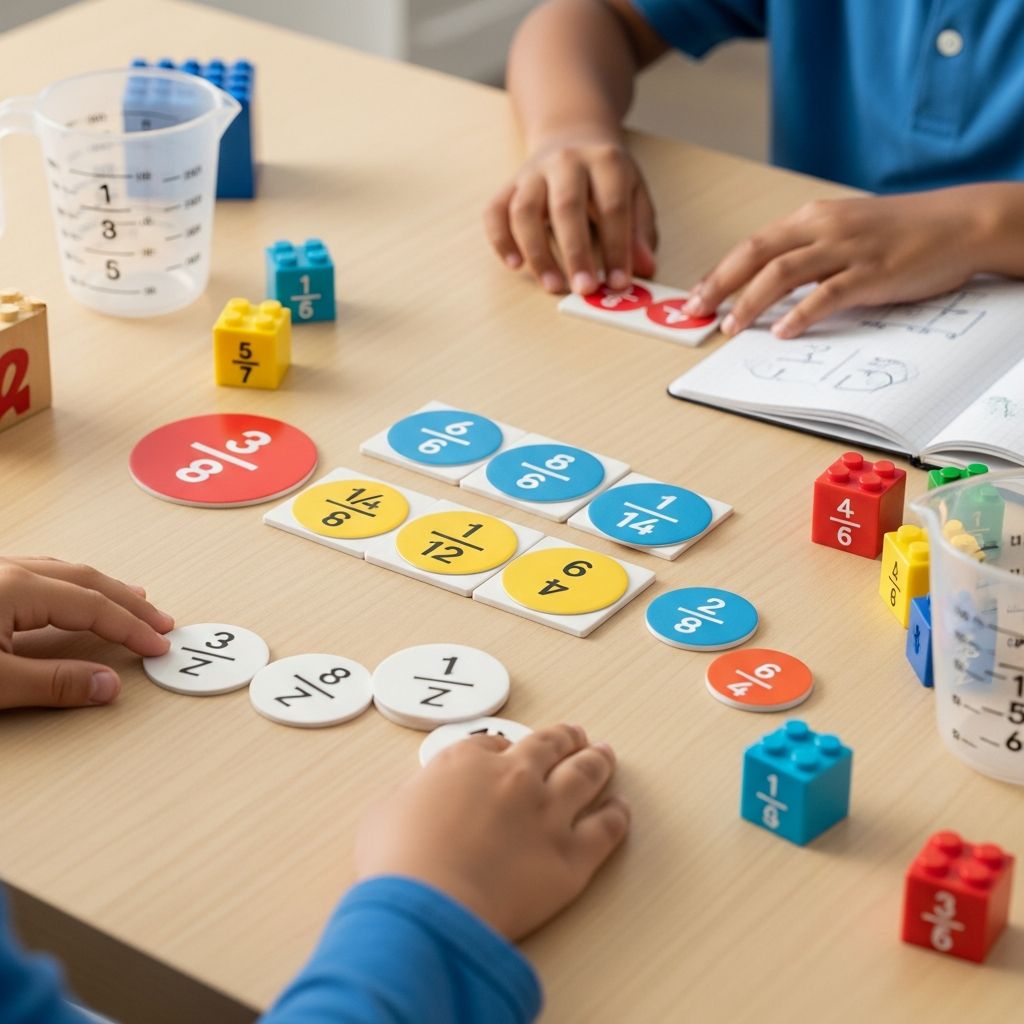
Building Strong Foundations in Fraction Understanding
Fractions represent one of the most critical yet challenging concepts in elementary mathematics instruction. Students often struggle with understanding what fractions truly represent, how they relate to one another, and how to apply them in meaningful contexts. The traditional approach of presenting fractions through abstract symbols and textbook problems frequently leaves learners confused and disconnected from the material. However, when educators employ tactile, visual, and interactive methodologies, students develop a more robust understanding of fractional concepts. By incorporating hands-on activities, movement-based learning, and collaborative problem-solving, educators can transform fraction instruction from a source of frustration into an engaging exploration of mathematical relationships.
Manipulative-Based Learning Approaches
Concrete manipulatives serve as powerful tools for helping students transition from abstract thinking to conceptual understanding. When students physically interact with materials that represent fractional parts, they develop internalized mental models that support mathematical reasoning. Plasticine or play dough, for instance, allows learners to create, reshape, and subdivide wholes in tangible ways. Students can flatten dough onto a surface, use geometric cutters to create different sectioned pieces, and explore the relationship between equal parts and whole units. This tactile exploration emphasizes that fractions must consist of equal divisions, a foundational concept that many students misunderstand.
Paper plates and cardstock offer another accessible approach to fraction manipulation. By cutting plates into various fractional pieces—halves, thirds, quarters, eighths—students can physically combine different fractions to form complete wholes. This activity clarifies the relationship between unit fractions and their equivalencies. Students might use a half-plate piece, a quarter piece, and two eighth pieces to reconstruct a complete circle, discovering through hands-on experience that multiple fractional combinations can represent the same whole.
Drawing paper combined with folding techniques provides a low-cost but highly effective learning tool. When students fold paper systematically in half multiple times, open it, trace the fold lines, and label the resulting sections, they create visual representations of equivalent fractions. This method demonstrates that fractions created through different folding patterns can represent identical portions of the whole. Students develop stronger retention when they physically create these representations rather than simply observing them in textbooks.
Comparative Analysis of Fractional Values
Understanding how fractions compare to benchmarks and to each other constitutes a crucial skill that supports later arithmetic operations. Rather than memorizing comparison rules, students benefit from visual and spatial reasoning activities that develop intuitive understanding. Number line activities, where students position fractional cards along a marked line with reference points at zero, one-half, and one, enable learners to develop estimation skills and deepen their sense of fraction magnitude.
When teachers facilitate small group discussions about fraction placement, students articulate their reasoning and learn from peers’ perspectives. A student might explain that six-tenths belongs just past the one-half mark because it exceeds one-half by only one-tenth. Another student might recognize that eight-ninths sits very close to one, containing just one part less than the whole. These verbal explanations solidify abstract concepts through language and peer interaction.
Sorting activities where students categorize fractions as less than, equal to, or greater than one-half develop classification skills and reinforce comparative thinking. Without relying on procedural algorithms, students develop mental benchmarks for evaluating fractional relationships. This conceptual foundation proves invaluable when students later encounter more complex fraction operations.
Interactive Games and Competitive Learning
Games provide naturally motivating contexts for practicing fraction skills while maintaining student engagement. When students play games, they encounter repetition and practice opportunities that feel purposeful rather than tedious. Card-based games prove particularly versatile for fraction instruction, as cards can represent various fractional concepts depending on how educators structure the activity.
In matching-style games, students receive cards displaying fractions in different representations—numerical form, pictorial form, and word form. Players might identify when a three-eighths card matches a visual representation showing three shaded sections of an eight-part circle. Similar games can focus specifically on equivalent fractions, where students match cards like one-half with two-fourths or three-fourths with six-eighths.
Movement-based games integrate physical activity with mathematical learning, addressing the reality that many students learn more effectively when their bodies engage alongside their minds. Hopscotch adaptations require students to toss a beanbag, land on a square displaying a fraction, and verbally name an equivalent fraction. This activity combines gross motor skills, fraction recognition, and mathematical communication within a single, enjoyable format.
Digital games and online fraction applications offer additional advantages, including immediate feedback, adaptive difficulty levels, and visual animations that clarify fractional concepts. These platforms often allow students to practice independently while teachers address specific needs of other learners. The interactive nature of digital tools appeals to students’ technological fluency while maintaining mathematical rigor.
Connecting Fractions to Personal Contexts
When fractions connect to students’ lives and interests, learning becomes more meaningful and memorable. Name-based fraction activities, where students analyze the letters in their names as fractional units, create immediate personal relevance. A student with the name “Sarah” might determine what fraction of their name consists of capital letters, tall letters, or lowercase letters. This real-world application demonstrates that fractions appear throughout everyday life, extending mathematical thinking beyond classroom walls.
Recipe-based activities similarly contextualize fractions within familiar domestic contexts. Discussing fractional quantities of ingredients in recipes helps students understand that fractions serve practical purposes in cooking and baking. Students might predict what happens if they double a recipe or reduce ingredients to half the original amount, applying fractional thinking to realistic scenarios.
Collaborative Small Group Structures
Small group instruction provides opportunities for targeted practice on specific fractional skills while allowing for differentiated approaches. Within small groups, teachers can assess student understanding in real-time and adjust instruction accordingly. Some students may need additional practice with simplifying fractions to their most basic form, while others benefit from activities that challenge them to generate equivalent fractions or identify fractions on number lines.
Partner activities where students receive fraction cards and must locate their “fraction partner” create collaborative contexts requiring mathematical reasoning and discussion. Students holding equivalent fractions must find one another, justifying why their fractions match. This partner-finding approach engages all students simultaneously while creating natural opportunities for peer interaction and mathematical discourse.
Whole-class activities where students form fractions by physically grouping together leverage the entire classroom as a learning space. If a teacher calls out “thirds,” students quickly organize themselves into three equal groups. This embodied mathematics helps students internalize the concept that fractions represent equal divisions of wholes, with the number in the denominator indicating how many groups are created.
Visual Organization and Display Strategies
Creating visual displays of fractional representations supports ongoing reference and reinforces learning across multiple encounters. Bulletin boards where students post various fractional representations and organize them by type create classroom environments rich with mathematical discourse. When boards display all halves in one section, all thirds in another, and all quarters in a third section, students develop categorical understanding alongside visual pattern recognition.
Sticky note activities where students create and contribute fractional representations to a collaborative display encourage ownership of the learning environment. As students add new fractions, they evaluate whether their contribution fills a gap in what’s already displayed or duplicates existing representations, promoting critical thinking about variety and completeness.
Skill Progression Through Sequenced Activities
Effective fraction instruction follows a logical progression from foundational concepts to more complex applications. Initial activities should emphasize the basic definition of fractions as equal parts of wholes. Only after students demonstrate secure understanding of this foundational concept should instruction progress to equivalent fractions, fraction comparison, and eventually fraction operations.
Activities addressing simplification or reduction skills benefit from initial sorting approaches where students categorize fractions as already simplified or requiring further simplification. Once students recognize patterns in simplification, they become better equipped to apply procedural steps. Similarly, before students attempt to generate equivalent fractions through multiplication, they should experience this concept visually through paper folding or pictorial representations.
Assessment Through Activity-Based Observation
The interactive nature of hands-on fraction activities provides natural assessment opportunities. As students engage in games, manipulate materials, and discuss their thinking, teachers observe evidence of understanding or confusion. A student who consistently places fractions incorrectly on a number line may require additional practice with benchmarking. A student who struggles to find equivalent fraction pairs may need more experience with visual representations of equivalency.
Student explanations during small group work reveal depth of understanding beyond what written responses alone would demonstrate. When a student explains that six-eighths equals three-fourths because “three-fourths is just a simpler way to name the same amount,” the teacher recognizes secure conceptual understanding rather than mere procedural knowledge.
Materials and Resource Efficiency
Effective fraction activities need not require expensive or specialized materials. Standard classroom supplies—paper plates, index cards, markers, rulers, sticky notes, drawing paper, and plastic knife utensils—support rich learning experiences. Many activities can utilize found or recycled materials, reducing costs while modeling sustainability. Digital resources and free online fraction games provide additional options for schools with limited budgets or classroom space constraints.
Frequently Asked Questions
Q: At what grade level should formal fraction instruction begin?
A: While preliminary concepts about parts and wholes can be introduced in first grade through informal language and simple activities, formal fraction instruction typically begins in third grade, progressing in complexity through subsequent years.
Q: How can I differentiate fraction instruction for mixed-ability groups?
A: Use activities that allow multiple entry points. Provide simpler fractions (halves, thirds) for some students while challenging others with more complex fractions. Assign different roles within partner activities, ensuring all students contribute meaningfully regardless of skill level.
Q: How much time should be devoted to manipulative-based learning versus procedural practice?
A: Research suggests beginning with substantial time using manipulatives to build conceptual understanding, gradually transitioning to more abstract representations as students demonstrate secure grasp of foundational concepts. A balance of both approaches supports retention and transfer.
Q: Can fraction games replace traditional fraction worksheets entirely?
A: While games provide valuable practice opportunities with higher engagement levels, some written reflection and practice remains beneficial for consolidating learning. The most effective approach combines varied instructional modalities rather than relying exclusively on any single method.
Q: How do I manage cleanup and organization when using multiple manipulatives?
A: Establish clear storage systems with labeled containers for each material type. Assign student helpers as material managers and build cleanup time into lessons. Pre-portioned supplies reduce preparation while making organization more manageable.
References
- 42 Fun Fraction Activities and Games for Kids — We Are Teachers. 2024. https://www.weareteachers.com/fraction-games/
- Fraction Activities: 5 Low Prep & Engaging Small Group Ideas — Krejci Creations. 2024. https://krejcicreations.com/small-group-fraction-activities/
- 7 Engaging Fractions Activities for Small Groups — eSpark Learning. 2024. https://www.esparklearning.com/blog/fractions-activities-for-small-groups/
- Principles and Standards for School Mathematics — National Council of Teachers of Mathematics. 2000. https://www.nctm.org/Standards-and-Positions/Principles-and-Standards/
- 15 Hands On Ways To Teach Fractions — Terrific Teaching Tactics. 2021. https://terrificteachingtactics.com/2021/06/17/15-hands-on-ways-to-teach-fractions/

- Integrated M.A. in Applied Linguistics, University of Hyderabad
- 5+ years in editorial, instructional, SEO, and research-based writing
Sneha is a relationships and lifestyle writer with a strong foundation in applied linguistics and certified training in relationship coaching. She brings over five years of writing experience to theskillvault, crafting thoughtful, research-driven content that empowers readers to build healthier relationships, boost emotional well-being, and embrace holistic living. Her writing and insights reflect the belief that beauty, happiness, and wellness…