
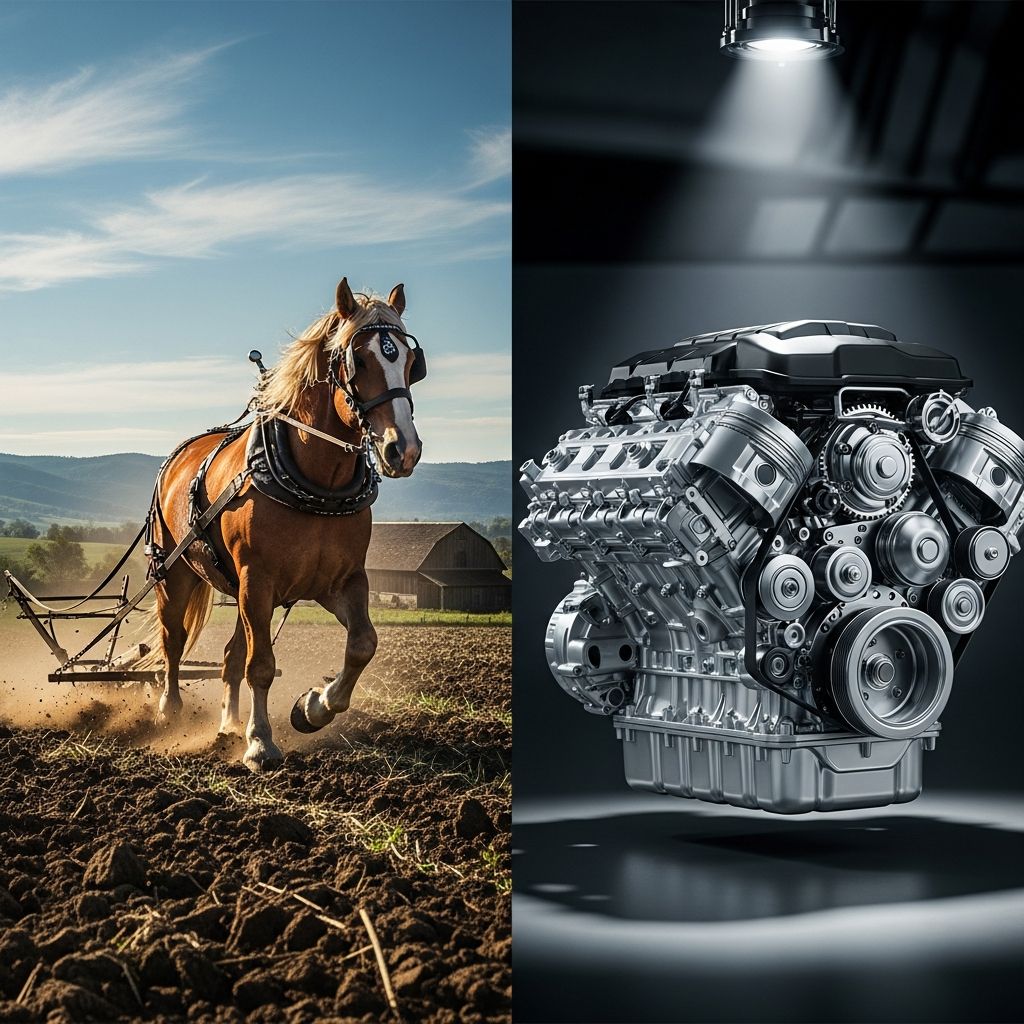
In the heart of the Industrial Revolution, a simple yet ingenious unit of measurement emerged that bridged the gap between animal muscle and mechanical might: **horsepower**. Invented by Scottish engineer James Watt, this term provided a tangible way to quantify the capabilities of steam engines, making complex machinery relatable to everyday farmers, miners, and mill owners who relied on horses for labor.
James Watt and the Dawn of Steam Power Innovation
James Watt, born in 1736, transformed the landscape of engineering with his improvements to the steam engine. Originally patented in 1769, Watt’s design featured a separate condenser that dramatically increased efficiency over Thomas Newcomen’s earlier atmospheric engine. This breakthrough was crucial for pumping water from deep coal mines, a task previously dominated by teams of horses.
Watt partnered with Matthew Boulton in 1775, establishing the Soho Manufactory near Birmingham, England. Their enterprise produced engines not just for mining but for mills, factories, and breweries. To sell these innovations, Watt needed a compelling metric. Horses were the benchmark of power—reliable, familiar, and quantifiable in economic terms. By equating engine output to horse performance, Watt created a marketing masterpiece that resonated with potential buyers.
Calculating the Power of a Single Horse
Watt’s experiments in the late 1770s involved observing brewery and mill horses circling wheels connected to pulleys. He measured how much weight they could lift over time. Through meticulous trials, he determined that a strong draft horse could sustain a force equivalent to lifting 33,000 pounds one foot off the ground in one minute—or 33,000 foot-pounds per minute.
This figure wasn’t arbitrary. Watt noted that a horse walking in a 24-foot diameter circle (a common mill setup) could make about 2.5 turns per second, pulling with roughly 180 pounds of force. Refining these observations from 1782 data (initially 32,400 foot-pounds), he and Boulton standardized it at 33,000 ft-lb/min in 1783. This overstated an average horse’s sustained output by about 50%, ensuring engines appeared superior and reliable for an 8-10 hour workday.
| Component | Value | Explanation |
|---|---|---|
| Force | 180-200 lbs | Average pull of a strong draft horse |
| Distance per revolution | ~75 ft (24-ft circle) | Circumference for mill wheel |
| Revolutions per minute | 2.5 | Sustainable pace without fatigue |
| Total work | 33,000 ft-lb/min | Standardized horsepower unit |
This table illustrates the empirical foundation of Watt’s horsepower, blending observation with practical engineering needs.
Horsepower as a Revolutionary Marketing Tool
Beyond science, horsepower was brilliant branding. In an era before standardized metrics, buyers could directly compare: ‘This engine does the work of 10 horses.’ Advertisements touted engines in horsepower multiples, accelerating adoption. By the 1790s, competitors like Boulton’s rivals adopted the term, embedding it in industrial lexicon.
The impact rippled through society. Factories scaled up, railways emerged, and urbanization accelerated. Horsepower quantified progress, symbolizing humanity’s triumph over animal limitation. Watt’s unit facilitated trade, insurance, and regulation, as engines were taxed or rated by horsepower.
Variations and Global Adaptations of Horsepower
James Watt’s imperial horsepower (hp or bhp) equals 745.7 watts in modern SI units. However, regional tweaks arose. The metric horsepower (PS or cv, from Pferdestärke or cheval-vapeur) is slightly less at 735.5 watts, used in Europe for vehicles.
- Imperial HP: 33,000 ft-lb/min ≈ 745.7 W – UK, USA standard.
- Metric HP (PS): 75 kg-m/min ≈ 735.5 W – Germany, France.
- Boiler HP: Heat input for evaporating 34.5 lbs water/hour from 212°F – ASME 1884 definition, ~9.81 kW.
- Tax HP: Early 20th-century formulas based on engine displacement for vehicle taxation.
These variants highlight horsepower’s flexibility, though the SI watt has largely supplanted it in scientific contexts since the 20th century. EU regulations since 2010 allow hp only as supplementary.
Horsepower Enters the Automotive Age
By the 19th century, horsepower rated stationary engines, locomotives, and early tractors. The 20th century brought automobiles. Henry Ford’s Model T was advertised at 20 hp, while luxury cars boasted hundreds. Today, car ads still lead with horsepower, from 100 hp economy sedans to 1,000+ hp supercars.
Modern testing uses dynamometers to measure brake horsepower (bhp) at the crankshaft or wheel horsepower (whp) post-drivetrain losses (typically 15-20% less). Electric vehicles convert it to kW, but hp persists in marketing for its evocative power imagery.
Modern Relevance and Equivalents
Despite the watt’s precision (1 hp ≈ 746 W), horsepower endures in consumer contexts. A 200 hp engine delivers ~149 kW, enough for highway speeds. Aviation uses it for piston engines, while turbines employ shaft horsepower (shp).
Equivalents include:
- 1 hp = 2,545 BTU/hour (heating).
- 1 hp = 42.4 BTU/min.
- 1 metric hp = 0.986 imperial hp.
Horsepower’s legacy underscores its role in demystifying power for the masses.
Frequently Asked Questions (FAQs)
What is the exact definition of one horsepower?
One imperial horsepower is the power to lift 33,000 pounds one foot in one minute, or 745.7 watts.
Why did James Watt choose horses as the benchmark?
Horses powered mills and mines; comparing engines to them made performance intuitive for buyers.
Is horsepower still used today?
Yes, primarily in automotive, aviation, and marketing, though watts dominate engineering.
How does metric horsepower differ?
It’s 735.5 watts, based on 75 meter-kilograms per second, common in Europe.
Can a real horse produce one horsepower continuously?
No, Watt’s figure is ~50% higher than an average horse’s 8-hour sustainable output.
Legacy of Horsepower in Engineering and Culture
Horsepower symbolizes the Industrial Revolution’s shift from organic to mechanical energy. Museums like the Science Museum in London display Watt’s engines, while car shows celebrate hp rivalries. Its endurance reflects human affinity for animal analogies—much like ‘horse latitudes’ in weather or ‘dark horse’ in politics.
In education, it teaches power as work over time (P = W/t). Students calculate: Work = force × distance; for hp, 550 ft-lb/second. This foundational concept powers curricula worldwide.
Challenges persist: Electric shift favors kW, and efficiency metrics like mpg or MPGe rise. Yet, as long as engines roar, horsepower will evoke raw power.
(Word count: 1,678)
References
- The interesting story behind the origin of the term ‘Horsepower’ — Times of India. 2024-05-29. https://timesofindia.indiatimes.com/etimes/trending/the-interesting-story-behind-the-origin-of-the-term-horsepower/photostory/108826892.cms
- Horsepower — Wikipedia. 2026-04-04 (accessed). https://en.wikipedia.org/wiki/Horsepower
- The History of the Term “Horsepower” — Global Electronic Services. N/A. https://gesrepair.com/the-history-of-the-term-horsepower/
- Horsepower | Definition, Unit, and Facts — Britannica. 2025-10-15. https://www.britannica.com/science/horsepower
- Horsepower: James Watt and the Transition from Horse to Steam (Video Transcript) — The History Guy (YouTube). 2023-11-12. https://www.youtube.com/watch?v=3apcSyFUeOs

- Integrated M.A. in Applied Linguistics, University of Hyderabad
- 5+ years in editorial, instructional, SEO, and research-based writing
Sneha is a relationships and lifestyle writer with a strong foundation in applied linguistics and certified training in relationship coaching. She brings over five years of writing experience to theskillvault, crafting thoughtful, research-driven content that empowers readers to build healthier relationships, boost emotional well-being, and embrace holistic living. Her writing and insights reflect the belief that beauty, happiness, and wellness…