
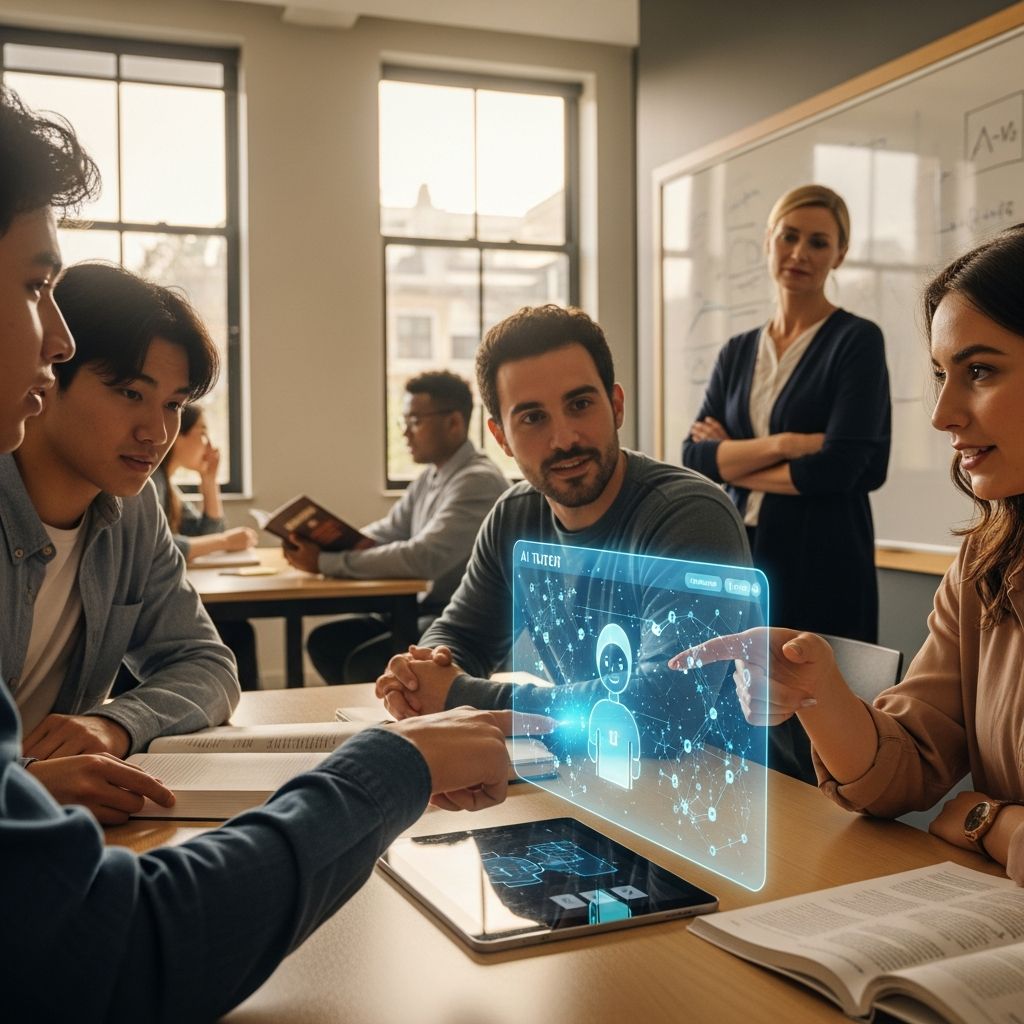
Artificial intelligence is reshaping education by introducing intelligent tutoring systems that deliver personalized instruction, automate routine tasks, and provide instant feedback. These tools empower teachers to focus on mentorship and complex guidance while addressing diverse student needs effectively.
The Emergence of Intelligent Tutoring Systems
Intelligent tutoring systems, powered by machine learning and natural language processing, simulate human-like instruction. They assess student performance in real-time, adapt content difficulty, and offer customized explanations. Unlike traditional one-size-fits-all teaching, these systems create dynamic learning experiences tailored to individual paces and styles.
Research highlights their potential to support education without supplanting human roles. For instance, surveys of students reveal strong approval for AI’s ability to handle repetitive tasks, allowing educators to prioritize relational aspects of teaching.
Key Advantages for Students and Institutions
AI tutors bring transformative benefits to learners and schools alike. Their 24/7 availability eliminates scheduling barriers, making high-quality support accessible regardless of location or time zone.
- Personalized Learning Paths: By analyzing data on errors and strengths, AI adjusts pacing and methods, improving comprehension for diverse learners including those with disabilities.
- Instant Feedback: Students receive immediate corrections and explanations, accelerating mastery compared to delayed human grading.
- Cost-Effective Scalability: In regions facing teacher shortages, AI provides affordable tutoring, bridging gaps in under-resourced areas.
Engagement surges through interactive elements like gamified quizzes and simulations, keeping students motivated. Institutions benefit from data-driven insights into class-wide trends, enabling proactive interventions.
Empowering Teachers Through Automation
One of the most compelling cases for AI integration is workload reduction. Educators often spend hours on grading, attendance, and planning—tasks AI handles efficiently and consistently.
| Task | Traditional Approach | AI-Assisted Approach | Impact |
|---|---|---|---|
| Grading Assignments | Manual review, hours per class | Automated with detailed feedback | Frees 20-30% of time for instruction |
| Lesson Planning | Static templates | Data-informed customization | Targets student gaps precisely |
| Student Progress Tracking | Periodic checks | Real-time analytics | Early identification of struggles |
Studies confirm AI assists novice tutors most dramatically, elevating their effectiveness to near-expert levels—up to 9 percentage points in student mastery gains. This model positions AI as a teaching assistant, enhancing human capabilities rather than competing with them.
Evidence from Real-World Applications
Pioneers like Khan Academy demonstrate AI’s practical impact. Their tools, such as Khanmigo, offer on-demand coaching that adapts to individual needs, supporting millions globally. Founders emphasize AI’s role in sparking education’s greatest transformation by personalizing at scale.
A Stanford study underscores this: AI provided real-time suggestions to human tutors, who retained decision-making control. Results showed superior outcomes, particularly when amplifying less experienced educators. This human-AI synergy proves more effective than either alone.
Surveys echo these findings. Among 50 students, a majority viewed AI as a complement, valuing its efficiency in administrative duties while affirming teachers’ irreplaceable empathy and inspiration.
Navigating Limitations and Ethical Concerns
Despite promise, AI tutors face hurdles. They occasionally produce inaccuracies or ‘hallucinations,’ requiring human oversight. Emotional intelligence—fostering resilience, creativity, and motivation—remains a human stronghold.
Equity issues arise: not all students have equal tech access, potentially widening divides. Over-reliance risks diminishing interpersonal skills. Experts advocate balanced integration, training teachers to verify AI outputs and blend it with human strengths.
Redefining Teacher Professional Development
The AI era demands evolved training. Future educators must master deploying AI tools, interpreting analytics, and designing hybrid experiences. Colleges of education are urged to prioritize this, as AI-proficient teachers achieve superior results and job satisfaction.
Policy must support smaller classes and fair compensation, recognizing AI-augmented teachers handle workloads equivalent to multiple staff. This sustains the profession amid burnout challenges.
Future Visions: A Collaborative Ecosystem
Imagine classrooms where AI manages basics, freeing teachers for deep discussions, mentorship, and inspiration. Sal Khan envisions AI sparking unprecedented positive change, with teachers as orchestrators of personalized journeys.
Broader adoption by platforms like Pearson signals momentum. Over 1,000 universities integrate AI-enhanced materials, signaling a shift toward hybrid models. Success hinges on implementation: efficiency should elevate efficacy, not cut corners.
Frequently Asked Questions
Can AI tutors fully replace human teachers?
No, research shows AI excels in routine tasks and personalization but lacks human empathy, adaptability to emotional needs, and inspirational qualities essential for holistic development.
How does AI reduce teacher workload?
AI automates grading, feedback, and planning, saving hours weekly and allowing focus on high-value interactions like mentoring.
Is AI effective for all students?
Yes for many, especially in personalization, but requires human oversight for accuracy and equity, particularly for diverse learners.
What training do teachers need for AI tools?
Skills in verification, data interpretation, hybrid lesson design, and ethical deployment to maximize benefits.
Will AI lead to teacher job losses?
Unlikely; it enhances efficiency, supports retention, and enables better outcomes, potentially justifying higher pay for skilled integrators.
Comparative Analysis: AI vs. Human Strengths
| Aspect | AI Tutors | Human Teachers |
|---|---|---|
| Availability | 24/7, scalable | Limited by schedule |
| Personalization | Data-driven adaptation | Intuitive empathy |
| Feedback Speed | Instant, consistent | Thoughtful, nuanced |
| Motivation | Gamification | Inspirational relationships |
| Creativity | Pattern-based | Innovative, contextual |
This synergy forms the optimal model: AI for efficiency, humans for heart.
References
- AI-Tutors: Can AI replace human teachers — International Journal of Mathematics Trends and Technology. 2025-06. https://www.mathsjournal.com/pdf/2025/vol10issue6/PartB/10-6-9-216.pdf
- How AI tutors and teaching assistants will transform education — TED Talk by Sal Khan, Khan Academy. 2023. https://www.youtube.com/watch?v=qlh8fiLiovI
- AI Won’t Replace Your Kid’s Teacher, But It Will Make Them Better — EdPost. 2024. https://www.edpost.com/stories/ai-wont-replace-your-kids-teacher-but-it-will-make-them-better
- AI Won’t Replace Teachers—But Teachers Who Use AI Will Change Teaching — Education Week. 2025-10. https://www.edweek.org/technology/opinion-ai-wont-replace-teachers-but-teachers-who-use-ai-will-change-teaching/2025/10
- AI Pioneers Want Bots to Replace Human Teachers – Here’s Why That’s Unlikely — The 74. 2024. https://www.the74million.org/article/ai-pioneers-want-bots-to-replace-human-teachers-heres-why-thats-unlikely/

Medha Deb is an editor with a master's degree in Applied Linguistics from the University of Hyderabad. She believes that her qualification has helped her develop a deep understanding of language and its application in various contexts. Medha specializes in the areas of beauty, health, sports, and wellness and is committed to ensuring that the content on the website is…