
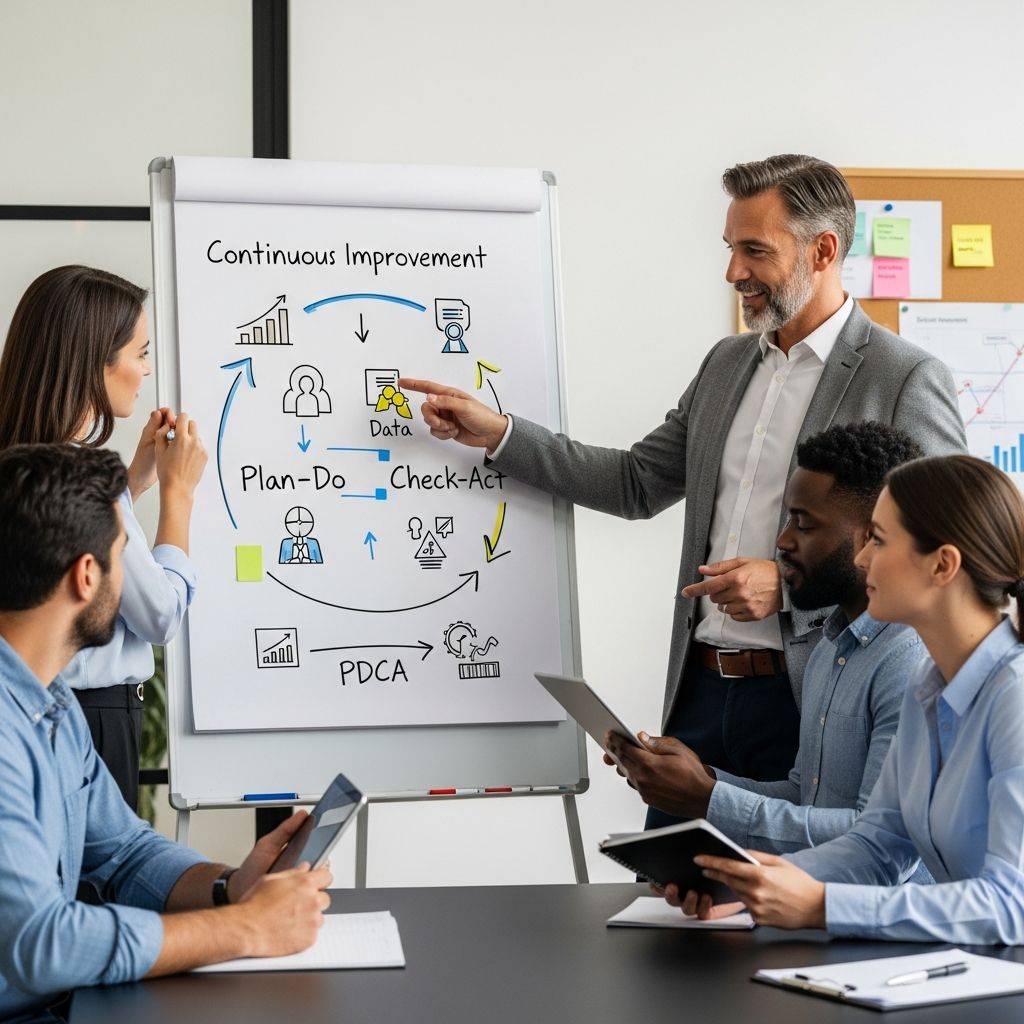
Organizations that apply lean management effectively know that tools alone do not transform performance. Sustainable results come when people at every level think and behave differently, continuously looking for better ways to create value for customers while reducing waste. Coaching is one of the most powerful levers to make this shift real and lasting.
This article explains how coaching supports lean management, how leaders can use coaching skills to nurture continuous improvement, and what practices help embed this mindset across the entire organization.
Lean Management and Continuous Improvement: A Quick Overview
Lean management is a systematic approach to delivering maximum value for customers with minimal waste, originally inspired by the Toyota Production System and now widely used in both manufacturing and knowledge work. At its core, lean focuses on:
- Clarifying what customers truly value.
- Removing activities that do not add value.
- Creating smooth flow of work across the value stream.
- Producing based on actual demand instead of forecasts.
- Always pursuing better ways of working through continuous improvement (kaizen).
Continuous improvement means regularly making small, incremental changes to processes, products, and services, guided by data, experimentation, and learning. Rather than waiting for big, occasional transformations, teams continually refine how they work, building capability and resilience over time.
Why a Culture Shift Matters More Than Tools
Many lean initiatives stall because they rely heavily on tools (like value stream maps, Kanban boards, or standard work templates) without changing the underlying culture. Research shows that lean is most effective when it is supported by a culture that respects people, involves them in problem-solving, and encourages learning from mistakes rather than hiding them.
In high-performing lean organizations:
- Every employee is invited to identify waste and suggest improvements.
- Leaders see their primary role as developing people, not just hitting short-term targets.
- Teams use data and visual management to spot issues early and respond quickly.
- Learning cycles (such as Plan-Do-Study-Act) are routine and embedded in daily work.
Building this kind of culture requires more than training sessions. It requires day-to-day coaching that reinforces new behaviors, supports experimentation, and helps people develop confidence in their own problem-solving skills.
The Role of Coaching in Lean Transformation
Coaching provides the bridge between lean concepts and everyday practice. Instead of prescribing solutions, effective lean coaches help individuals and teams think more deeply about problems, test hypotheses, and learn from outcomes.
Coaching in a lean context typically aims to:
- Develop problem-solving skills: Guiding people to define problems clearly, analyze root causes, and test countermeasures.
- Reinforce lean principles: Linking daily decisions back to value, flow, waste reduction, and customer needs.
- Strengthen ownership: Encouraging teams to own their processes and improvements rather than waiting for top-down directives.
- Normalize experimentation: Helping people see experiments as safe, structured ways to learn, not as risky failures.
When leaders adopt a coaching stance, they help translate lean from a project into a way of thinking and working.
Key Lean Principles and How Coaching Reinforces Them
Lean management is often described through five foundational principles: value, value stream, flow, pull, and perfection. Coaching supports each of these principles in distinct ways.
| Lean Principle | What It Means | How Coaching Helps |
|---|---|---|
| Define value | Understand what the customer truly needs and is willing to pay for. | Coaches challenge teams to clarify who the customer is, what problem is being solved, and how success will be measured. |
| Map the value stream | Visualize all steps needed to deliver value and identify waste. | Coaching prompts cross-functional dialogue to surface hidden steps, handoffs, and delays, and to question their necessity. |
| Create flow | Ensure work moves smoothly without interruptions or bottlenecks. | Coaches help teams spot recurring blockers, understand causes, and test structural changes to improve flow. |
| Establish pull | Produce only in response to real customer demand. | Coaching questions assumptions about forecasts and pushes teams to design systems that respond to actual demand signals. |
| Seek perfection | Continuously pursue better performance and less waste. | Coaches reinforce the mindset that there is always room for improvement and help structure ongoing kaizen activities. |
Core Coaching Skills for Lean Leaders
Leaders do not need to become professional coaches, but they do need a basic toolkit of coaching skills that align with lean philosophy.
1. Asking Insightful Questions
Powerful questions help people think more deeply instead of jumping to solutions. Examples include:
- “What problem are we trying to solve from the customer’s perspective?”
- “Where in the process does this issue first appear?”
- “What data do we have, and what do we still need to learn?”
- “What small experiment could we run this week?”
These questions reinforce value focus, process thinking, and experimentation—key lean habits.
2. Active Listening and Observation
Lean emphasizes going to see the work where it happens (often called “go and see” or gemba walks). Effective coaches:
- Observe how work really flows rather than relying only on reports.
- Listen for frustration, workarounds, and hidden constraints.
- Notice non-verbal signals that indicate stress or disengagement.
This presence builds trust and uncovers real improvement opportunities.
3. Giving Constructive, Timely Feedback
Feedback is crucial to learning. In a lean context, feedback should:
- Focus on behaviors and their impact on process and outcomes.
- Highlight what is working well, not just what needs to change.
- Connect back to lean principles (e.g., “This change improved flow by reducing waiting time”).
Done regularly and respectfully, feedback supports continuous improvement rather than blame.
4. Facilitating Experiments and Reflection
Lean improvement is often structured through cycles such as Plan-Do-Study-Act (PDSA). Coaches help teams:
- Define clear hypotheses and success criteria.
- Run small, time-boxed experiments instead of large risky changes.
- Reflect honestly on results and adapt based on learning.
This builds organizational muscle for evidence-based decision-making.
Designing a Coaching Program to Support Lean
To move beyond isolated efforts, organizations can design a structured coaching program that directly supports their lean journey.
Clarify the Purpose and Outcomes
Before launching, define how coaching is expected to contribute to lean goals. Potential outcomes include:
- Higher employee participation in improvement activities.
- More issues resolved at the team level without escalation.
- Reduced process variability and waste aligned with value stream priorities.
- Increased psychological safety and engagement, enabling people to speak up about problems.
Identify Who Will Be Coached
Effective lean coaching typically targets three main groups:
- Executives – to champion lean values, remove structural barriers, and model coaching behaviors.
- Middle managers – to shift from command-and-control to supporting problem-solving teams.
- Frontline leaders and key specialists – to embed coaching in daily huddles, stand-ups, and improvement meetings.
Integrate Coaching with Lean Routines
Coaching should be woven into existing lean practices, not treated as a separate initiative. Examples include:
- Using daily stand-ups as opportunities to coach on problem definition and prioritization.
- Embedding coaching questions into value stream mapping workshops.
- Scheduling brief reflection sessions after PDSA cycles.
- Including coaching behavior in leader standard work.
Measure Impact Over Time
Because lean emphasizes data, it is natural to track how coaching influences both behavioral and performance outcomes, such as:
- Number and quality of improvement ideas generated by teams.
- Cycle time reductions, defect rate reductions, or throughput improvements in key processes.
- Employee engagement or psychological safety indicators.
- Leadership behavior changes (e.g., frequency of coaching conversations).
Practical Tactics to Embed Continuous Improvement
Coaching is most powerful when it is supported by simple, repeatable practices that keep continuous improvement visible and actionable.
Visual Management and Team Boards
Visual management tools, such as team boards or digital dashboards, help make work, issues, and progress transparent. Coaches can guide teams to use these visuals to:
- Track work in progress and spot bottlenecks.
- Log improvement ideas and their status.
- Review performance trends and decide where to focus next.
Short, Frequent Improvement Cycles
Instead of large, infrequent projects, encourage small experiments aligned with lean principles:
- Limit work-in-progress and test how it affects flow.
- Change a single step in a process to reduce waiting or rework.
- Rearrange workspace or digital tools to reduce motion or handoffs.
Coaches help teams design these experiments so they are safe-to-try and instructive.
Standardize for Learning, Not Rigidity
Standard work is essential in lean because it provides a stable baseline for identifying and testing improvements. Coaching can prevent teams from viewing standards as rigid rules by emphasizing that:
- Standards capture the current best-known method.
- Anyone can suggest changes if they can show improvement.
- Updating standards is part of continuous improvement, not a separate activity.
Common Pitfalls and How Coaching Can Address Them
Even well-intended lean initiatives encounter obstacles. Coaching helps navigate these challenges constructively.
1. Tool-Driven, Not Principle-Driven
Problem: Teams adopt lean tools without understanding the underlying principles, leading to superficial or short-lived gains.
Coaching response:
- Ask how each tool connects to customer value and waste reduction.
- Encourage reflection on outcomes rather than box-ticking.
- Reinforce that tools are means, not ends.
2. Fear of Failure and Blame Culture
Problem: People hesitate to surface problems or propose experiments, worried about criticism or negative consequences.
Coaching response:
- Frame experiments as learning cycles, not pass/fail tests.
- Model vulnerability by acknowledging leaders’ own mistakes.
- Celebrate well-designed experiments regardless of outcome.
3. Overload and Change Fatigue
Problem: Teams feel overwhelmed by day-to-day work and view improvement as extra work rather than part of their job.
Coaching response:
- Help prioritize a small number of high-impact improvement opportunities.
- Design micro-improvements that can be tested quickly.
- Highlight time and effort saved by successful changes to reinforce benefits.
How HR and L&D Can Enable Coaching for Lean
Human Resources and Learning & Development functions play a critical enabling role in integrating coaching with lean.
- Capability building: Design learning paths that combine lean concepts with coaching skills for all levels of leadership.
- Talent and performance systems: Recognize and reward behaviors that support continuous improvement and coaching, not just short-term results.
- Internal coach communities: Develop networks of trained internal coaches who support key value streams and change initiatives.
- Data and evaluation: Partner with operations to measure the impact of coaching on both people and process outcomes.
Frequently Asked Questions (FAQs)
Q: How is continuous improvement different from lean?
A: Continuous improvement is a broad philosophy of making ongoing, incremental enhancements in how work is done. Lean is a specific management system with defined principles and tools focused on maximizing customer value while eliminating waste. Continuous improvement is a core element within lean, and lean provides a structured way to practice it.
Q: Why is coaching so important for lean management?
A: Coaching helps employees develop the skills and confidence to identify problems, analyze root causes, and run experiments rather than waiting for instructions. This aligns directly with lean’s emphasis on respect for people and continuous improvement and is essential for sustaining gains beyond initial projects.
Q: Can coaching for lean work in non-manufacturing environments?
A: Yes. Lean principles have been successfully adapted to services, healthcare, software, and other knowledge-work settings. Coaching is especially valuable in these environments because much of the work is intangible, and people need support to visualize processes, make waste visible, and experiment safely with new ways of working.
Q: How long does it take to build a culture of continuous improvement?
A: Timelines vary, but research and practice show that culture change is a multi-year journey. Early improvements can appear within weeks or months, but deeply embedding continuous improvement requires consistent leadership behavior, aligned systems, and ongoing coaching over several years.
Q: What is the first step if our lean efforts have stalled?
A: A practical first step is to reconnect with lean principles and assess current leadership behaviors. Introducing or strengthening coaching for a pilot group of leaders and teams, focusing on one key value stream, can demonstrate the power of a coaching approach and rebuild momentum.
References
- Lean Thinking for Continuous Improvement — SixSigma.us. 2023-05-10. https://www.6sigma.us/six-sigma-in-focus/lean-thinking-for-continuous-improvement/
- Lean Continuous Improvement: Origins, Principles & Goals — Southern Methodist University. 2022-08-01. https://blog.smu.edu/global/what-is-lean-continuous-improvement/
- Continuous Improvement vs Lean: What’s the Difference? — KaiNexus. 2023-04-12. https://blog.kainexus.com/continuous-improvement-vs-lean
- The Five Principles of Lean — The Lean Way. 2021-03-20. https://theleanway.net/The-Five-Principles-of-Lean
- What is Lean Process Improvement? — Atlassian. 2024-01-05. https://www.atlassian.com/agile/project-management/lean-process-improvement
- The 5 Lean Principles Explained — Businessmap. 2023-02-16. https://businessmap.io/lean-management/implementing-lean-principles
- Continuous Improvement (Kaizen) — Lean Enterprise Institute. 2018-09-01. https://www.lean.org/lexicon-terms/continuous-improvement/
- What is Lean? — Michigan Technological University Office of Continuous Improvement. 2020-06-15. https://www.mtu.edu/improvement/learn/what/

- Integrated M.A. in Applied Linguistics, University of Hyderabad
- 5+ years in editorial, instructional, SEO, and research-based writing
Sneha is a relationships and lifestyle writer with a strong foundation in applied linguistics and certified training in relationship coaching. She brings over five years of writing experience to theskillvault, crafting thoughtful, research-driven content that empowers readers to build healthier relationships, boost emotional well-being, and embrace holistic living. Her writing and insights reflect the belief that beauty, happiness, and wellness…