
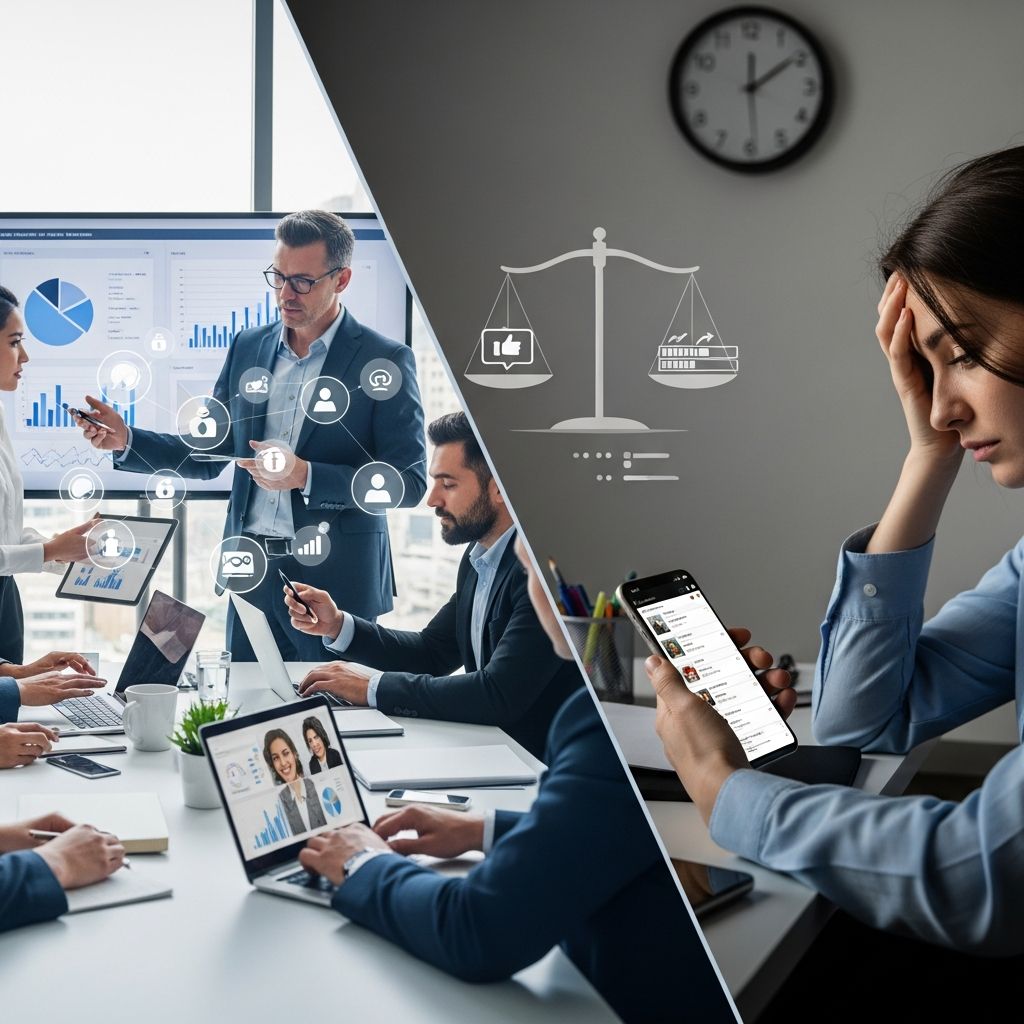
Social media platforms influence employee output in multifaceted ways, serving as both powerful enhancers of collaboration and notorious sources of distraction. Research indicates potential productivity gains of 20-25% through strategic use, yet unchecked access can drain up to 9.5% of daily efficiency.
Understanding the Productivity Paradox
The tension between social media’s allure and its utility defines modern workplaces. Employees spend roughly 12% of their workday on platforms like Facebook, Twitter, and LinkedIn, with only 59% dedicated to core tasks, equating to 65 unproductive hours monthly. This paradox arises because platforms engineered for engagement—via dopamine-inducing notifications—fragment attention, particularly in focus-intensive roles.
Yet, when channeled correctly, these tools foster knowledge exchange and motivation. A McKinsey analysis highlights how social networks can elevate productivity by 20-25% in collaborative settings. The key lies in distinguishing work-oriented from recreational use, as peer-reviewed studies confirm the former boosts efficiency while the latter risks burnout.
Positive Impacts: When Social Media Fuels Efficiency
Social media transforms remote and hybrid work by bridging communication gaps and amplifying recognition. Here’s how it drives gains:
- Knowledge Sharing and Collaboration: Platforms enable rapid information dissemination, with work-oriented usage directly correlating to higher output. Features like instant availability and diverse communication symbols enhance team coordination.
- Employee Recognition: Public shout-outs on LinkedIn or Instagram stories boost morale and retention. Sharing achievements gives workers a sense of purpose, encouraging sustained effort.
- Mental Rejuvenation: Short breaks for uplifting content release dopamine, countering fatigue from prolonged tasks and restoring focus.
In tech and marketing sectors, 78-82% of employees use social media productively during hours, reflecting adaptive policies.
Negative Effects: The Hidden Costs of Distraction
Despite benefits, misuse erodes focus. Unrestricted personal scrolling consumes 40-45 minutes daily, slashing 9.5% of productivity. Constant updates promote superficial processing, impairing deep analytical work.
| Metric | Impact | Source |
|---|---|---|
| Average Daily Social Media Time at Work | 40-45 minutes (non-work) | |
| Productivity Loss | 9.5% daily; 12% of workday | |
| Employer Concern | 30% view as negative (2024) | |
| Attention Span Reduction | Heavy users struggle with task-switching |
Additional harms include sleep disruption from late-night scrolling and ‘herd mentality’ stifling innovation. About 77% of workers check social media during the day, amplifying these issues.
Work vs. Social Usage: A Research-Backed Comparison
Uses Gratification Theory (UGT) explains motivations: work-oriented access (e.g., project updates) heightens efficiency (t=12.933, p<0.01), while social-oriented (e.g., casual chats) aids satisfaction but less directly productivity (t=2.287, p<0.05). Managers should promote structured groups for task-sharing to leverage this.
Strategies for Maximizing Benefits in Your Team
To tilt the balance positively, implement these evidence-based tactics:
- Set Clear Guidelines: Define work-permissible platforms and times, like designated Slack channels for updates.
- Integrate Tools: Use enterprise versions (e.g., Microsoft Teams, Workplace by Meta) to blend social features with productivity tracking.
- Promote Mindful Breaks: Encourage 5-10 minute dopamine resets via curated feeds, avoiding endless scrolls.
- Recognition Programs: Weekly LinkedIn spotlights to foster retention and motivation.
- Monitoring and Training: Analytics to curb overuse, paired with workshops on digital hygiene.
Recent trends show employer skepticism dropping from 35% to 30%, signaling better management.
Industry Spotlights: Real-World Applications
Technology Sector
With 82% usage, tech firms harness Twitter for real-time ideation and LinkedIn for talent scouting, yielding collaboration boosts.
Finance and Marketing
78% engagement here focuses on trend monitoring and client outreach, directly tying to revenue.
Remote Work Revolution: Social Media as a Lifeline
In distributed teams, platforms combat isolation. Acknowledging remote contributions via posts enhances credibility and loyalty, while inspirational content sustains vigor amid high workloads. Resource management integrates social tools for balanced schedules, preventing burnout.
Long-Term Implications for Organizational Culture
Embracing social media thoughtfully cultivates inclusive cultures. It counters ‘inside-the-box’ thinking by exposing diverse views—if moderated—and mitigates mental health strains through controlled access. Forward-thinking companies create hybrid policies blending freedom with accountability.
Frequently Asked Questions (FAQs)
How much time do employees typically spend on social media at work?
A: On average, 12% of the workday, or about 40-45 minutes for non-work purposes, leading to significant productivity dips.
Can social media actually increase productivity?
A: Yes, McKinsey estimates 20-25% gains through knowledge sharing and recognition when used work-oriented.
What are the biggest risks of social media in the workplace?
A: Attention fragmentation, addiction-like dopamine loops, and reduced deep focus, especially in analytical roles.
How can managers encourage productive social media use?
A: Via guidelines, recognition posts, mindful break policies, and integrated tools like Teams.
Does social media help with remote employee retention?
A: Absolutely—public acknowledgments boost morale and loyalty, reducing turnover.
Conclusion: Striking the Right Balance
Social media’s workplace role hinges on intentional use. By prioritizing work-aligned applications and curbing distractions, organizations unlock substantial efficiency while nurturing engaged teams. Adapt policies to your context for optimal results.
References
- How Social Media enhance workplace productivity — Saviom Software. 2023. https://www.saviom.com/blog/the-importance-of-social-media-in-remote-work/
- How Does Social Media Affect Productivity? — Flash Hub. 2024. https://flashhub.io/how-does-social-media-affect-productivity/
- Social networks at work: productivity or distraction? — Lumiun Blog. 2024. https://www.lumiun.com/blog/en/social-networks-at-work-productivity-or-distraction/
- The Impact of Social Media Usage on Work Efficiency — National Library of Medicine (PMC). 2021-07-28. https://pmc.ncbi.nlm.nih.gov/articles/PMC8355543/
- Social media impact on work productivity — Khorrami Consulting. 2023. https://www.khorramiconsulting.com/social-media-impact-on-work-productivity/
- Social Media At Workplace Statistics 2024 — ElectroIQ. 2024. https://electroiq.com/stats/social-media-at-workplace-statistics/
- The Hidden Impact of Social Media in the Workplace — Rutgers University. 2023. https://www.rutgers.edu/news/hidden-impact-social-media-workplace

- Integrated M.A. in Applied Linguistics, University of Hyderabad
- 5+ years in editorial, instructional, SEO, and research-based writing
Sneha is a relationships and lifestyle writer with a strong foundation in applied linguistics and certified training in relationship coaching. She brings over five years of writing experience to theskillvault, crafting thoughtful, research-driven content that empowers readers to build healthier relationships, boost emotional well-being, and embrace holistic living. Her writing and insights reflect the belief that beauty, happiness, and wellness…