
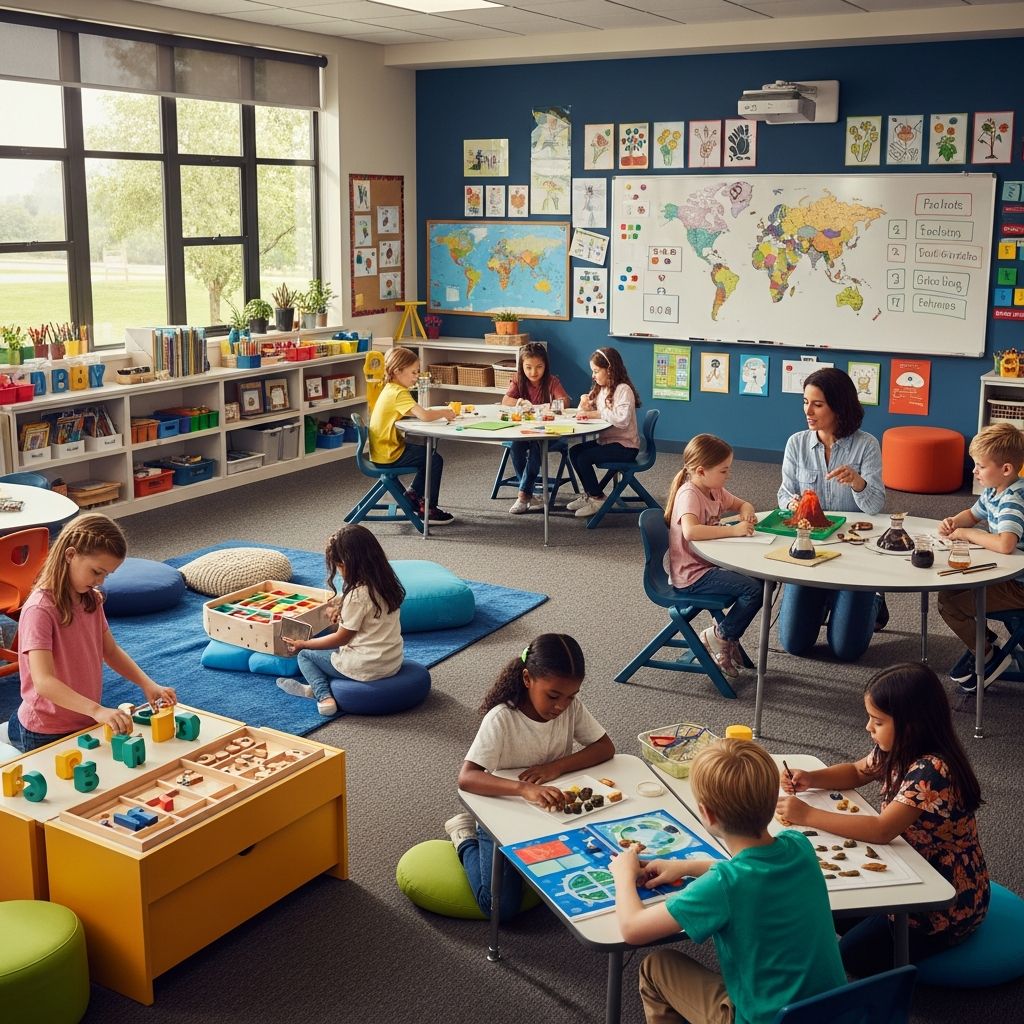
Building Excitement in Primary Education: A Comprehensive Guide to Dynamic Lesson Design
The challenge of maintaining student attention in primary classrooms represents one of the most significant hurdles educators face today. Children at this developmental stage possess natural curiosity and enthusiasm for discovery, yet their capacity to sustain focus remains limited. The key to overcoming this challenge lies in transforming conventional instructional methods into experiences that are simultaneously educational and genuinely enjoyable. This comprehensive exploration provides practical guidance for educators seeking to elevate their teaching practice and create memorable learning experiences.
Understanding Your Student Population
Effective instruction begins with recognizing that each student brings distinct preferences, strengths, and interests to the learning environment. Rather than implementing a standardized approach, successful educators take time to understand their students as individuals. This understanding can be developed through multiple channels: classroom observations, informal conversations, family interviews, and direct inquiry about student passions and hobbies.
When educators leverage this knowledge, they can deliberately design lessons that resonate with individual learners. For instance, a student fascinated by space exploration might find geometry more meaningful through lessons involving planetary mechanics. Another student interested in cooking might approach fractions through recipe measurements. This personalization signals to students that their interests matter and creates authentic connections between curriculum content and their lives.
Addressing Diverse Learning Preferences
Students process information through distinct pathways, and recognizing these differences allows educators to design more inclusive lessons. The framework of learning modalities provides useful guidance:
- Auditory learners benefit most from listening experiences, including narrative presentations, musical elements, and group discussions where they can hear multiple perspectives
- Visual learners respond strongly to color, imagery, diagrams, infographics, and demonstrations they can observe
- Kinesthetic learners require physical engagement, including movement-based activities, hands-on construction, and embodied learning experiences
The most effective lessons integrate multiple modalities, ensuring that no student is consistently disadvantaged by instructional approach. A history lesson might incorporate dramatic storytelling (auditory), illustrated timelines (visual), and role-playing activities (kinesthetic), allowing each learner to engage through their preferred channel while exposure to other modalities supports brain development.
Infusing Enjoyment Through Strategic Play
Play represents one of the most powerful learning mechanisms available to primary educators. Games naturally incorporate challenge, motivation, and immediate feedback—elements that sustain engagement. However, games must be purposefully selected to reinforce learning objectives rather than serve as mere time-filling entertainment.
Educational games function across multiple scales. In larger classroom settings, competitive formats like quiz competitions or team-based challenges create excitement while reinforcing content knowledge. Smaller group or individual settings allow for more personalized game experiences. Digital platforms have expanded options dramatically, offering interactive experiences that feel contemporary and engaging to digitally-native students. The element of competition, even when mild, triggers motivation systems that passive instruction cannot achieve.
Establishing Authentic Connections to Real-World Contexts
Abstract concepts gain meaning when students understand their relevance to tangible experiences. Rather than presenting mathematical principles in isolation, connecting them to real situations helps students see learning as purposeful. A tutor might use household items to explore fractional concepts, making measurement meaningful through practical application. A teacher might establish a classroom economy where currency represents points earned through learning, creating an authentic context for practicing money management skills.
Storytelling provides another mechanism for establishing real-world connection. Embedding content within a narrative structure—whether a historical story, a fictional adventure, or a contemporary scenario—gives students a framework for understanding why the information matters. A lesson on multiplication becomes more engaging when framed as a puzzle to unlock treasure, with each solution revealing the next clue in an adventure narrative.
Leveraging Technology for Enhanced Engagement
Contemporary educational technology offers unprecedented opportunities for creating interactive, immersive learning experiences. Digital tools extend far beyond simple content delivery, enabling new forms of student interaction and visualization. Assessment platforms can transform quizzes from anxiety-inducing events into game-like experiences with immediate feedback. Virtual environments allow students to explore locations and scenarios impossible to access physically.
Augmented reality represents a particularly transformative technology for primary education. Through AR applications, students can examine three-dimensional models of biological systems, explore historical environments as they existed centuries ago, or interact with scientific phenomena that would otherwise remain abstract. These technologies transform passive observation into active investigation, fundamentally changing how students engage with content.
Technology also enables differentiation at scale. Teachers can easily adjust content difficulty, provide multiple answer formats, or offer varied pacing based on individual student performance. Digital platforms record student progress, providing teachers with data to guide instructional decisions.
Fostering Psychological Safety in Learning Environments
Fear of failure represents a significant barrier to student engagement. When students worry about making mistakes or being judged, they disengage from challenging activities. Conversely, environments where errors are normalized as part of learning encourage students to take intellectual risks and persist through difficulty.
Teachers establish psychological safety through explicit messaging that mistakes represent valuable learning opportunities rather than failures. Celebrating examples of productive struggle, discussing how mistakes led to breakthrough understanding, and responding to errors with curiosity rather than criticism all communicate that the classroom is a safe space for learning. This psychological foundation proves essential for sustained engagement and long-term academic development.
Developing Collaborative Learning Experiences
While individual work has its place, collaborative structures significantly enhance engagement. Group projects, partner activities, and peer teaching opportunities create social dimensions that increase motivation. Students often invest greater effort when they feel responsibility to their team members.
Peer teaching proves particularly powerful, as students must articulate understanding to others, which requires deeper processing than passive learning. Reciprocal teaching structures, where students take turns explaining concepts to classmates, create accountability while building confidence. Even non-traditional peer arrangements—such as a student explaining material to a younger sibling or family member—can enhance learning through the teaching process.
Incorporating Movement and Physical Activity
Neurological research confirms that physical activity enhances cognitive function and maintains focus. Yet traditional classroom structures often restrict movement, leading to restlessness and reduced engagement. Strategic incorporation of movement aligns with both developmental needs and neuroscience.
Movement can be integrated in multiple ways: transitions between activities can involve physical challenges, instruction can incorporate gestures and movement-based demonstration, and activities can be designed to require students to move around the learning space. Even brief “brain breaks” featuring simple physical activity improve subsequent focus and learning. These don’t require elaborate equipment—simple activities like guided stretching, dancing to music, or movement-based games accomplish the objective while providing enjoyable breaks in seated instruction.
Practical Application: A Multilayered Approach to Mathematics Instruction
Consider how these principles might combine in a single lesson on multiplicative thinking for upper primary students:
The lesson opens with a narrative hook: students are secret agents decoding messages through a treasure hunt. This story frame immediately establishes relevance and excitement. Next, visual elements—maps with clues, images representing treasure—provide visual engagement. Students physically move around the classroom or outdoor space to locate each clue, satisfying kinesthetic needs. Each clue requires solving a multiplication problem to proceed, reinforcing the mathematical concept. Collaborative elements emerge as students work in pairs to decode each puzzle. The experience concludes with a celebration of group success and reflection on problem-solving strategies used.
This single lesson incorporates multiple engagement strategies: narrative structure, visual elements, movement, collaboration, problem-solving challenge, and celebration. The mathematics learning objective remains central, but delivery through engaging structures dramatically increases student investment.
Essential Elements for Success
| Engagement Strategy | Implementation in Classrooms | Implementation for Individual Tutoring |
|---|---|---|
| Personal Interest Integration | Class surveys and observations | Direct one-to-one conversations |
| Multi-Sensory Instruction | Group activities with varied formats | Customized approaches per learner |
| Game-Based Learning | Team competitions, group challenges | Adapted games, digital platforms |
| Real-World Contexts | Field trips, scenario simulations | Household items, personal examples |
| Technology Integration | Interactive apps, virtual platforms | Digital tools, online resources |
| Psychological Safety | Class culture emphasizing growth | Patient, non-judgmental approach |
| Collaborative Structures | Group projects, peer teaching | Involving family members, peer interaction |
| Physical Activity | Brain breaks, active games | Standing activities, movement games |
Frequently Asked Questions
Q: How can teachers manage implementing these strategies with large class sizes?
A: Strategies can be scaled for larger groups by utilizing peer structures, station rotations, and digital tools that automate differentiation. Begin with one or two new strategies rather than attempting comprehensive overhaul, allowing time to develop proficiency before adding complexity.
Q: What if students resist game-based or movement-based activities?
A: Resistance often stems from unfamiliar structures. Explicit instruction about expectations, starting with lower-stakes activities, and building community trust gradually helps students acclimate to new formats. Some students also need movement-free options for processing, which should be respected.
Q: How much technology is necessary for creating engaging lessons?
A: While technology offers powerful options, engaging lessons don’t require expensive equipment. Story-based learning, creative movement activities, and collaborative projects create engagement through structure rather than technology. Technology amplifies engagement but shouldn’t be seen as prerequisite.
Q: How can parents support engagement at home?
A: Parents can reinforce engagement strategies by incorporating storytelling into family experiences, connecting learning to real-world situations, and asking children about content they’ve learned. Even informal conversations about school content extend and reinforce classroom learning.
Q: How do educators balance fun with rigorous learning objectives?
A: Engaging structures and rigorous learning aren’t opposing forces. By deliberately designing activities where engagement supports rather than distracts from learning objectives, educators ensure that enjoyment and academic rigor reinforce each other rather than competing.
Conclusion and Moving Forward
Creating lessons that genuinely engage primary students represents an investment in both immediate learning and long-term educational trajectories. Students who experience learning as enjoyable, personally relevant, and supportive are more likely to develop intrinsic motivation, resilience, and positive dispositions toward academic pursuits. The strategies explored here—understanding learners as individuals, incorporating varied modalities, establishing psychological safety, and integrating movement and collaboration—provide a framework for transformation.
Implementation needn’t be revolutionary. Educators selecting one or two strategies to develop deeply, then gradually expanding their practice, create sustainable change. Each addition to an educator’s engagement toolkit expands possibilities for reaching more learners more effectively. The result justifies the effort: students who thrive academically and discover that learning is genuinely satisfying.
References
- Engaging Lesson Plans: How to Make Learning Fun for Primary Students — Greenhouse Learning. 2024. https://greenhouselearning.co.uk/engaging-lesson-plans-how-to-make-learning-fun-for-primary-students/
- 40+ Fun and Ready-to-Use Lesson Plans for Primary School — BookWidgets Blog. 2019. https://www.bookwidgets.com/blog/2019/05/31-fun-and-ready-to-use-lesson-plans-for-primary-school
- How to Build Engaging Lessons for Elementary Students — Kiddom. 2024. https://www.kiddom.co/build-engaging-lessons-elementary-students
- Playful Learning Activities for Elementary School — Unruly Splats. 2024. https://www.unrulysplats.com/blog/playful-learning-activities-for-elementary-school
- Free Teaching Resources: Fun Classroom Activities & Lesson Plans — Houghton Mifflin Harcourt. 2024. https://www.hmhco.com/blog/free-learning-resources

- Integrated M.A. in Applied Linguistics, University of Hyderabad
- 5+ years in editorial, instructional, SEO, and research-based writing
Sneha is a relationships and lifestyle writer with a strong foundation in applied linguistics and certified training in relationship coaching. She brings over five years of writing experience to theskillvault, crafting thoughtful, research-driven content that empowers readers to build healthier relationships, boost emotional well-being, and embrace holistic living. Her writing and insights reflect the belief that beauty, happiness, and wellness…