
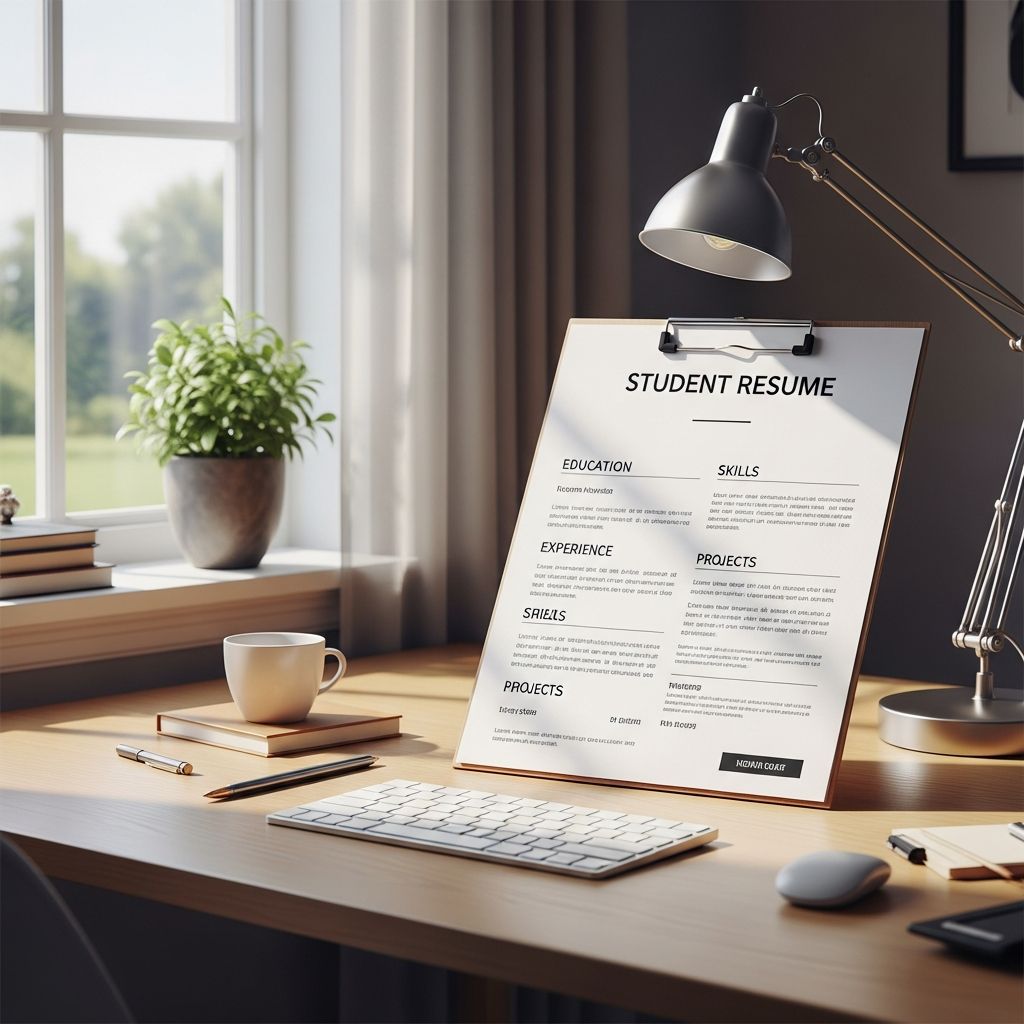
Why a Strong Student Resume Matters
For students and recent graduates, a resume is more than just a list of jobs and classes. It’s a strategic document that tells a story about who you are, what you can do, and how you can add value to an organization. Employers often spend less than a minute scanning each resume, so clarity, relevance, and professionalism are critical.
A well-crafted student resume bridges the gap between limited work history and strong potential. It highlights academic achievements, relevant coursework, leadership roles, projects, and transferable skills in a way that aligns with the needs of the employer. Whether you’re applying for internships, part-time jobs, co-ops, or entry-level positions, a polished resume significantly increases your chances of getting noticed.
Core Principles of an Effective Student Resume
Before diving into structure and content, it’s important to understand the underlying principles that make a student resume effective:
- Clarity and readability: Use a clean layout, consistent formatting, and a professional font (e.g., Arial, Calibri, Times New Roman) in 10–12 pt size.
- Relevance: Tailor each resume to the specific opportunity by emphasizing the most relevant experiences and skills.
- Conciseness: Keep it to one page, especially early in your career. Focus on quality over quantity.
- Accuracy: Double-check dates, job titles, company names, and contact information for consistency and correctness.
- Professional tone: Avoid personal pronouns (I, me, my), slang, and overly casual language.
Essential Sections to Include
A strong student resume typically includes the following sections, ordered to highlight your strengths:
Contact Information
At the top of the page, include:
- Full name (larger font, bold)
- Phone number
- Professional email address (e.g., firstname.lastname@domain.com)
- LinkedIn profile (optional, if complete and professional)
- City and state (no full street address needed)
Make sure your email address is appropriate (avoid nicknames or unprofessional handles).
Education
For students, education is usually the most important section and should come near the top. Include:
- Institution name
- Location (city, state)
- Degree(s) pursued or earned (e.g., B.A. in Psychology, expected May 2026)
- Major(s) and minor(s) or concentrations
- Graduation date (or expected date)
- GPA (if 3.0 or higher; otherwise, consider omitting or including only major GPA if stronger)
- Relevant coursework (3–5 courses directly related to the opportunity)
- Honors (Dean’s List, scholarships, academic awards)
Experience
This section includes paid jobs, internships, co-ops, and significant volunteer or research roles. For each position, list:
- Job title
- Organization name
- Location (city, state)
- Dates of employment (month and year)
- Bullet points describing responsibilities, skills used, and results achieved
Use strong action verbs (e.g., managed, coordinated, analyzed, developed, implemented) and, when possible, quantify achievements (e.g., increased efficiency by 15%, managed a team of 5, processed 50+ applications per week).
Skills
A dedicated skills section helps employers quickly see your qualifications. Organize skills into categories such as:
- Technical/Computer Skills: Software (Microsoft Office, Google Workspace), programming languages, design tools, data analysis tools, etc.
- Language Skills: List languages other than English and indicate proficiency level (e.g., Spanish – Conversational, French – Fluent).
- Soft Skills: Communication, teamwork, problem-solving, time management, leadership, adaptability.
Be specific and honest about your skill level (e.g., “Proficient in Excel,” “Basic HTML/CSS,” “Fluent in Spanish”).
Leadership, Involvement, and Activities
Employers value students who are engaged beyond the classroom. This section can include:
- Student organizations and clubs
- Leadership roles (president, treasurer, event coordinator, etc.)
- Volunteer work and community service
- Fraternities/sororities, sports teams, or performance groups
- Study abroad or global learning experiences
For each role, briefly describe your responsibilities and any notable achievements (e.g., “Organized campus sustainability week, engaging 200+ students” or “Raised $5,000 for local food bank through fundraising campaign”).
Projects and Research
For many students, especially in technical, scientific, or creative fields, projects and research are key differentiators. Include:
- Project or research title
- Course or program name (if applicable)
- Dates
- Brief description of the work, methods used, and outcomes
Examples: “Capstone project: Designed and prototyped a mobile app for campus navigation using Figma and React Native” or “Research Assistant: Collected and analyzed survey data on student mental health, contributing to a departmental report.”
Honors and Awards
If you have several academic or extracurricular awards, consider a separate section. Include:
- Name of the award or honor
- Granting organization or institution
- Year received
Examples: Dean’s List (Fall 2023, Spring 2024), Academic Excellence Scholarship, Outstanding Student Leader Award.
Structuring Your Resume for Maximum Impact
The order of sections should reflect your strengths and the requirements of the opportunity. A common structure for students is:
- Contact Information
- Education
- Experience (internships, jobs, research)
- Skills
- Leadership, Involvement, and Activities
- Projects and Research (if applicable)
- Honors and Awards (if applicable)
If you have strong leadership or project experience, you might move those sections higher. For creative fields, a portfolio link or “Creative Work” section may be appropriate.
Writing Strong Bullet Points
Each bullet point under experience, leadership, and projects should follow a clear, results-oriented formula:
- Start with a strong action verb (e.g., led, coordinated, developed, analyzed, implemented, improved).
- Describe the task or responsibility.
- Explain the purpose, method, or result (ideally with a quantifiable outcome).
Examples of weak vs. strong bullet points:
| Weak | Strong |
|---|---|
| Responsible for social media posts. | Created and scheduled 15+ weekly social media posts, increasing engagement by 25% over three months. |
| Helped with event planning. | Coordinated logistics for a 100-person campus event, including venue booking, vendor coordination, and volunteer management. |
| Did data entry. | Processed and verified 200+ customer records per week, improving data accuracy by 15%. |
Tailoring Your Resume for Each Application
One of the most effective strategies is to customize your resume for each opportunity. Here’s how:
- Review the job description: Identify key skills, qualifications, and keywords (e.g., “project management,” “data analysis,” “customer service,” “team collaboration”).
- Match your experiences: Emphasize roles and achievements that align with those keywords.
- Adjust section headings: Use titles that reflect your experience (e.g., “Leadership & Campus Involvement,” “Service & Volunteer Experience,” “Research & Projects”).
- Use a master resume: Maintain a comprehensive “master” version with all your experiences, then create tailored versions for each application.
Formatting and Design Best Practices
Professional formatting enhances readability and ensures your resume passes applicant tracking systems (ATS). Follow these guidelines:
- Use a simple, clean layout with consistent margins (0.5–1 inch).
- Stick to one or two fonts and use bold/italic sparingly for headings and job titles.
- Use bullet points for descriptions; avoid long paragraphs.
- Left-align all text; avoid centering large blocks of text.
- Save and submit as a PDF unless otherwise specified (to preserve formatting).
- Avoid graphics, photos, and excessive colors (unless applying to creative fields where a portfolio is expected).
Common Mistakes to Avoid
Even small errors can hurt your credibility. Watch out for:
- Spelling and grammar mistakes (always proofread and ask someone else to review).
- Inconsistent formatting (e.g., mixing date formats, inconsistent bullet styles).
- Using personal pronouns (I, me, my) or informal language.
- Listing irrelevant experiences or skills that don’t support the opportunity.
- Overloading with too much information; keep it concise and focused.
- Including personal details like age, gender, religion, or photos (not standard in most U.S. resumes).
Using a Resume Template Wisely
Templates can be helpful for structure and design, but they should be used as a starting point, not a rigid formula. When using a student resume template:
- Choose a clean, professional design that is ATS-friendly.
- Customize section headings and content to reflect your unique experiences.
- Ensure the template fits on one page and doesn’t sacrifice readability for style.
- Never copy and paste content from a template; write your own original descriptions.
Building a Master Resume
A master resume is a comprehensive document that includes every job, project, course, skill, and achievement you’ve ever had. It serves as a reference when creating tailored resumes for specific opportunities. Benefits include:
- Having all your information in one place.
- Being able to quickly pull relevant experiences for different applications.
- Tracking your growth and accomplishments over time.
Update your master resume regularly, especially after completing a new job, project, or course.
Final Checklist Before Submitting
Before sending your resume, run through this checklist:
- Is the resume limited to one page (for students and recent grads)?
- Is the contact information accurate and professional?
- Is education clearly presented with degree, major, and graduation date?
- Are experiences listed in reverse chronological order?
- Do bullet points start with strong action verbs and include results?
- Are skills relevant and clearly categorized?
- Is the formatting consistent (fonts, spacing, alignment)?
- Have I removed personal pronouns and informal language?
- Have I proofread carefully for spelling, grammar, and typos?
- Have I tailored the resume to the specific job or opportunity?
Frequently Asked Questions
How long should a student resume be?
For most students and recent graduates, a one-page resume is ideal. It forces you to be concise and focus on the most relevant experiences. Only consider a second page if you have extensive, highly relevant experience (e.g., multiple internships, research, leadership roles).
Should I include my GPA?
If your overall GPA is 3.0 or higher, it’s generally worth including. If it’s lower, you might omit it or include only your major GPA if it’s stronger. Always be honest and accurate with GPA reporting.
What if I don’t have much work experience?
Focus on transferable experiences: part-time jobs, internships, volunteer work, class projects, research, leadership roles, and relevant coursework. Emphasize skills like communication, teamwork, problem-solving, and time management.
Do I need an objective or summary?
Most student resumes do not need an objective or summary. If you choose to include one, keep it very brief (1–2 lines) and highly tailored to the specific opportunity. For most students, strong content in the education, experience, and skills sections is more effective.
How do I handle part-time or short-term jobs?
Include them if they demonstrate relevant skills or responsibilities. Focus on what you accomplished and the skills you used, rather than the duration. If a job is very short and not relevant, it’s okay to omit it.
Should I include hobbies or interests?
Only include hobbies or interests if they are meaningful and could spark conversation or demonstrate relevant qualities (e.g., “Competitive debate,” “Marathon running,” “Open-source software contributor”). Avoid generic interests like “reading” or “travel” unless they are directly relevant.
How often should I update my resume?
Update your resume regularly—after each new job, internship, project, course, or achievement. Maintaining a current resume makes it easier to apply for opportunities quickly and ensures you don’t forget important details.
References
- Resume and Cover Letter Guide 2025 — Baruch College, CUNY. 2020-04. https://studentaffairs.baruch.cuny.edu/wp-content/uploads/sites/6/2020/04/Resume-and-Cover-Letter-Guide-2025.pdf
- Building a College Resume: What Every Student Should Include — University of Cincinnati. 2025-09. https://www.uc.edu/news/articles/2025/09/college-resume.html
- Resume Guide — Syracuse University College of Law, Office of Career Services. https://law.syracuse.edu/wp-content/uploads/Resume-Guide.pdf

Medha Deb is an editor with a master's degree in Applied Linguistics from the University of Hyderabad. She believes that her qualification has helped her develop a deep understanding of language and its application in various contexts. Medha specializes in the areas of beauty, health, sports, and wellness and is committed to ensuring that the content on the website is…