
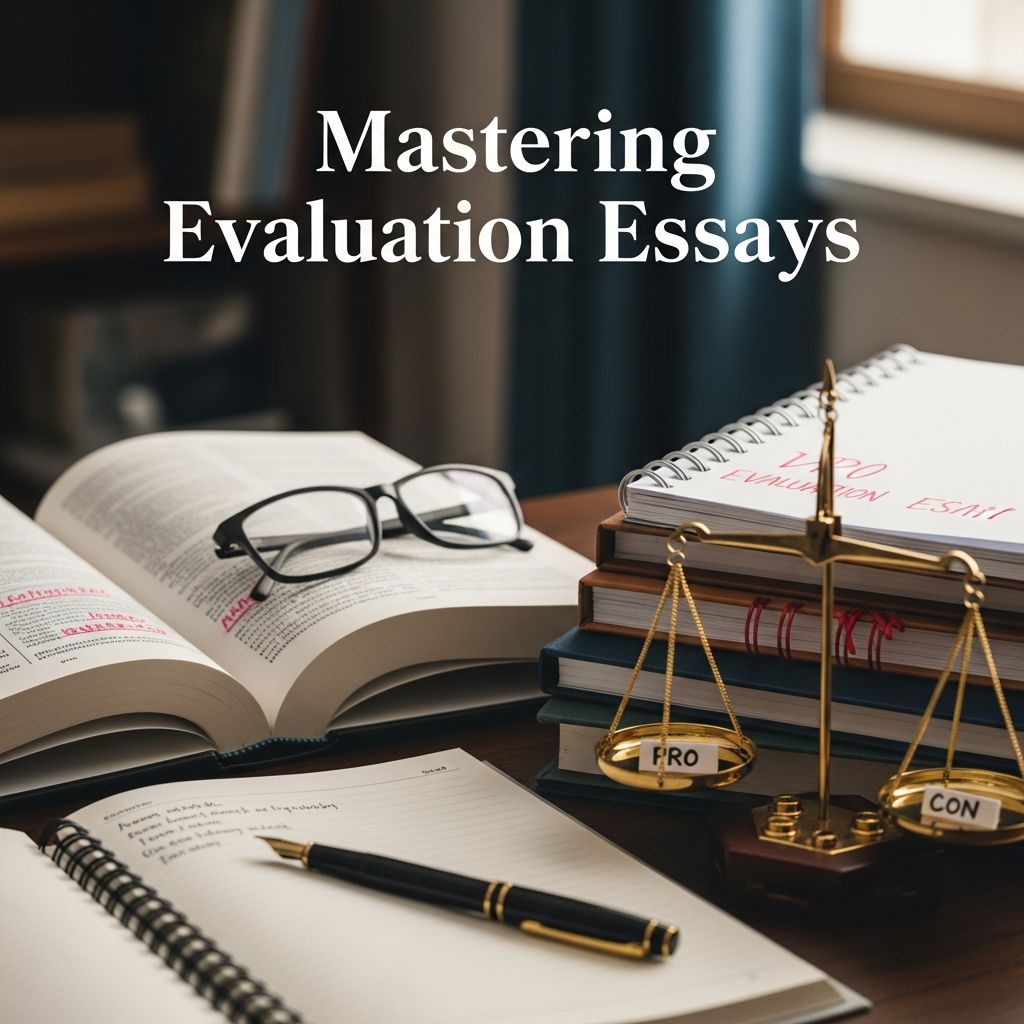
Evaluation essays challenge writers to assess subjects thoughtfully, using defined standards to form balanced judgments. These assignments sharpen critical thinking by requiring objective analysis supported by evidence, making them essential in academic and professional contexts.
Defining the Evaluation Essay
An evaluation essay systematically reviews a subject—such as a product, service, film, book, or policy—by applying specific criteria to determine its quality or effectiveness. Unlike simple opinions, it demands a structured argument where the writer explains why the subject succeeds or fails based on measurable standards. This form of writing mirrors professional reviews in journalism or consumer reports, fostering skills in logical reasoning and persuasion.
At its core, the essay balances personal insight with impartial evidence. Writers must avoid bias, instead building a case through clear metrics like performance, value, innovation, or impact. For instance, evaluating a smartphone might involve criteria such as battery life, camera quality, and user interface usability.
Core Components of Effective Evaluations
Successful evaluation essays rest on three foundational pillars: judgment, criteria, and evidence. Each plays a vital role in constructing a convincing narrative.
- Judgment: This is the writer’s overarching verdict—positive, negative, or mixed—on the subject’s merit. It appears early as the thesis and guides the entire discussion.
- Criteria: These are the benchmarks or standards used to measure the subject. They must be relevant, fair, and explicitly stated to allow readers to follow the logic.
- Evidence: Concrete support, including facts, examples, statistics, or expert quotes, validates the criteria application. Without it, judgments seem arbitrary.
Integrating these elements ensures the essay transcends subjective rants, offering credible analysis. Common pitfalls include vague criteria or unsupported claims, which undermine authority.
Choosing and Refining Your Topic
Topic selection sets the essay’s foundation. Opt for subjects with ample information and multiple evaluation angles to avoid superficial analysis. Popular categories include technology (e.g., apps or gadgets), entertainment (movies, albums), services (restaurants, online platforms), and public issues (policies, events).
Refine by asking: Does it allow clear criteria? Is evidence accessible? For example, evaluating a streaming service could use criteria like content library, streaming speed, and pricing. Avoid overly niche topics lacking data, as they limit depth.
| Topic Type | Example | Potential Criteria |
|---|---|---|
| Technology | Smartphone Model | Battery, Camera, Durability |
| Entertainment | Movie Release | Plot, Acting, Visuals |
| Service | Restaurant | Food Quality, Service, Ambiance |
| Public | City Park | Accessibility, Maintenance, Safety |
This table illustrates how diverse topics support structured evaluations, ensuring comprehensive coverage.
Structuring Your Evaluation Essay
A logical structure enhances readability and persuasiveness. Follow this blueprint for clarity.
Introduction: Hook and Thesis
Begin with context about the subject to orient readers, followed by the thesis stating your judgment and previewing criteria. Example: “Netflix excels in content variety and user experience but falls short in pricing, making it a strong yet imperfect streaming choice.” This focuses the essay immediately.
Body: Criteria-Driven Analysis
Dedicate paragraphs to each criterion, presenting evidence and analysis. Use transitions for flow. For three criteria, structure as:
- Paragraph 1: Criterion 1 + Evidence + Link to Judgment
- Paragraph 2: Criterion 2 + Evidence + Counterpoints
- Paragraph 3: Criterion 3 + Evidence + Overall Impact
Incorporate counterarguments to demonstrate balance, e.g., acknowledging a flaw while showing why strengths prevail.
Conclusion: Synthesize and Recommend
Restate the judgment, summarize key points, and offer implications or recommendations. End strongly: “Given its superior features, this smartphone merits purchase for most users.” Avoid new information.
Selecting Robust Criteria
Criteria must be tailored to the subject and audience. For objectivity, derive them from expert standards or common expectations. In academic settings, consult course guidelines or field-specific benchmarks.
Strategies include:
- Brainstorm 4-6 potential standards.
- Prioritize 3 most relevant.
- Ensure measurability (e.g., quantify speed or ratings).
For a restaurant: Food taste (subjective but evidenced by reviews), service efficiency (timed), value (price-to-portion ratio). Poor criteria like “it’s cool” fail to persuade.
Gathering and Presenting Evidence
Evidence elevates opinions to arguments. Sources include personal experience, user reviews, statistics, comparisons, and expert analyses. Cite reliably to build trust.
Presentation tips:
- Integrate seamlessly: “With a 4.8/5 rating from 10,000 users, the app’s interface proves intuitive[evidence].”
- Balance quantitative (stats) and qualitative (quotes) data.
- Compare to alternatives for context.
Writing Techniques for Impact
Employ vivid language to engage: Use sensory details for tangibles, analytical terms for abstracts. Maintain formal tone, varying sentence length for rhythm. Revise for clarity, eliminating jargon unless defined.
Address bias by questioning assumptions and seeking diverse viewpoints. Peer review helps refine arguments.
Common Mistakes and How to Avoid Them
Writers often falter by:
- Skipping criteria definition—always list explicitly.
- Over-relying on emotion—prioritize logic.
- Ignoring counterpoints—briefly refute for credibility.
- Weak conclusions—reinforce without repeating.
Proofread for coherence; use outlines to stay on track.
Real-World Applications
Beyond academia, evaluation skills aid career reviews, product feedback, and policy analysis. Newspapers and magazines rely on this format for editorials, honing high-order thinking.
Frequently Asked Questions (FAQs)
What distinguishes an evaluation essay from a review?
Reviews are informal and opinion-heavy; evaluation essays use structured criteria and evidence for objective judgment.
How many criteria should I use?
Typically 3-5, ensuring depth without overwhelming the essay.
Can I use first-person?
Yes, for personal experience, but balance with objective evidence.
What if evidence contradicts my judgment?
Acknowledge it, adjust if needed, or explain why it doesn’t outweigh positives.
How long should an evaluation essay be?
Usually 500-1000 words, depending on assignment, with body comprising 70%.
Practice Prompts for Skill Building
- Evaluate your favorite social media platform.
- Assess a recent blockbuster film.
- Review an online learning tool.
These build confidence through application.
References
- Evaluation Essay Definition, Example & Parts — Study.com. 2023. https://study.com/academy/lesson/evaluative-essay-examples-format-characteristics.html
- 4.4 Evaluation – English Composition — University of Hawaii Pressbooks (.edu). 2022-01-15. https://pressbooks.oer.hawaii.edu/englishcomposition/chapter/evaluation/
- How to Write an Evaluation Essay Step-by-Step With Samples — Academized. 2024. https://academized.com/blog/evaluation-essay
- Evaluation Essays – English 101: Journey Into Open — Maricopa Community Colleges (.edu). 2023. https://open.maricopa.edu/english101open/chapter/evaluation-essays/
- Writing The Evaluation Essay — State Fair Community College (.edu). 2022. https://www.sfccmo.edu/files/admissions/college-now/nsf-ate-grant/evaluation-essay-kate-herrington.pdf
- Quick Guide to an Evaluation Essay — University of Nevada, Reno Writing & Speaking Center (.edu). 2023-05-10. https://www.unr.edu/writing-speaking-center/writing-speaking-resources/quick-guide-to-an-evaluation-essay

- Integrated M.A. in Applied Linguistics, University of Hyderabad
- 5+ years in editorial, instructional, SEO, and research-based writing
Sneha is a relationships and lifestyle writer with a strong foundation in applied linguistics and certified training in relationship coaching. She brings over five years of writing experience to theskillvault, crafting thoughtful, research-driven content that empowers readers to build healthier relationships, boost emotional well-being, and embrace holistic living. Her writing and insights reflect the belief that beauty, happiness, and wellness…