
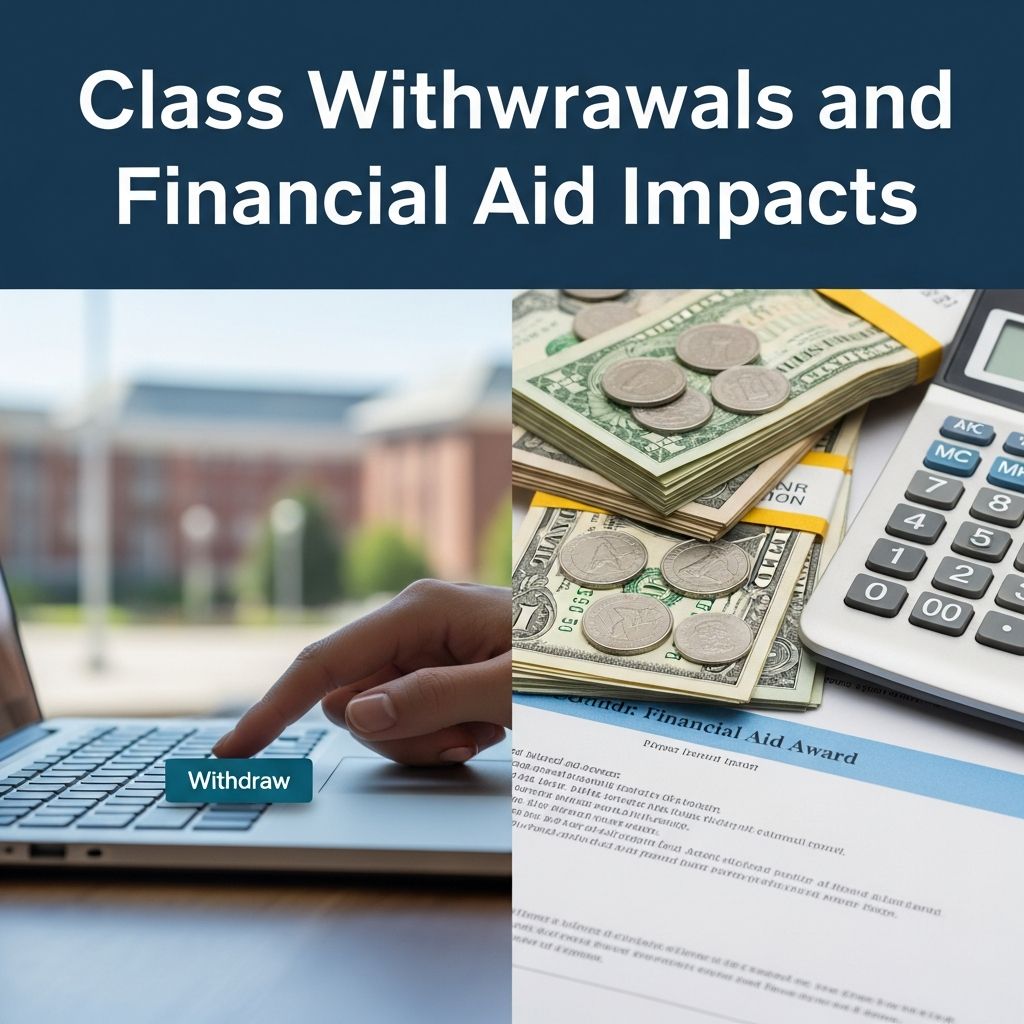
Deciding to withdraw from a college course is a significant choice that extends beyond academics, directly influencing financial aid packages. Federal regulations tie aid eligibility to enrollment and academic performance metrics, meaning course changes can trigger recalculations or losses of funding. This comprehensive guide explores these dynamics, helping students navigate potential pitfalls while maintaining funding stability.
Understanding Enrollment Status Thresholds
Colleges classify students based on credit hours: full-time typically requires 12 or more credits, half-time 6-11, and less than that part-time or non-enrolled. Dropping below these levels after aid disbursement prompts aid offices to adjust awards proportionally. For instance, shifting from full-time to part-time might reduce loan or grant amounts, as aid is calibrated to anticipated needs.
- Full-time: 12+ credits – Maximizes Pell Grants, loans, and work-study.
- Half-time: 6-11 credits – Qualifies for reduced aid portions.
- Less than half-time: Under 6 credits – Often ineligible for most federal aid.
A table illustrates common impacts:
| Status Change | Aid Type Affected | Potential Outcome |
|---|---|---|
| Full to Half-Time | Pell Grants, Subsidized Loans | Reduction; possible repayment |
| Half to Less Than Half | All Federal Aid | Cancellation or full repayment |
| No Status Change | N/A | Usually unaffected |
Always verify your school’s specific credit definitions before acting.
Satisfactory Academic Progress: The Core Standard
Satisfactory Academic Progress (SAP) is a federal mandate requiring students to meet GPA, completion rate, and degree progression benchmarks annually. Withdrawals count against completion rates—typically needing 67% of attempted credits passed—potentially placing students on warning, probation, or suspension. A single withdrawal might not derail SAP if overall metrics hold, but repeated ones accumulate risk.
SAP evaluations occur at semester’s end, factoring withdrawals as attempted but not earned credits. Schools set unique paces, like completing degree requirements within 150% of program length. Falling short jeopardizes all aid renewal.
Key SAP Components
- GPA Minimum: Often 2.0 cumulative.
- Completion Ratio: 67% attempted credits passed.
- Maximum Timeframe: 150% of program credits.
Proactive monitoring via student portals prevents surprises.
Return of Title IV Funds Calculation
Federal law (Title IV) presumes students earn aid daily over the term. Withdrawing before 60% completion means unearned portions must return, starting with grants then loans. Formula: (Days Attended / Total Days) x Aid Disbursed = Earned Aid. Post-60%, all aid is earned—no repayment.
Example: 100-day term, withdraw on day 40. Earned: 40%. If $5,000 disbursed, repay $3,000. Schools handle calculations, notifying via portals. Grants repaid first can create balances owed to institutions.
Difference Between Dropping and Withdrawing
“Dropping” occurs pre-deadline (often week 2), erasing the course from records—no tuition, no transcript mark, no aid impact. “Withdrawing” post-deadline adds a “W,” charges tuition, notes transcript, and risks aid adjustments per above rules. Distinction is crucial; check calendars.
| Action | Timing | Transcript | Tuition | Aid Impact |
|---|---|---|---|---|
| Drop | Early semester | None | Refunded | None |
| Withdraw | Late semester | “W” grade | Charged | Possible |
Consequences for Loans and Scholarships
Federal loans enter grace periods upon half-time drop, starting repayment clocks. Private scholarships often mirror SAP or credit minima; institutional ones vary. State aid like lotteries demands full-time status. Multiple withdrawals amplify risks, potentially exhausting appeals.
Transcript “W”s signal patterns to grad schools or employers, though not GPA-harming.
Strategies to Protect Your Aid
- Consult Advisors Early: Discuss with financial aid offices pre-withdrawal.
- Timing Matters: Post-60% point minimizes Return calculations.
- Appeal Options: Document hardships (illness, family) for SAP reinstatement.
- Alternatives: Incomplete grades or reduced loads via advisors.
- Track Progress: Use portals for real-time SAP/enrollment views.
Building relationships with aid staff unlocks flexibility.
Full vs. Partial Withdrawals: Risk Levels
Single-class withdrawal seldom disrupts if status/SAP intact—common after 60% term. Multiple or full withdrawals trigger intense scrutiny: full-term exit mandates full Return calc, often owing thousands. Unofficial (stop attending) yields “F”s, worse for SAP/GPA.
Partial: Monitor credits. Full: Expect aid loss, repayment, future ineligibility.
Institutional Variations and Policies
While federal rules standardize much, schools customize SAP paces, deadlines, appeal processes. Community colleges might tolerate more withdrawals; universities stricter. Review handbooks or query offices.
Long-Term Academic and Career Ramifications
Excessive “W”s delay graduation, inflate costs, signal inconsistency. Balance withdrawals with successes; one per term often manageable. Advisors help replan paths.
Frequently Asked Questions
Will withdrawing from one class cancel my entire aid package?
No, typically not if enrollment status and SAP remain met. Single late-semester withdrawals post-60% point are low-risk.
Do I repay aid for withdrawn classes?
Possibly, if below 60% term or status drops. Grants repaid first; loans later.
Does a withdrawal lower my GPA?
No direct impact—”W” is neutral. But completion rate suffers for SAP.
Can I appeal financial aid loss after withdrawal?
Yes, with documented extenuating circumstances via school processes.
What if I stop attending without official withdrawal?
Counts as unofficial; results in “F”s, harming SAP/GPA worse than “W”.
How soon must I repay unearned aid?
Schools notify; grants within 45 days, loans per terms.
This guide empowers informed decisions. Prioritize consultations to safeguard education funding.
References
- How Does Withdrawing From a Class Affect Financial Aid? — Scholarships360. 2023. https://scholarships360.org/financial-aid/how-does-withdrawing-from-a-class-affect-financial-aid/
- Impact of Withdrawal on Students Receiving Federal Financial Aid — University of Alabama Student Accounts. 2024. https://studentaccounts.ua.edu/impact-of-withdrawal-on-students-receiving-federal-financial-aid/
- The Impact of Withdrawing on Current and Future Financial Aid — SUNY Empire State University. 2024. https://student-accounts.sunyempire.edu/student-accounts/withdrawals/withdrawal-impact-financial-aid/
- What happens to financial aid if you drop a class? — College Raptor. 2023. https://www.collegeraptor.com/paying-for-college/articles/questions-answers/what-happens-to-financial-aid-if-you-drop-a-class/
- Effects of Withdrawing or Not Attending Class — Frederick Community College. 2023. https://frederick-public.courseleaf.com/financial-aid/effects-withdrawing-attending-class/effects-withdrawing-attending-class.pdf
- Effect of Withdrawal on Eligibility — University of South Carolina Palmetto College. 2024. https://sc.edu/about/system_and_campuses/palmetto_college/internal/financial_aid/eligibility/effect_of_withdrawal_on_eligibility/
- Withdrawals and the Return of Title IV Funds — Federal Student Aid (ED.gov). 2021-02-01. https://fsapartners.ed.gov/sites/default/files/2021-02/1617FSAHbkVol5Ch1.pdf

Medha Deb is an editor with a master's degree in Applied Linguistics from the University of Hyderabad. She believes that her qualification has helped her develop a deep understanding of language and its application in various contexts. Medha specializes in the areas of beauty, health, sports, and wellness and is committed to ensuring that the content on the website is…