
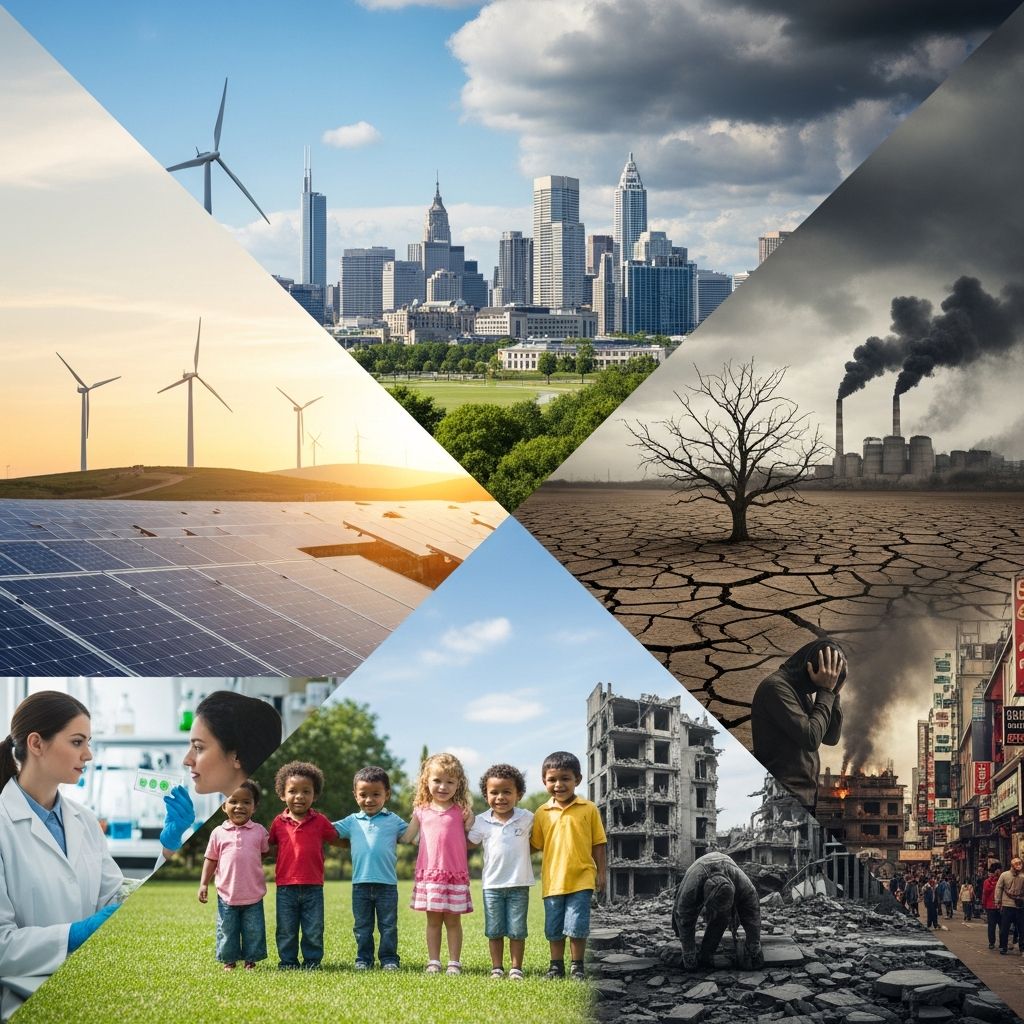
Whether the world is improving or deteriorating depends heavily on which trends you look at and over what time frame. Over the past century, humanity has made extraordinary gains in health, wealth, and knowledge, while also creating new global threats that could undo that progress.
This article uses empirical data from high-quality international sources to unpack the paradox: how the world can be both better than ever and in serious danger at the same time.
1. How to Think Clearly About Global Progress
Before asking whether things are improving, it helps to clarify what we are measuring and how we reason about change.
1.1 Common pitfalls in judging the state of the world
- News bias: News focuses on sudden disasters and conflicts, not gradual improvements like rising literacy or declining child mortality.
- Short time horizons: Looking at only the past 5–10 years can hide century-scale improvements or structural risks building slowly.
- Selective metrics: Focusing on one indicator (e.g., GDP, or CO2 emissions) can give a distorted picture if others move in the opposite direction.
- Emotional salience: Shocking events (pandemics, wars, disasters) loom larger in our minds than less visible progress (vaccination campaigns, infrastructure, institutions).
A more reliable approach is to combine long-run historical data with current risk assessments. That means asking both:
- “How have key human outcomes changed over decades or centuries?”
- “What is the probability of large-scale catastrophes in the future?”
1.2 A simple framework: past, present, future
| Time frame | Main question | Typical answer (based on data) |
|---|---|---|
| Past → Now | Have core human outcomes improved over decades? | Yes, very substantially, in health, poverty, education, and rights. |
| Now → 2030 | Are we on track for agreed global targets (SDGs)? | Mostly no; many targets are off track, stalled, or regressing. |
| Now → centuries ahead | Could we face catastrophic or existential risks? | Yes; new technologies and environmental pressures create serious upside and downside risks. |
2. Areas Where Humanity Has Dramatically Improved
On long timescales, the world has become far better for most people. Key measures of well-being have improved in ways that would be astonishing to previous generations.
2.1 Health: from high mortality to longer lives
- Life expectancy: Global average life expectancy roughly doubled over the 20th century, driven by vaccines, antibiotics, sanitation, and better nutrition. The World Health Organization’s work on universal health coverage and disease control continues to push this forward, although progress has slowed in some regions.
- Child mortality: Child deaths have fallen sharply worldwide as immunisation, maternal care, and basic health services expanded.
- Infectious disease control: Eradication of smallpox, major reductions in polio, and better treatment for HIV, tuberculosis, and malaria have saved many millions of lives.
These gains mean that for a typical person today, surviving childhood and reaching old age is far more likely than it was for their grandparents or great-grandparents.
2.2 Poverty and material living standards
Over the past 30–40 years, hundreds of millions of people have escaped extreme income poverty, aided by economic growth, trade, and development policies. The World Bank’s global monitoring of the Sustainable Development Goals documents substantial long-run progress on SDG 1 (No Poverty), even though recent crises have reversed some gains in the short term.
Beyond income, several aspects of material well-being have improved:
- Greater access to electricity and modern energy.
- Expansion of safe drinking water and basic sanitation.
- More people covered by social protection systems and financial services.
2.3 Education and information access
- Enrollment and literacy: Participation in primary education is now near universal in many parts of the world, and global literacy has risen substantially over the last century.
- Digital connectivity: Access to the internet and mobile communication has expanded rapidly, allowing billions of people to share information, learn skills, and participate in global conversations.
These changes expand people’s capabilities: not just to survive, but to pursue education, work, and civic participation.
2.4 Rights, safety, and governance (with caveats)
Over the long run, many forms of legal discrimination and institutionalised violence have been reduced. Some indicators related to crime and corruption also show improvements:
- Declining bribery rates: A recent global progress report on Sustainable Development Goal 16 (peace, justice, and strong institutions) found that the share of people paying bribes fell from 18.3% in 2010 to 17.0% in 2023 on average, indicating gradual progress in some areas of governance.
- Institutional frameworks: More countries have adopted formal commitments to human rights, anti-corruption standards, and rule-of-law reforms, though implementation is uneven.
However, as we will see later, some of these gains are fragile and under threat from conflict, democratic backsliding, and weakening institutions.
3. Where Progress Has Stalled or Is Going Backwards
Despite these broad improvements, recent data on the Sustainable Development Goals (SDGs) highlight a worrying loss of momentum.
3.1 The SDG scorecard: off track at the halfway mark
The United Nations’ 2023 SDG Progress Chart assesses trends across 169 targets under 17 goals, using data from 2015 (the baseline year) to the most recent available.
- Only 15% of assessable SDG targets are on track to be achieved by 2030.
- 48% are moderately or severely off track from the trajectories needed to reach their targets.
- 37% show no progress or have actually regressed below the 2015 baseline.
These figures reflect disruptions from the COVID-19 pandemic, economic shocks, rising conflicts, and climate-related disasters, but they also reveal deeper structural challenges.
3.2 Inequality, conflict, and governance setbacks
The first Global Progress Report on SDG 16 paints a mixed and often troubling picture:
- Civilian deaths in conflict: Civilian fatalities in armed conflicts rose sharply between 2022 and 2023, with a 72% increase, reaching the highest level recorded in recent years.
- Slow progress on violence reduction: Targets such as halving homicide rates are far from being achieved in many contexts.
- Rule of law and trust: Weak institutions, corruption, and limited access to justice persist in many countries, undermining the foundations for long-term progress.
Rising tensions and fragility not only harm people directly, but also make it harder to cooperate on shared global problems like climate change or pandemics.
3.3 Climate change and environmental degradation
On environmental dimensions, the current trajectory is deeply concerning:
- Greenhouse gas emissions: Global emissions remain high and are not yet on a path consistent with limiting warming to 1.5°C, despite some growth in renewable energy capacity.
- SDGs on climate, oceans, and biodiversity: The SDG progress chart shows that many targets related to climate action (Goal 13), life below water (Goal 14), and life on land (Goal 15) are off track or regressing, reflecting continued ecosystem loss and unsustainable resource use.
These trends may not show up immediately in life expectancy or income statistics, but they increase the risk of severe future harms through extreme weather, food insecurity, displacement, and conflict.
4. Why Both Optimism and Alarm Are Reasonable
How can we reconcile extraordinary long-term improvements with sobering near-term indicators and rising global risks? A key insight is that:
- Humanity’s capabilities have grown faster than ever—science, technology, coordination, and wealth.
- The power of our mistakes has also grown—we can now cause much larger harms, more quickly, and on a global scale.
4.1 Positive feedback: why past gains matter
Past progress is not just a “nice story”; it provides tools to address our current crises:
- Better health systems and surveillance increase our ability to detect and respond to pandemics.
- Richer, more educated societies have more resources and expertise to invest in clean energy, adaptation, and innovation.
- International institutions and data systems (like the SDG framework) give us a shared language for tracking problems and coordinating responses.
From this perspective, historical improvements are evidence that large-scale progress is possible when knowledge, incentives, and institutions align.
4.2 Negative feedback: how new risks grow with power
At the same time, many of our achievements amplify systemic risks:
- Advanced industrial activity increases greenhouse gas emissions and intensifies climate risks.
- Highly interconnected economies and transport networks make the world more vulnerable to fast-spreading shocks, such as financial crises or novel pathogens.
- Powerful emerging technologies (from bioengineering to AI) could bring enormous benefits but also new pathways to catastrophic or even existential harm if misused or poorly governed.
This dual nature of progress means that simply asking “better or worse?” is too crude. We live in a world where typical daily life is better for most people than in the past, while the tail risks—low-probability, high-impact disasters—may be more serious than ever.
5. What the Data Suggest About Our Future
Global trajectories are not fixed. The SDG assessments and other international reports highlight both the dangers of continuing on our current path and the opportunities for course correction.
5.1 Lessons from the SDG midpoint
The 2023 midpoint review of the SDGs emphasizes that without major changes, many 2030 targets will be missed. Yet it also identifies drivers that can accelerate progress:
- Targeted investments in health, education, and social protection can deliver large, measurable gains quickly.
- Clean energy transitions can reduce emissions while improving air quality and energy access, creating a “triple dividend” of climate, health, and development benefits.
- Strengthened institutions and reduced corruption improve the effectiveness of all other interventions.
The main message is not that progress has failed, but that effort and policy choices matter enormously. Long-term trends can bend upward or downward depending on what governments, organisations, and citizens do now.
5.2 Strategic priorities for safeguarding progress
To ensure that the world is “getting better” in a robust, long-lasting sense, many analysts argue for focusing on issues that combine large scale, neglectedness, and tractability. Examples include:
- Strengthening global health systems and pandemic preparedness to prevent or mitigate future health crises.
- Accelerating decarbonisation and climate adaptation, particularly in vulnerable regions.
- Improving peace, justice, and institutions (SDG 16) to reduce conflict, corruption, and instability that derail development.
- Developing safeguards and governance for powerful emerging technologies, so that innovation reduces rather than amplifies catastrophic risks.
These priorities build on the capabilities created by previous progress while directly addressing the main threats that could undermine it.
6. Practical Takeaways: How to Interpret “Is the World Getting Better?”
When confronting headlines or statistics about the world, the following rules of thumb can help keep your judgments grounded:
- Separate levels from trends: Recognise that many indicators are at their best levels in history (e.g., average life expectancy), even if short-term trends have stalled or reversed.
- Distinguish personal experience from global averages: Conditions can improve globally while deteriorating in specific countries or communities.
- Pay attention to tail risks: Even if average outcomes look good, small probabilities of very bad events (e.g., large-scale conflicts, pandemics, or climate tipping points) deserve serious attention.
- Use multiple indicators: No single measure (GDP, emissions, life expectancy) can fully capture whether the world is doing well overall.
Under this lens, the most accurate summary is that the world is simultaneously:
- Better than ever for many people in everyday life.
- Off track on many shared goals for 2030.
- Facing serious long-term risks that require deliberate action now.
Frequently Asked Questions (FAQs)
Q1: If the SDGs are off track, does that mean previous progress was an illusion?
No. Historical improvements in health, education, and poverty reduction are well-documented and substantial. The fact that many SDG targets are currently off track means recent crises and structural problems have slowed or reversed some trends, not that past gains did not occur.
Q2: How did COVID-19 affect whether the world is getting better or worse?
The pandemic temporarily reduced life expectancy in several regions, pushed millions back into poverty, and disrupted education, contributing to the stalling of SDG progress. However, it also demonstrated the value of global health systems, rapid vaccine development, and data sharing, which are part of the broader story of long-term progress.
Q3: Are younger generations worse off than older ones?
Young people today benefit from higher average education levels and better access to technology than earlier generations, but they also face high housing costs in some countries, labour market uncertainty, and heightened climate and conflict risks. Indices tracking youth well-being over time show improvements in many dimensions but also indicate that progress has stalled or reversed in some countries, signalling a need for renewed efforts focused on youth.
Q4: Can individual choices really influence global trends?
Most large-scale progress results from institutions, policies, and technologies. Individuals influence these indirectly by voting, advocacy, career choices, research, and philanthropy. Many impactful actions involve helping to build or reform systems that shape outcomes for millions of people.
Q5: So, is it more rational to be optimistic or pessimistic?
It is most rational to be conditionally hopeful: recognise the enormous improvements already achieved, take seriously the evidence that many goals are off track and that new risks are growing, and then focus on actions that can meaningfully improve our trajectory.
References
- The Sustainable Development Goals Progress Chart 2023 — United Nations Department of Economic and Social Affairs (UN DESA). 2023-07-10. https://unstats.un.org/sdgs/report/2023/progress-chart/
- The Sustainable Development Goals Report 2023: Special Edition — United Nations. 2023-07-10. https://unstats.un.org/sdgs/report/2023/
- Youth Progress Index 2023 — European Youth Forum & partners. 2023-09-01. https://www.youthforum.org/policy-library/youth-progress-index-2023
- Global Progress Report on Sustainable Development Goal 16 Indicators — UNDP, UNHCR, UNODC. 2024-07-01. https://www.undp.org/publications/global-progress-report-sdg-16-indicators
- 2023 Progress Report on the Global Action Plan for Healthy Lives and Well-being for All (SDG3 GAP) — World Health Organization. 2023-09-18. https://www.who.int/publications/i/item/9789240073371
- Atlas of Sustainable Development Goals 2023 — World Bank. 2023-05-24. https://datatopics.worldbank.org/sdgatlas/
- SDG Tracker: Measuring progress towards the Sustainable Development Goals — Our World in Data. 2023-01-01. https://ourworldindata.org/sdgs

Medha Deb is an editor with a master's degree in Applied Linguistics from the University of Hyderabad. She believes that her qualification has helped her develop a deep understanding of language and its application in various contexts. Medha specializes in the areas of beauty, health, sports, and wellness and is committed to ensuring that the content on the website is…