
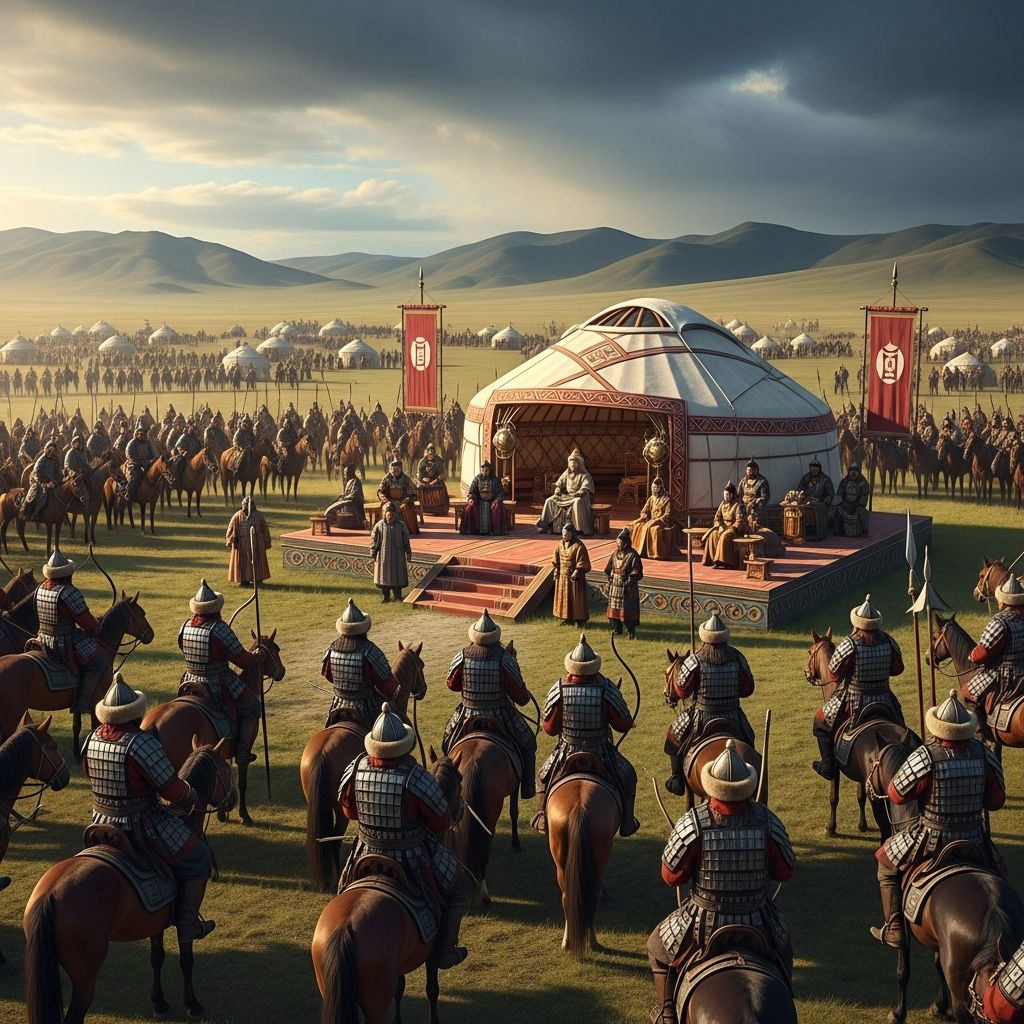
The kurultai stands as a cornerstone of steppe nomadic society, representing a unique form of collective leadership that propelled the Mongol Empire to unprecedented heights. These assemblies brought together elite warriors, clan heads, and influential figures to deliberate on war, succession, and governance, embodying a blend of democracy and hierarchy in the vast Eurasian grasslands.
Roots in the Steppe Traditions
Emerging from ancient Turkic and Mongol customs, the kurultai—derived from roots meaning ‘to assemble’—evolved as a vital institution for nomadic peoples. Long before centralized states dominated Eurasia, these gatherings ensured survival in harsh environments by fostering unity among scattered tribes. Participants, including princes, military commanders, spiritual advisors, and even high-ranking women, convened under open skies or near sacred rivers to address collective needs.
Seating arrangements reflected strict social order, with the most prestigious at the center. Days unfolded with rituals: sharing kumis (fermented mare’s milk), feasting on roasted meats, and exchanging ceremonial toasts. Entertainment like wrestling matches, archery contests, and epic recitations reinforced bonds and hierarchy, turning the event into a multifaceted cultural spectacle.
The Game-Changing 1206 Gathering
No kurultai resonates more profoundly than the one held in 1206 at the Onon River’s source. Here, Temujin, a resilient warrior who had overcome betrayal and exile, was elevated to Genghis Khan, the ‘Universal Ruler.’ This assembly unified fractious Mongol tribes, marking the Mongol Empire’s birth. Chiefs raised the nine-tailed white banner, symbolizing authority, and pledged allegiance through consensus.
Beyond proclamation, the meeting served strategic purposes. Genghis outlined military reforms, restructured the decimal-based army (units of 10, 100, 1,000, and 10,000), and introduced the Yassa code’s foundational laws. This democratic veneer—where nobles debated and voted—lent immense legitimacy, transforming personal ambition into empire-wide mandate.
Mechanisms of Power and Influence
Kurultais operated without written records, relying on oral tradition for policy enforcement. They assigned key roles, plotted campaigns, and redistributed spoils, blending consultation with the khan’s will. While appearing egalitarian, dominance by noble families underscored elite control.
- Leadership Selection: Elected khans gained divine-like sanction, crucial for loyalty.
- Military Planning: Campaigns against Jin China or Khwarezm were strategized here.
- Legal Framework: Enforced hierarchies while allowing flexible consensus.
Women, though not always voting, wielded influence as clan matriarchs or advisors, highlighting gender dynamics in nomadic politics.
Evolution Through the Empire’s Golden Age
Post-Genghis, kurultais sustained the empire. After his 1227 death, nobles convened to elect Ögedei as successor, averting chaos. Similar assemblies followed Möngke’s 1259 passing, though interregnums stalled invasions—like withdrawals from Europe and the Middle East.
Under subordinate leaders, smaller kurultais managed regional affairs, adapting to conquered lands by incorporating local elites. This flexibility aided governance over diverse populations from Persia to Korea.
| Kurultai Event | Year | Key Outcome |
|---|---|---|
| Genghis Khan’s Election | 1206 | Unification of tribes; empire foundation |
| Ögedei’s Succession | 1229 | Continued expansion; stability |
| Möngke’s Election | 1251 | Revived conquests in Middle East |
Decline and Transformative Legacy
By the 14th century, as the empire fragmented into khanates, grand kurultais waned amid civil wars and sedentarization. Yet, their essence persisted in successor states like the Timurids.
In modern Central Asia, the tradition endures symbolically and politically:
- Kazakhstan: World Kurultai of Kazakhs (1992 onward) unites diaspora for cultural preservation.
- Mongolia: State Great Khural parliament echoes ‘khural’ (assembly).
- Kyrgyzstan: Informal qurultais during crises express public will.
- Russia: Bashkortostan’s State Assembly Kurultai; Buryatia’s People’s Khural.
Hungary’s Kurultáj revives it through festivals with throat singing, reenactments, and heritage displays. This revival underscores self-governance roots predating modern parliaments.
Comparing Kurultai to Western Institutions
| Aspect | Kurultai | Western Parliament |
|---|---|---|
| Structure | Oral, elite consensus | Written laws, elected reps |
| Venue | Open steppe | Fixed buildings |
| Focus | War, succession | Legislation, budgets |
| Participation | Nobles, warriors | Broad electorate |
Though less formalized, kurultais offered pragmatic adaptability suited to mobility.
Frequently Asked Questions (FAQs)
What defined a traditional kurultai?
A kurultai was an assembly of Mongol and Turkic elites for deciding leadership, wars, and policies through debate and consensus.
How did the 1206 kurultai change history?
It proclaimed Genghis Khan, unifying tribes and launching the world’s largest contiguous empire.
Who could participate in these assemblies?
Primarily nobility, military leaders, princes, and influential women; up to thousands attended major ones.
Do kurultais exist today?
Yes, in adapted forms like Kazakhstan’s cultural gatherings and regional parliaments in Russia and Mongolia.
Why did kurultais decline?
Empire fragmentation, urbanization, and rise of dynastic rule diminished their necessity by the 14th century.
Modern Revivals and Cultural Resonance
Today, kurultais symbolize resilience. Kazakhstan’s events foster pan-Kazakh identity amid globalization. Mongolia’s Khural integrates democratic elections with tradition. These echo the original’s role in crisis resolution and unity.
Scholars view kurultais as proto-parliaments, proving nomadic societies developed sophisticated governance. Their legacy challenges stereotypes of ‘barbarian’ hordes, revealing structured politics.
In Hungary, annual Kurultáj draws thousands for nomadic heritage, blending education with spectacle—mounted warriors, ancient crafts, and multilingual forums. This global interest highlights universal appeal of collective wisdom.
Broader Impacts on Eurasian History
Kurultais influenced beyond Mongolia. Kazakh Khanate used them for disputes and defense. Post-Soviet states revived them for nation-building, linking past to present.
During empire zenith, they enabled rapid adaptation: post-Ögedei, expansions reached Europe; Möngke’s assembly targeted Song China. Delays in succession, however, exposed vulnerabilities, as in 1241 European retreats.
Economically, assemblies redistributed wealth from conquests, funding further campaigns and stabilizing alliances. Socially, they codified meritocracy, elevating capable leaders over birthright alone.
Understanding kurultais illuminates why nomads conquered sedentary empires: through inclusive yet decisive forums, they harnessed tribal energies into imperial might.
References
- What was the significance of the kurultai in Genghis Khan’s ascent? — TutorChase. 2023. https://www.tutorchase.com/answers/ib/history/what-was-the-significance-of-the-kurultai-in-genghis-khan-s-ascent
- Kurultai — Wikipedia. 2023-10-01. https://en.wikipedia.org/wiki/Kurultai
- Nomadic Institutions: The Origins of Kurultai — IFEAC. 2022-05-15. https://ifeac.hypotheses.org/15876
- Kurultai: World History – Before 1500 Study Guide — Fiveable. 2024. https://fiveable.me/world-history-to-1500/key-terms/kurultai
- What is a qurultay and which nations still hold it? — Qazinform. 2023-09-20. https://qazinform.com/news/what-is-a-qurultay-and-which-nations-still-hold-it-cce145
- Mongol empire – Relative Unity, 1227-60 — Britannica. 2024-01-12. https://www.britannica.com/place/Mongol-empire/The-period-of-relative-unity-1227-60

- Integrated M.A. in Applied Linguistics, University of Hyderabad
- 5+ years in editorial, instructional, SEO, and research-based writing
Sneha is a relationships and lifestyle writer with a strong foundation in applied linguistics and certified training in relationship coaching. She brings over five years of writing experience to theskillvault, crafting thoughtful, research-driven content that empowers readers to build healthier relationships, boost emotional well-being, and embrace holistic living. Her writing and insights reflect the belief that beauty, happiness, and wellness…