
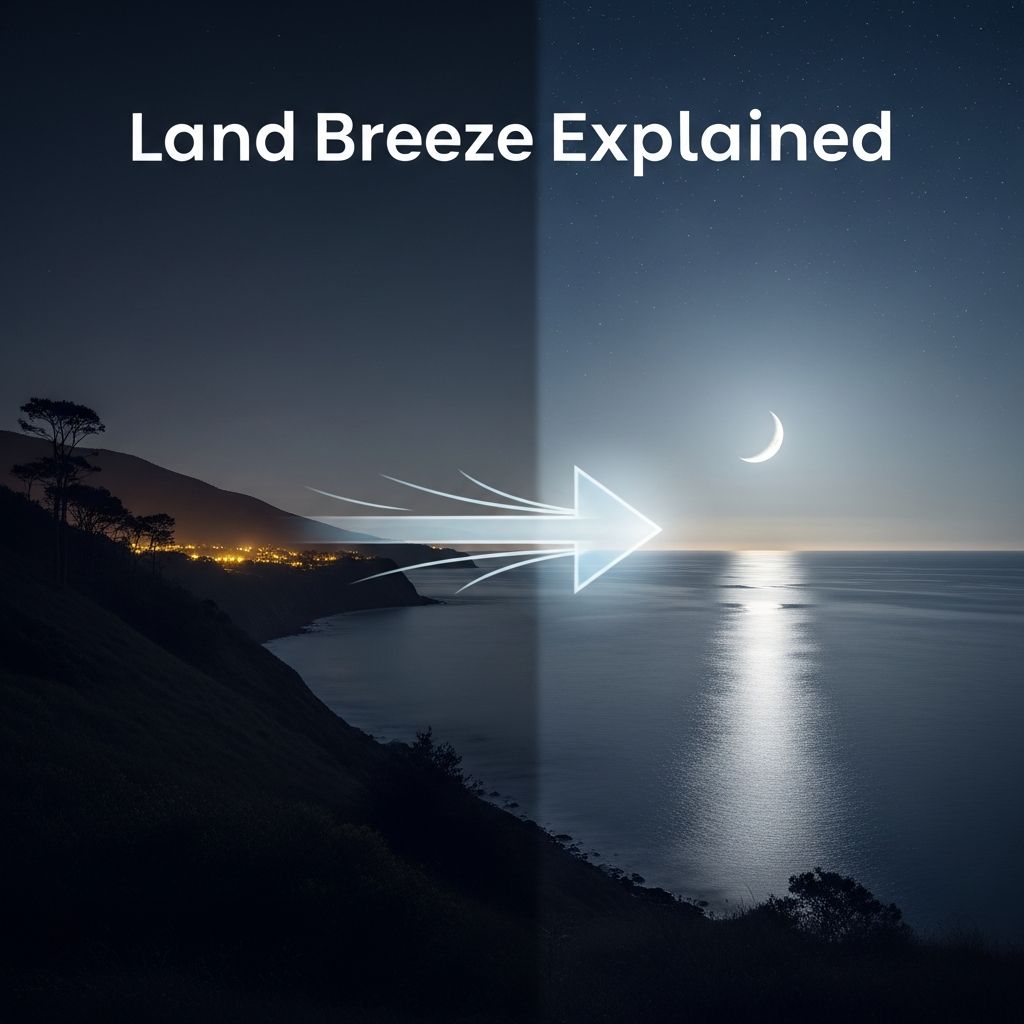
Land breezes represent a fascinating local wind phenomenon occurring along coastlines, where cooler air over land flows toward warmer waters at night. This process arises from differential cooling rates between terrestrial surfaces and adjacent oceans or lakes, creating pressure gradients that drive airflow.
The Fundamental Mechanics of Land Breeze Formation
At sunset, land surfaces rapidly lose heat accumulated during the day, cooling faster than nearby water bodies due to lower heat capacity. Water retains warmth longer, maintaining higher temperatures overnight. This contrast leads to denser, cooler air sinking over land, forming a high-pressure zone, while warmer air over water rises, generating lower pressure.
Air naturally moves from high to low pressure, resulting in wind directed from land seaward. Unlike daytime sea breezes, land breezes develop in shallower atmospheric layers because nocturnal cooling is confined near the surface, limited by an inversion layer aloft.
- Key Triggers: Nighttime dominance, clear skies enhancing radiational cooling, and proximity to large water bodies.
- Typical Conditions: Strongest in fall and winter when water remains relatively warm compared to chilled land.
- Depth and Strength: Shallower (often under 1 km) and weaker (8-10 knots) than sea breezes due to surface friction from terrain and vegetation.
Contrasting Land Breezes with Sea Breezes
Sea and land breezes form a diurnal cycle along coasts. Daytime solar heating warms land quicker, spawning sea breezes (ocean to land), which reverse into land breezes post-sunset.
| Aspect | Land Breeze | Sea Breeze |
|---|---|---|
| Time of Occurrence | Night/Early Morning | Daytime/Afternoon |
| Direction | Land to Sea | Sea to Land |
| Driving Force | Land cools faster than sea | Land heats faster than sea |
| Wind Speed | 8-10 knots (weaker) | 10-20 knots (stronger) |
| Humidity | Dry | Humid |
| Depth | Shallow (<1-2 km) | Deeper (up to 2-3 km) |
This table highlights core distinctions, underscoring how daily temperature cycles dictate wind regimes.
Atmospheric Dynamics and Vertical Structure
Land breeze circulation involves surface outflow from land, converging over water to form ascending currents. This low-level convergence promotes cloud formation offshore, often visible as nocturnal marine stratus dissipating with morning sea breezes.
Above the surface, return flow aloft completes the circulation cell. However, nighttime stability—caused by radiational cooling—suppresses vertical mixing, keeping the system shallow. Friction from coastal features further dampens speeds.
In mathematical terms, the pressure gradient force (\( abla P / \rho \)) propels the breeze, balanced by Coriolis (minor at local scales) and frictional forces. For coastal zones, breeze extent rarely exceeds 10-20 km offshore.
Seasonal and Geographic Influences
Land breezes peak in transitional seasons like autumn and winter, when lingering ocean warmth contrasts sharply with cooling land. Summer nights may see muted effects due to comparable temperatures.
Geographically, they thrive near large water bodies—think Great Lakes, Mediterranean coasts, or Florida’s shores. Inland seas or lakes produce analogous ‘lake breezes.’ Topography matters: flat coasts enhance flows, while cliffs disrupt them.
- Global Examples:
- Mediterranean: Regular in summer nights, aiding sailing.
- US East Coast: Influences overnight fog patterns.
- Tropical Islands: Modulates local climates.
Impacts on Ecosystems, Navigation, and Daily Life
Land breezes transport drier continental air seaward, reducing coastal humidity and fostering clearer offshore conditions. This aids nocturnal cloud development but disperses with dawn.
For mariners, they provide predictable tailwinds for offshore voyages but challenge nearshore anchoring due to variable convergence. Fishermen leverage them for calmer seas.
Ecologically, they mix air masses, influencing pollutant dispersion and bird migration. In urban coasts, they carry city lights’ glow offshore, creating unique bioluminescent contrasts with warmer waters.
Observational Evidence and Measurement
Modern tools like buoys from NOAA’s National Data Buoy Center confirm land breeze signatures: falling temperatures onshore, offshore winds post-midnight.
Satellite imagery reveals offshore cloud streets aligned with breezes. Anemometers at coastal stations log speeds peaking 2-4 AM, aligning with maximum land-sea temperature deltas (often 3-5°C).
Climate Change Considerations
Warming oceans may intensify land breezes by widening temperature gaps, potentially altering coastal rainfall and fog regimes. Recent models suggest enhanced nocturnal circulations in a hotter climate, impacting agriculture and tourism.
Frequently Asked Questions About Land Breezes
Why do land breezes blow from land to sea?
Land cools quicker at night, creating high pressure, while sea air stays warmer, forming low pressure. Air flows high to low.
Are land breezes stronger than sea breezes?
No, they are weaker (8-10 knots) due to shallower depth and friction.
Can land breezes occur inland?
Rarely; they require significant land-water contrasts, strongest within 50 km of coasts.
How do land breezes affect weather forecasting?
They influence overnight temperatures and cloud cover, essential for marine and aviation predictions.
Do land breezes happen year-round?
Yes, but most pronounced in cooler seasons when sea stays warmer.
Advanced Insights for Meteorology Enthusiasts
For deeper study, consider the thermal internal boundary layer (TIBL) in land breeze models. Numerical weather prediction (NWP) like WRF incorporates these for high-resolution coastal forecasts. Empirical data from field campaigns, such as those over Lake Michigan, validate theories with observed return flows at 500-1000m altitudes.
Compare with katabatic winds (mountain descents) or anabatic (upslope); land breezes are mesoscale, thermally direct circulations.
References
- Land breeze | Definition, Diagram, & Facts — Britannica. 2023-10-15. https://www.britannica.com/science/land-breeze
- What are sea breezes and why do they occur? – Answer — National Data Buoy Center (NOAA). 2024-01-01. https://www.ndbc.noaa.gov/education/seabreeze_ans.shtml
- LAND BREEZES EXPLAINED — Scott Marine Surveyors. 2019-04-01. https://www.royscottmarine.com/Scott-Marine-Blog/2019/4/LAND-BREEZES-EXPLAINED
- Introduction to Land and Sea Breeze — BYJU’S (educational resource). 2023-05-20. https://byjus.com/physics/land-and-sea-breeze/
- Land breeze and Sea breeze — YouTube (educational video). 2022-08-10. https://www.youtube.com/watch?v=50IgKb48YZ0

Medha Deb is an editor with a master's degree in Applied Linguistics from the University of Hyderabad. She believes that her qualification has helped her develop a deep understanding of language and its application in various contexts. Medha specializes in the areas of beauty, health, sports, and wellness and is committed to ensuring that the content on the website is…