
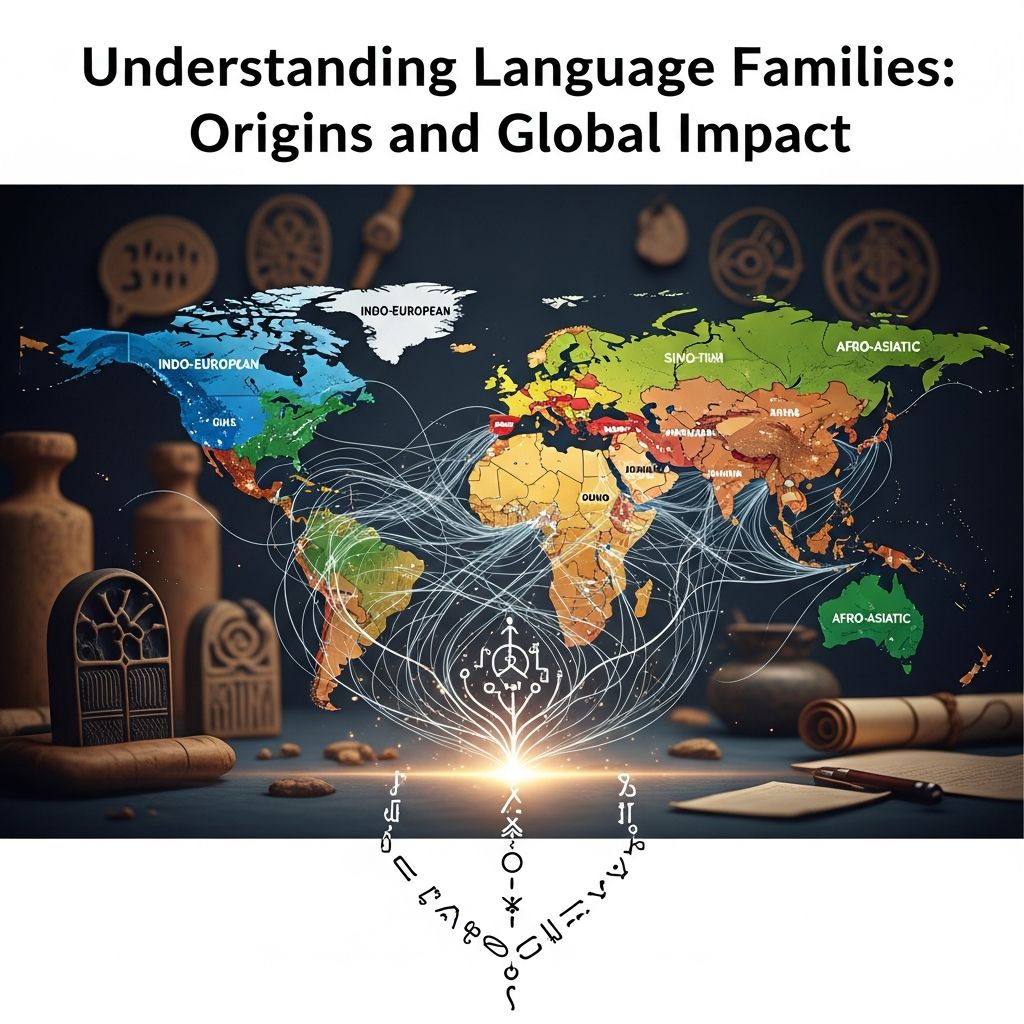
Language families represent groups of languages connected by descent from a shared ancestral tongue, known as a proto-language. This genetic classification mirrors biological evolution, where languages diverge over time through sound changes, grammatical shifts, and vocabulary evolution.
The Foundations of Linguistic Kinship
At the heart of linguistics lies the concept of relatedness among languages. Just as humans trace ancestry through DNA, linguists reconstruct language histories via the comparative method. This involves identifying cognates—words in different languages with similar forms and meanings—and systematic sound correspondences to hypothesize proto-forms.
For instance, the English word “mother,” German “Mutter,” and Sanskrit “matr” all stem from a Proto-Indo-European root *méh₂tēr. Such patterns allow scholars to group languages hierarchically: families into branches, branches into sub-branches, down to dialects.
This tree-like model, analogous to phylogenetic trees in biology, underscores that language families are monophyletic—all descendants of the ancestor belong to the group, excluding unrelated intruders.
Major Language Families Dominating the World
Over 150 language families exist today, encompassing thousands of daughter languages. The largest by speakers is Indo-European, with about 2.91 billion users across 437 languages, spanning Europe, Asia, and beyond.
Following closely is Sino-Tibetan, boasting 1.268 billion speakers in 453 languages, primarily in East Asia. Niger-Congo ranks third globally and first in Africa, with 1,524 languages spoken by 437 million people.
| Language Family | Number of Languages | Estimated Speakers (Billions) | Primary Regions |
|---|---|---|---|
| Indo-European | 437 | 2.91 | Europe, South Asia, Americas |
| Sino-Tibetan | 453 | 1.268 | East Asia |
| Niger-Congo | 1,524 | 0.437 | Sub-Saharan Africa |
| Afroasiatic | ~375 | ~500 million | North Africa, Middle East |
| Austronesian | ~1,200 | ~380 million | Southeast Asia, Pacific |
This table highlights the scale of diversity, where speaker numbers reflect colonial histories and migrations.
Diving Deep into the Indo-European Giant
The Indo-European family exemplifies vast spread and influence. Spoken by nearly half the world’s population, it includes everyday languages like English, Hindi, Spanish, and Russian.
Its branches include:
- Germanic: English, German, Dutch—West Germanic subgroup dominant in Northern Europe and North America.
- Romance: Derived from Vulgar Latin; Spanish, French, Italian, Portuguese thrive in Europe, Latin America, Africa.
- Slavic: Russian, Polish, Czech—prevalent in Eastern Europe.
- Indo-Iranian: Hindi, Bengali, Persian—South and Central Asia hubs.
- Others: Baltic (Latvian, Lithuanian), Celtic (Irish Gaelic), Hellenic (Greek), Armenian.
Proto-Indo-European, spoken around 4500-2500 BCE possibly in the Pontic-Caspian steppe, spread via migrations, Yamnaya culture expansions.
Sino-Tibetan: Asia’s Linguistic Powerhouse
Concentrated in China and neighboring regions, Sino-Tibetan splits into Sinitic (Mandarin, Cantonese) and Tibeto-Burman (Tibetan, Burmese) branches. Mandarin alone claims over a billion speakers, driving the family’s numerical dominance.
Unlike tonal Indo-European languages, many Sino-Tibetan tongues rely heavily on tones for meaning distinction. Historical expansions tied to ancient Chinese dynasties and migrations illustrate how geography shapes divergence.
Africa’s Mosaic: Niger-Congo and Beyond
Niger-Congo, Africa’s behemoth, features noun class systems akin to grammatical gender. Bantu languages like Swahili and Zulu form a key subgroup, spreading from West to East Africa via Bantu expansion around 3000 years ago.
Afroasiatic, another African heavyweight, includes Semitic (Arabic, Hebrew), Berber, Cushitic, and Egyptian branches. Arabic’s 400+ million speakers underscore its reach from North Africa to the Middle East.
Island-Hoppers: Austronesian Adventures
Spanning from Madagascar to Easter Island, Austronesian languages reflect Polynesian seafaring prowess. Tagalog (Filipino), Indonesian, Maori, and Hawaiian belong here, with over 1,200 members.
Proto-Austronesian originated in Taiwan around 3000 BCE, migrating southward and eastward, carrying linguistic markers of maritime culture.
Reconstructing the Past: Tools and Challenges
Linguists employ the comparative method rigorously: align cognates, posit sound laws (e.g., Grimm’s Law in Germanic), reconstruct proto-phonology.
Challenges arise with language isolates (e.g., Basque) or controversial links like Altaic hypothesis. Mass comparison, criticized for lax methodology, contrasts with family-tree models.
Glottochronology estimates divergence times via lexicon stability, though debated for assumptions.
Cultural and Historical Ripples
Language families map human migrations: Indo-European tracks steppe nomads, Austronesian ocean voyages. They preserve mythologies, laws, sciences—Sanskrit Vedas, Latin classics, Arabic Golden Age texts.
In globalization, dominant families like Indo-European influence via English, but revitalization efforts sustain smaller ones, preserving indigenous knowledge.
Future Frontiers in Linguistic Research
Genomics corroborates linguistics, linking R1a haplogroup to Indo-European spread. Computational phylogenetics refines trees using big data.
Endangered languages spur documentation; over half of 7,000+ tongues risk extinction, urging preservation of family diversity.
Frequently Asked Questions (FAQs)
What defines a language family?
A language family groups tongues descended from a common proto-language, proven by shared vocabulary, grammar, and sounds.
How many language families exist?
Linguists recognize over 150 living families, plus extinct ones, totaling vast diversity.
Which is the largest language family?
Indo-European leads with 2.91 billion speakers across 437 languages.
Can languages from different families mix?
Yes, via borrowing (e.g., English French loans), but genetic relation requires descent, not contact.
How do we know proto-languages existed?
Reconstruction from cognates and sound laws provides evidence, like Proto-Indo-European roots.
This exploration reveals language families as windows into humanity’s shared past, evolving narratives of migration, innovation, and connection. (Word count: 1678)
References
- Language Family (Linguistics) – Overview — StudyGuides.com. 2023. https://studyguides.com/study-methods/overview/cmkwc9pf6f69l01d571fcps1k
- All In The Language Family: A Guide To Language Families — Babbel. 2023-05-15. https://www.babbel.com/en/magazine/language-families
- Language family — Wikipedia. 2026-04-01. https://en.wikipedia.org/wiki/Language_family
- Language Families of the World — World Atlas. 2023. https://www.worldatlas.com/articles/language-families-with-the-highest-number-of-speakers.html
- Language Families: Definition and Structure — Lexika Translations. 2024-02-20. https://www.lexika-translations.com/blog/language-families-definition-and-structure/
- 8.9: Language Families — Social Sci LibreTexts (Canada College). 2023-08-10. https://socialsci.libretexts.org/Courses/Canada_College/Essentials_of_Linguistics_Remix_2.0/08:_Historical_Linguistics/8.09:_Language_Families

- Integrated M.A. in Applied Linguistics, University of Hyderabad
- 5+ years in editorial, instructional, SEO, and research-based writing
Sneha is a relationships and lifestyle writer with a strong foundation in applied linguistics and certified training in relationship coaching. She brings over five years of writing experience to theskillvault, crafting thoughtful, research-driven content that empowers readers to build healthier relationships, boost emotional well-being, and embrace holistic living. Her writing and insights reflect the belief that beauty, happiness, and wellness…