
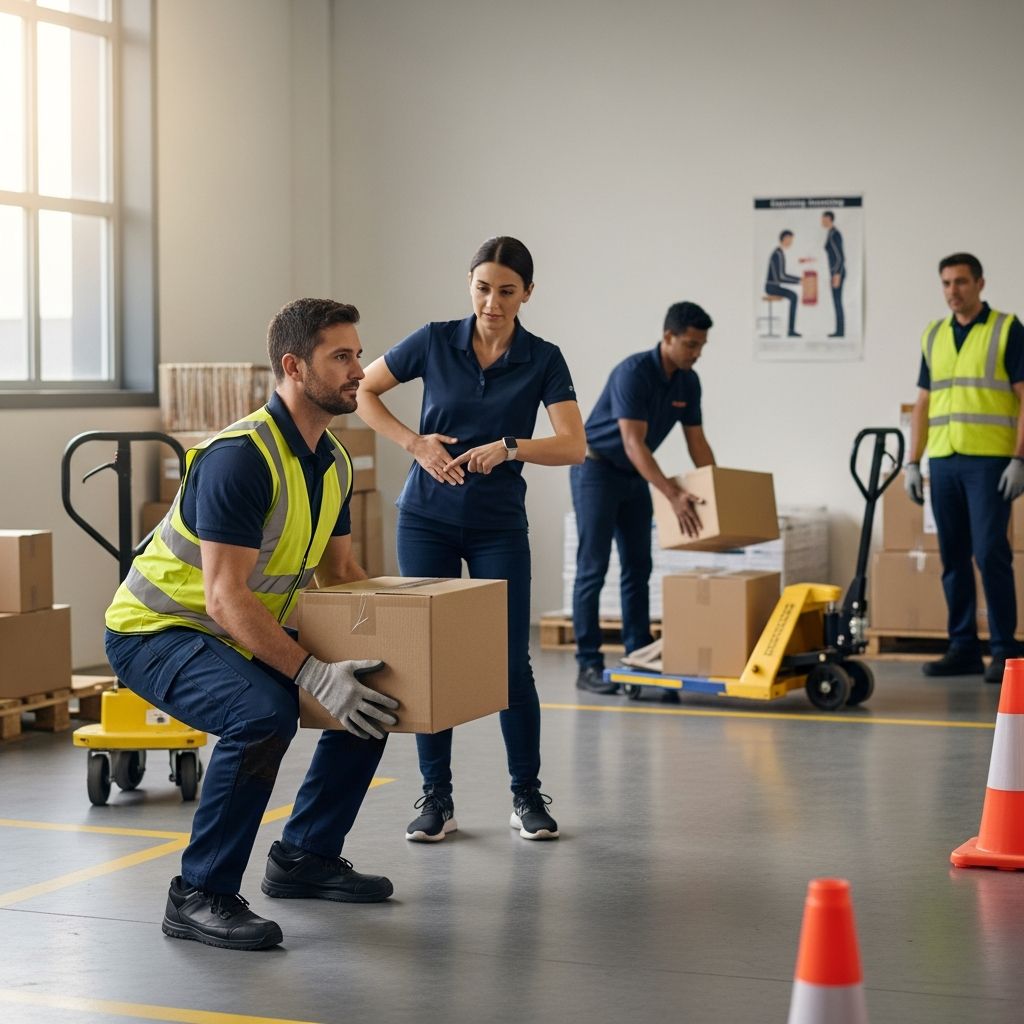
Manual handling involves using bodily force to move, support, or transport objects, a common activity across industries that poses significant injury risks if mishandled. Implementing proper techniques and risk controls can drastically reduce these dangers, promoting healthier workplaces.
Understanding Manual Handling in Modern Workplaces
From warehouses to offices, manual handling tasks like lifting boxes, pushing carts, or carrying equipment are routine. These activities qualify as hazardous when they involve repetitive motions, awkward postures, or excessive force, potentially leading to musculoskeletal disorders (MSDs). According to Safe Work Australia, hazardous manual tasks include lifting, lowering, pushing, pulling, carrying, or restraining objects with factors like sustained force or vibration. Employers must identify and manage these to fulfill work health and safety (WHS) duties.
WorkSafeBC notes that bending, twisting, heavy loads, and poor postures amplify risks, resulting in sprains, strains, and long-term mobility issues. Prioritizing safe practices not only protects workers but also cuts downtime and costs associated with injuries.
Key Risks and Injury Statistics
Manual handling accounts for a large share of workplace injuries. Common hazards stem from heavy or unstable loads, insufficient personnel, repetitive actions, and environmental factors like slippery floors or poor lighting. MasterMover highlights that these lead to back strains, sprains, hernias, and slips.
MSDs, the most prevalent work-related injuries, cause pain, reduced mobility, and chronic conditions impacting life quality. SaferMe identifies specific triggers: bulky or sharp loads hard to grip, tasks needing more hands than available, and fatigue from repetition. Raken adds that pushing, pulling, restraining, carrying, throwing, or holding all carry risks if not executed properly.
| Hazard Type | Description | Potential Injuries |
|---|---|---|
| Heavy/Bulky Loads | Objects exceeding safe weight limits or awkward shapes | Back strains, muscle tears |
| Repetitive Motions | Frequent lifting without breaks | MSDs, soft tissue damage |
| Awkward Postures | Twisting, reaching, or bending unnaturally | Sprains, joint stress |
| Environmental Factors | Obstacles, poor flooring, vibration | Slips, trips, hernias |
Conducting Thorough Risk Assessments
A structured risk assessment is foundational to safe manual handling. Safe Work Australia mandates assessing tasks suspected of being hazardous, involving workers for accurate insights, especially those with prior injuries or inexperience. Steps include:
- Identify tasks with repetitive force, awkward postures, or high loads.
- Evaluate postures, movements, and forces posing dangers.
- Pinpoint causes like poor equipment or layout.
- Develop elimination or minimization strategies.
MasterMover recommends avoiding manual movement where possible, then assessing and reducing risks via equipment or task redesign. Consider vulnerable groups and consult the model Code of Practice for Hazardous Manual Tasks.
Proven Techniques for Safe Lifting and Movement
When manual handling is unavoidable, technique is critical. OSHA advises against twisting the torso—keep ‘nose between your toes’—and lifting above shoulder height. Stanford EHS outlines core steps: stand close with feet shoulder-width, bend knees while keeping back straight, lift with legs, and grip securely.
Universal tips from multiple sources include planning the lift, maintaining load proximity to the body, avoiding twists, and taking breaks. EHS Insight emphasizes training on these to master handling.
- Assess the Task: Check load weight, stability, and path for obstacles.
- Position Yourself: Feet apart, centered over load, knees bent.
- Grip and Lift: Hold close, straighten legs smoothly.
- Move Safely: Pivot feet, not spine; lower controlled.
- Team Lift if Needed: Coordinate for heavy items.
Core Principles for Injury-Free Handling
Adopt these five principles, adapted from industry best practices, to systematize safe manual handling:
- Plan Ahead: Evaluate feasibility, clear obstacles, ensure help if required.
- Position Properly: Stable stance, good posture, body aligned.
- Pick Up Securely: Load hugged to torso for balance.
- Proceed Smoothly: Straight spine, fluid motion without jerks.
- Place Gently: Lower steadily, avoid sudden drops.
These minimize strain across pushing, pulling, and carrying.
Strategies to Eliminate or Minimize Hazards
The hierarchy of controls prioritizes elimination. Automate or redesign tasks to remove manual effort, like using conveyors. If not feasible:
- Redesign workspaces for optimal heights and layouts.
- Employ mechanical aids: trolleys, hoists, or powered movers.
- Rotate tasks to prevent repetition.
- Team up for heavy loads.
- Enhance environment: non-slip floors, better lighting.
Safe Work Australia stresses good work design from the start. Employers should set weight limits, mandating machinery beyond them.
Training and Education Essentials
Comprehensive training equips workers with knowledge and skills. Cover hazard recognition, techniques, and equipment use. Regular toolbox talks, like those from SaferMe and Raken, reinforce safe practices. Involve all levels: PCBUs manage risks, designers ensure safe products.
WorkSafeBC provides resources for assessments and reductions. Ongoing refreshers address evolving tasks.
Industry-Specific Considerations
Warehousing demands trolleys for pallets; construction needs team lifts for materials; healthcare requires patient handling aids. Tailor assessments to context, always prioritizing ergonomics.
Frequently Asked Questions (FAQs)
What is the maximum safe lifting weight?
No universal limit exists; it varies by individual, task, and conditions. Assess per guidelines, using aids beyond reasonable thresholds.
How often should breaks occur during repetitive handling?
As needed to avoid fatigue; rotate tasks or rest every 30-60 minutes for high-repetition work.
Can manual handling cause long-term health issues?
Yes, leading to chronic MSDs affecting mobility and career longevity.
What if a task can’t be eliminated?
Minimize via redesign, aids, training, and monitoring.
Who is responsible for manual handling safety?
Employers (PCBUs), workers, designers—all share WHS duties.
Building a Safer Handling Culture
Fostering awareness through policies, audits, and feedback creates lasting safety. Regular assessments and updates keep practices current, reducing injuries effectively.
References
- Manual Handling Guide for Safety Managers — MasterMover. 2023. https://www.mastermover.com/en-us/manual-handling
- Lifting, pushing and pulling (manual tasks) — Safe Work Australia. 2024-10-01. https://www.safeworkaustralia.gov.au/safety-topic/hazards/lifting-pushing-and-pulling-manual-tasks
- Manual Handling toolbox talk — SaferMe. 2023. https://www.safer.me/toolbox-talk/manual-handling-toolbox-talk/
- Manual Handling & Proper Lifting Safety Toolbox Talk — Raken. 2024. https://www.rakenapp.com/features/toolbox-talks/manual-handling-safety
- Lifting & handling — WorkSafeBC. 2025-01-15. https://www.worksafebc.com/en/health-safety/hazards-exposures/lifting-handling

Medha Deb is an editor with a master's degree in Applied Linguistics from the University of Hyderabad. She believes that her qualification has helped her develop a deep understanding of language and its application in various contexts. Medha specializes in the areas of beauty, health, sports, and wellness and is committed to ensuring that the content on the website is…