
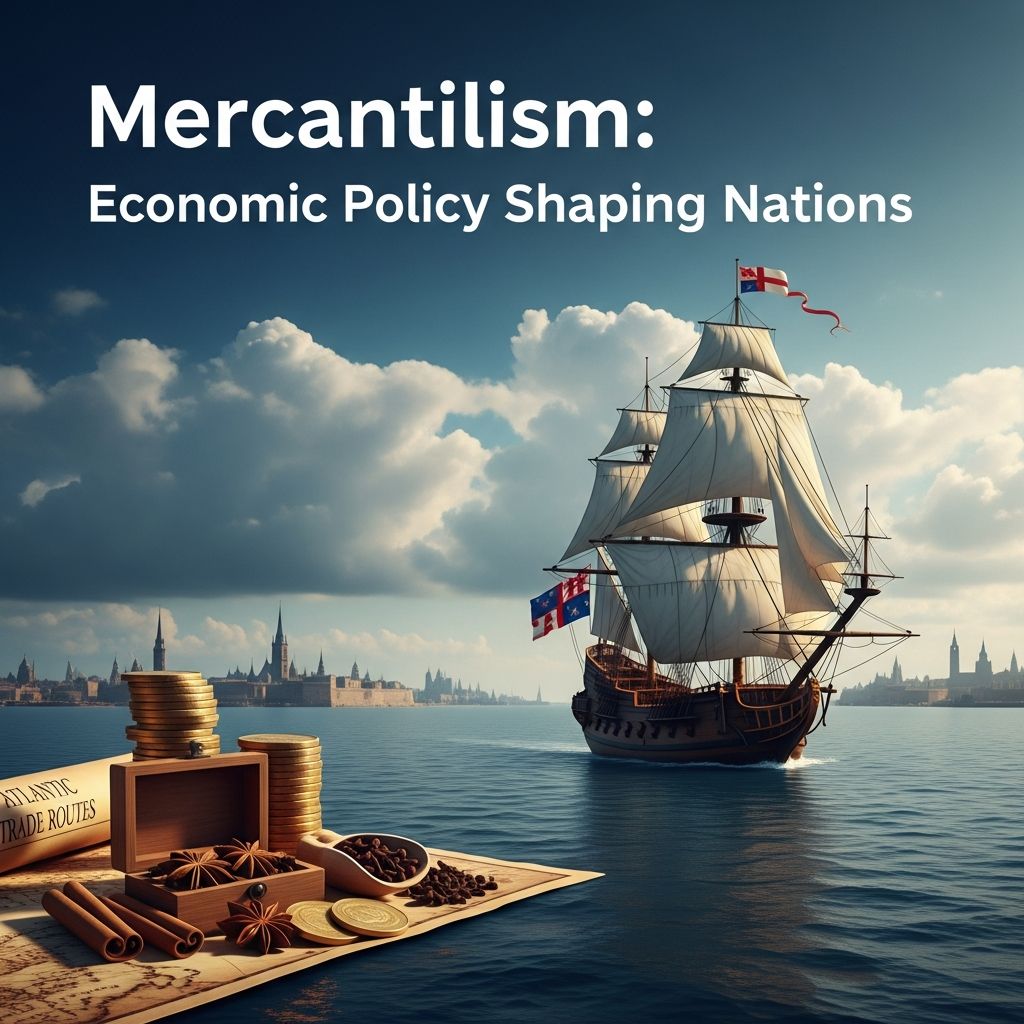
Foundations of an Economic Philosophy
Between the sixteenth and eighteenth centuries, a distinctive economic philosophy emerged across Western Europe that would fundamentally reshape international trade and colonial relationships. This system, known as mercantilism, represented a deliberate governmental strategy to concentrate wealth and power within individual nation-states. Unlike the free-market principles that would later dominate economic thought, mercantilism embraced active state intervention as the primary mechanism for building national prosperity. The philosophy rested on a fundamental assumption: wealth existed in finite quantities, and one nation’s gain necessarily constituted another nation’s loss. This zero-sum perception of international commerce created an intensely competitive atmosphere among European powers, each seeking to maximize their economic advantage at the expense of rivals.
The term “mercantilism” itself carries an interesting historical irony. Prominent economic thinkers of the seventeenth century—including Thomas Mun in England, Jean-Baptiste Colbert in France, and Antonio Serra in Italy—developed and promoted these policies without ever using the specific label. It was Adam Smith, the Scottish economist whose revolutionary ideas would eventually dismantle mercantile systems, who coined the term “mercantile system” in his groundbreaking work Wealth of Nations (1776) to describe the economic approach he sought to critique and replace. Despite their lack of unified terminology, mercantilist thinkers shared common objectives and methodologies that created a coherent economic doctrine across multiple nations.
The Core Mechanics of Trade Advantage
At the heart of mercantile theory lay a deceptively simple objective: ensure that a nation exported significantly more goods than it imported. This fundamental principle drove virtually every mercantilist policy and regulation. Governments reasoned that export revenues would flow into national treasuries in the form of precious metals, primarily gold and silver, thereby enriching the state while impoverishing competitors who experienced trade deficits. The logic appeared straightforward—control the flow of goods across borders, maintain a favorable trade balance, and accumulate bullion (precious metals) that represented tangible national wealth.
To achieve this favorable trade balance, mercantilist governments implemented an extensive array of regulatory mechanisms. High tariffs on imported manufactured goods became nearly universal features of mercantilist policy, effectively pricing foreign products out of domestic markets and forcing consumers to purchase domestic alternatives. Quotas restricted the quantity of specific imports allowed to enter national territories. Subsidies artificially reduced the prices of exported goods, making them more competitive in international markets. These interventionist policies represented a complete rejection of free trade principles, instead employing the state’s regulatory apparatus as an instrument for economic warfare conducted through commercial means rather than military force.
The Bullionist Foundation and Its Evolution
In its simplest formulation, mercantilism embraced bullionism—the conviction that a nation’s true wealth could be measured by the quantity of precious metals, particularly gold and silver, held within its borders. This obsession with accumulating bullion shaped mercantilist policy across multiple dimensions. However, sophisticated mercantilist thinkers recognized a crucial distinction that often escaped popular understanding: accumulating bullion mattered less than ensuring bullion actively circulated through the economy. Mercantilist theorists understood that wealth creation required dynamic commercial activity. Money needed to flow through markets, facilitating trade and generating employment. A nation’s precious metals locked away in royal treasuries accomplished little compared to those same metals stimulating economic transactions.
This evolution in mercantilist thought represented a maturation of the economic philosophy. Early mercantilists focused primarily on maximizing bullion imports. Later thinkers recognized that sustainable wealth accumulation required a functioning economy with active commerce, productive industries, and engaged merchants. The distinction between mere hoarding and active circulation became increasingly important as mercantilist theory developed across the seventeenth and eighteenth centuries.
Governmental Power and Economic Regulation
Mercantilism functioned as the economic expression of political absolutism, a system where centralized governmental authority controlled economic activity to enhance state power. Rulers viewed national economies as tools to be manipulated for state objectives rather than organic systems operating according to market principles. This perspective justified comprehensive governmental intervention in economic matters that would later be considered beyond legitimate state authority.
The regulatory apparatus of mercantilist states extended into numerous sectors:
- Establishment of trade monopolies granted to favored merchant companies, most notably the British East India Company, ensuring state control over lucrative international commerce
- Creation of guild systems and trade associations granted exclusive rights to produce and sell specific goods, limiting competition and maintaining quality standards beneficial to export markets
- Implementation of colonial trading restrictions ensuring colonies served as captive markets for metropolitan manufactures while providing raw materials at favorable prices
- Direct government subsidies to encourage development of strategic industries deemed important for national power and independence
- Imposition of strict manufacturing regulations controlling production processes, quality standards, and labor practices to maintain export competitiveness
Colonial Systems and Extractive Economics
Mercantilism provided the intellectual and economic justification for European colonial expansion, fundamentally reshaping global trade patterns and political relationships. The system created a hierarchical economic structure where colonies existed primarily to serve metropolitan (home country) interests. This arrangement benefited merchants and manufacturers in imperial nations while systematically disadvantaging colonial consumers and producers.
The colonial mercantilist structure operated through a deliberate pattern:
- Colonies harvested raw materials and natural resources, extracting wealth from colonial territories
- Metropolitan manufacturers processed raw materials into finished goods, capturing the added value of production
- Colonial consumers purchased finished goods at inflated prices, often subject to substantial tariffs, enriching metropolitan merchants and manufacturers
- Colonies remained prohibited from developing competing manufacturing industries, ensuring permanent economic subordination
This extractive system generated substantial wealth for imperial powers. European governments accumulated precious metals through favorable trade balances, merchants obtained enormous profits from marked-up colonial sales, and manufacturers enjoyed protected markets shielded from colonial competition. Conversely, colonies remained economically underdeveloped, their resources extracted at minimal cost to metropolitan interests. The Navigation Act of 1651, the first significant mercantilist legislation in British North America, institutionalized these exploitative relationships, requiring colonial trade to flow through British channels and restricting colonial manufacturing development.
Strategic Competition and International Conflict
Because mercantilist theory conceived international trade as a zero-sum competition where one nation’s commercial success necessitated another’s failure, the system created inherent friction among competing powers. Nations competed aggressively for colonial territories, trade monopolies, and favorable commercial relationships. These economic rivalries frequently escalated into military conflicts. The Anglo-Dutch Wars of the late seventeenth century exemplified how mercantilist competition could generate sustained international warfare, as England and the Netherlands battled for control of lucrative trade routes and colonial markets.
Mercantilism motivated nations to expand colonial empires extensively. More colonies meant more captive markets, additional sources of raw materials, and greater accumulation of bullion through favorable trade balances. This imperial expansion, driven by mercantilist economic logic, resulted in European domination of vast territories and populations across Africa, Asia, and the Americas. While mercantilism was not the sole cause of European imperialism, it provided powerful economic incentives that transformed colonial expansion from occasional territorial acquisition into systematic, state-sponsored enterprise.
Decline and Philosophical Rejection
By the late eighteenth century, mercantilism faced increasingly powerful intellectual opposition. Adam Smith’s Wealth of Nations (1776) provided a comprehensive critique of mercantilist assumptions, arguing that free trade, specialization, and market competition produced greater overall prosperity than governmental regulation and monopolistic privilege. Smith demonstrated that mercantilism’s zero-sum logic was fundamentally flawed—international trade could benefit all participants simultaneously if parties specialized in producing goods where they possessed comparative advantages.
The rise of laissez-faire economics challenged mercantilism’s core justification for governmental intervention. Economists increasingly argued that free markets, operating without state manipulation, generated superior economic outcomes and greater consumer welfare. This philosophical shift, combined with the practical failures of mercantile systems to prevent economic stagnation and generate sustained prosperity, led to mercantilism’s gradual abandonment during the late eighteenth and early nineteenth centuries.
Contemporary economics universally rejects mercantilism as theoretically flawed and practically counterproductive. Modern economists recognize that trade surpluses and bullion accumulation do not constitute genuine measures of national prosperity, and that governmental trade barriers and monopolistic privileges create inefficiencies that reduce overall economic welfare. The system’s abandonment represented a fundamental reorientation of economic philosophy toward market-based mechanisms and free trade principles.
Historical Consequences and Modern Implications
Despite mercantilism’s intellectual obsolescence, its historical impacts remain profound. The system’s mercantilist logic justified European colonization, extracting resources worth billions in contemporary monetary terms from colonial territories. This extractive colonial system, built on mercantilist principles, devastated colonial development prospects and contributed to patterns of global inequality persisting into the contemporary era.
In North America specifically, mercantilist restrictions severely constrained colonial economic development. Manufacturing restrictions prevented colonists from developing competing industries. Trade restrictions channeled colonial commerce through London merchants, enriching British intermediaries at colonists’ expense. Navigation Acts prohibited direct colonial trade with non-British markets, creating monopolistic pricing and restricting colonists’ economic opportunities. These grievances accumulated over decades, becoming central motivations for the American Revolutionary War (1775-1783), as colonists sought independence partly to escape mercantilist restrictions on their economic autonomy.
While formal mercantilism has disappeared from developed economies, some economists and policymakers argue that its underlying logic persists in modified forms. Economic nationalism and protectionist policies in contemporary trade disputes sometimes reflect mercantilist impulses—the desire to achieve trade surpluses, protect domestic industries through tariffs and quotas, and view international commerce as inherently competitive rather than mutually beneficial. However, these modern practices are typically justified through different rhetoric and operate within a fundamentally different theoretical framework than historical mercantilism.
Common Questions About Mercantilism
Q: How did mercantilism differ from feudalism?
A: Feudalism organized society around land ownership and hierarchical social relationships, while mercantilism represented a commercial economic system emphasizing trade and governmental regulation of commerce. Mercantilism emerged during feudalism’s decline, replacing agricultural-focused economies with trade-focused systems and creating centralized state power based on commercial wealth rather than land tenure.
Q: Why did mercantilists believe gold and silver represented true wealth?
A: Mercantilists associated precious metals with security and power. Gold and silver could be accumulated, stored, and transferred, giving rulers tangible resources to fund armies, diplomacy, and state projects. Precious metals also represented universally accepted value in international commerce, making them more reliable stores of value than land or goods.
Q: Did mercantilism successfully enrich European nations?
A: Mercantilism generated substantial short-term wealth for European merchants and governments, particularly through colonial extraction and favorable trade balances. However, it ultimately proved economically inefficient, preventing specialization, innovation, and the consumer welfare benefits that free trade generates. The system’s long-term economic consequences were negative compared to economies that abandoned mercantilist restrictions.
Q: How did the Navigation Acts affect colonial American development?
A: Navigation Acts restricted colonial manufacturing, forcing colonies to purchase expensive English manufactures while their raw materials were sold at artificially depressed prices. These restrictions prevented colonial industrialization and economic diversification, generating resentment that contributed significantly to revolutionary sentiment in the American colonies.
Q: Are any countries still practicing mercantilism today?
A: While formal mercantilism has disappeared, some economists argue that modern protectionist policies—tariffs, quotas, and subsidies protecting domestic industries—reflect mercantilist logic applied within contemporary frameworks. However, most developed nations have adopted free-trade principles, recognizing that mutually beneficial commerce generates greater prosperity than competitive restriction.
References
- Mercantilism | Definition & Examples — Britannica Money. 2024. https://www.britannica.com/money/mercantilism
- Mercantilism — The Library of Economics and Liberty (Econlib). 2024. https://www.econlib.org/library/Enc/Mercantilism.html
- Colonial Mercantilism: Definition, History & Effects — Study.com. 2024. https://study.com/academy/lesson/colonial-mercantilism-definition-history-effects.html
- Mercantilism | Diplomacy and International Relations — EBSCO Research Starters. 2024. https://www.ebsco.com/research-starters/diplomacy-and-international-relations/mercantilism
- Mercantilism Definition & Meaning — Merriam-Webster Dictionary. 2024. https://www.merriam-webster.com/dictionary/mercantilism

Medha Deb is an editor with a master's degree in Applied Linguistics from the University of Hyderabad. She believes that her qualification has helped her develop a deep understanding of language and its application in various contexts. Medha specializes in the areas of beauty, health, sports, and wellness and is committed to ensuring that the content on the website is…