
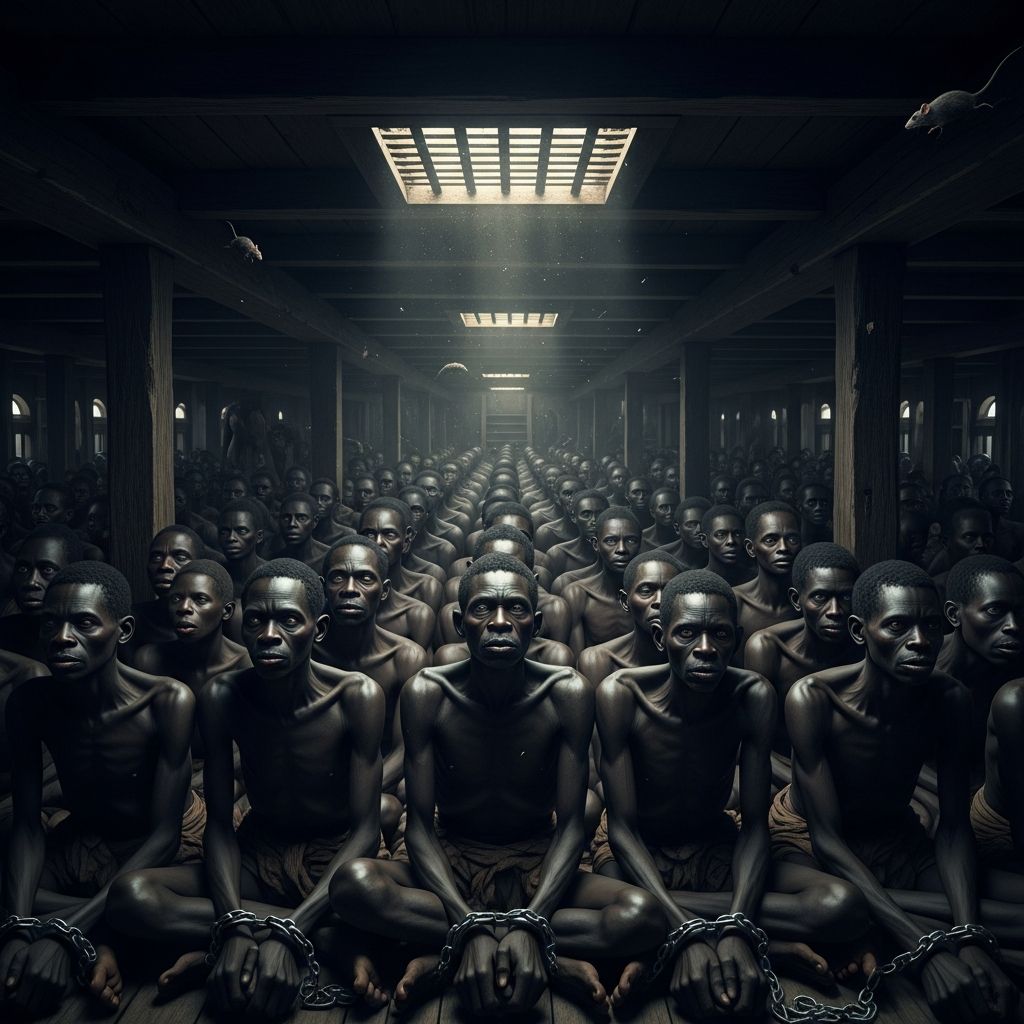
The Middle Passage refers to the grueling transatlantic voyage that carried millions of enslaved Africans to the Americas, forming the brutal core of the triangular trade system that fueled European economies for centuries. This leg of the journey, spanning from West and Central African coasts to ports in the Caribbean, Brazil, and North America, was marked by extreme overcrowding, disease, starvation, and violence, resulting in the deaths of approximately two million people.
Origins of the Triangular Trade Network
The transatlantic slave trade emerged in the 16th century as European powers sought cheap labor for their New World colonies. Ships loaded with manufactured goods like textiles, guns, and iron departed from ports in Europe, such as Liverpool, Nantes, and Lisbon, heading to Africa. There, these items were exchanged for human captives, who were then shipped across the Atlantic—the infamous Middle Passage. Upon arrival in the Americas, survivors were sold to work on plantations producing sugar, tobacco, cotton, and rum, which were transported back to Europe to complete the triangle.
This economic cycle began systematically after 1525, with the first recorded slave ship voyage from São Tomé to New Spain. By the 18th century, it had become a massive enterprise organized by companies and investor groups, transporting an estimated 12.5 million Africans between 1517 and 1867.
Capture and the Journey to African Ports
Before boarding ships, Africans endured the ‘First Passage,’ a forced march from inland regions to coastal forts. Captives, often seized in wars between African kingdoms or raids by European-allied traders, trekked hundreds of miles chained together, suffering dehydration, beatings, and exposure. Along the Guinea Coast, Slave Coast, and Angola, they were held in barracoons—cramped holding pens—sometimes for months, awaiting purchase.
- Many died en route due to exhaustion and disease, with mortality rates high before even reaching the sea.
- Branding with hot irons marked them as property upon arrival at ports.
- European traders anchored for weeks or up to a year, trading goods for 150 to 600 captives per ship.
Life Aboard Slave Ships: Unspeakable Conditions
Slave ships, retrofitted merchant vessels or purpose-built ‘slavers,’ maximized ‘cargo’ capacity at the expense of humanity. Men were shackled in leg irons below decks in rows, unable to stand, crammed into spaces as low as 18 inches high. Women and children occupied slightly less confined areas but were still separated and vulnerable to assault. Ventilation was minimal, air thick with filth, sweat, and excrement.
Voyages lasted 80 days on average, though some extended to months due to multiple port stops or calms. Without sanitation, dysentery, flux (dysentery-like illness), scurvy, and smallpox ravaged holds. Crews rationed spoiled food and contaminated water to cut costs, leading to starvation.
| Aspect | Conditions | Impact |
|---|---|---|
| Space | 5-6 sq ft per person | Inability to move, leading to sores and infections |
| Hygiene | No latrines; waste accumulated | Epidemics killing 10-20% per voyage |
| Food/Water | Horse beans, yams, minimal water | Malnutrition and dehydration |
| Duration | 2-3 months | Prolonged suffering, high mortality |
Capt. William Mein described holds as ‘a container filled with living creatures who were in a most miserable situation,’ underscoring the dehumanization.
Mortality Rates and Human Cost
Modern estimates indicate 12.5 million Africans embarked on the Middle Passage, with 10.7 million surviving to disembark—a 14% overall mortality rate, or about 1.8-2 million deaths at sea. Early voyages saw higher losses (up to 30%) before ship designs improved. Broader slave trade mortality, including pre- and post-voyage, may reach four million.
Destinations varied: 40% to Brazil (4.8 million), 47% to the Caribbean (4.7 million), and just 4% (388,000) to North America. High death rates persisted post-arrival, with many succumbing in the first years due to weakened states.
Forms of Resistance and Survival Strategies
Enslaved Africans resisted fiercely. Some refused food, requiring force-feeding via speculums. Others staged revolts—over 55 documented shipboard uprisings—or jumped overboard in mass suicides, prompting nets around ships. Despite chains, captives formed bonds, singing, storytelling, and creating kinship networks that birthed transatlantic communities.
- Individual acts: Self-starvation, suicide dives.
- Collective: Mutinies, like the 1839 Amistad revolt.
- Cultural: Oral histories preserved identities amid horror.
Key Destinations and Economic Drivers
Brazil received the largest share due to sugar plantations, followed by British and French Caribbean islands for rum and molasses. North American imports were fewer but foundational to Southern economies. Ports like Boston participated early; the ship Desire (1637) marked New England’s entry.
The trade generated immense wealth: Britain’s economy boomed from slave-produced goods, funding industrialization.
Path to Abolition and Legal Endings
Abolitionist pressure mounted in the 18th century, fueled by survivor testimonies like Olaudah Equiano’s narrative. Denmark banned the trade in 1803, Britain in 1807, and the U.S. in 1808. Enforcement lagged; illegal trade continued until Brazil’s 1850 ban.
Slavery persisted in the Americas until the U.S. Civil War (1865), leaving legacies of racial inequality.
Lasting Legacies of the Middle Passage
The Middle Passage tore families apart, erased languages, and instilled generational trauma, shaping African diasporas. It forged resilient cultures blending African roots with New World realities, evident in music, religion, and resistance movements.
Today, sites like Faneuil Hall in Boston commemorate this history, reminding us of slavery’s role in building modern nations.
Frequently Asked Questions (FAQs)
What was the Middle Passage?
The Middle Passage was the transatlantic sea voyage transporting enslaved Africans to the Americas as part of the triangular slave trade, notorious for its deadly conditions.
How many people died during the Middle Passage?
Approximately 1.8-2 million of 12.5 million embarked died en route, a 14% mortality rate.
How long did the Middle Passage last?
Voyages typically took 80 days to several months, depending on weather and stops.
Why was it called the ‘Middle Passage’?
It was the middle leg of the triangular trade: Europe to Africa, Africa to Americas, Americas to Europe.
Did enslaved Africans resist the Middle Passage?
Yes, through revolts, hunger strikes, suicides, and cultural preservation.
References
- Middle Passage — Wikipedia. Accessed 2026. https://en.wikipedia.org/wiki/Middle_Passage
- Middle Passage | Definition, Conditions, Significance, & Facts — Encyclopædia Britannica. Accessed 2026. https://www.britannica.com/topic/Middle-Passage-slave-trade
- The Middle Passage and Slave Trade — Students of History. Accessed 2026. https://www.studentsofhistory.com/middle-passage
- The Middle Passage — U.S. National Park Service. Accessed 2026. https://www.nps.gov/articles/the-middle-passage.htm
- The Transatlantic Slave Trade and the Middle Passage — Encyclopedia Virginia. Accessed 2026. https://encyclopediavirginia.org/entries/transatlantic-slave-trade-the/
- Middle Passage — Slavery and Remembrance. Accessed 2026. https://slaveryandremembrance.org/articles/article/?id=A0032

Medha Deb is an editor with a master's degree in Applied Linguistics from the University of Hyderabad. She believes that her qualification has helped her develop a deep understanding of language and its application in various contexts. Medha specializes in the areas of beauty, health, sports, and wellness and is committed to ensuring that the content on the website is…