
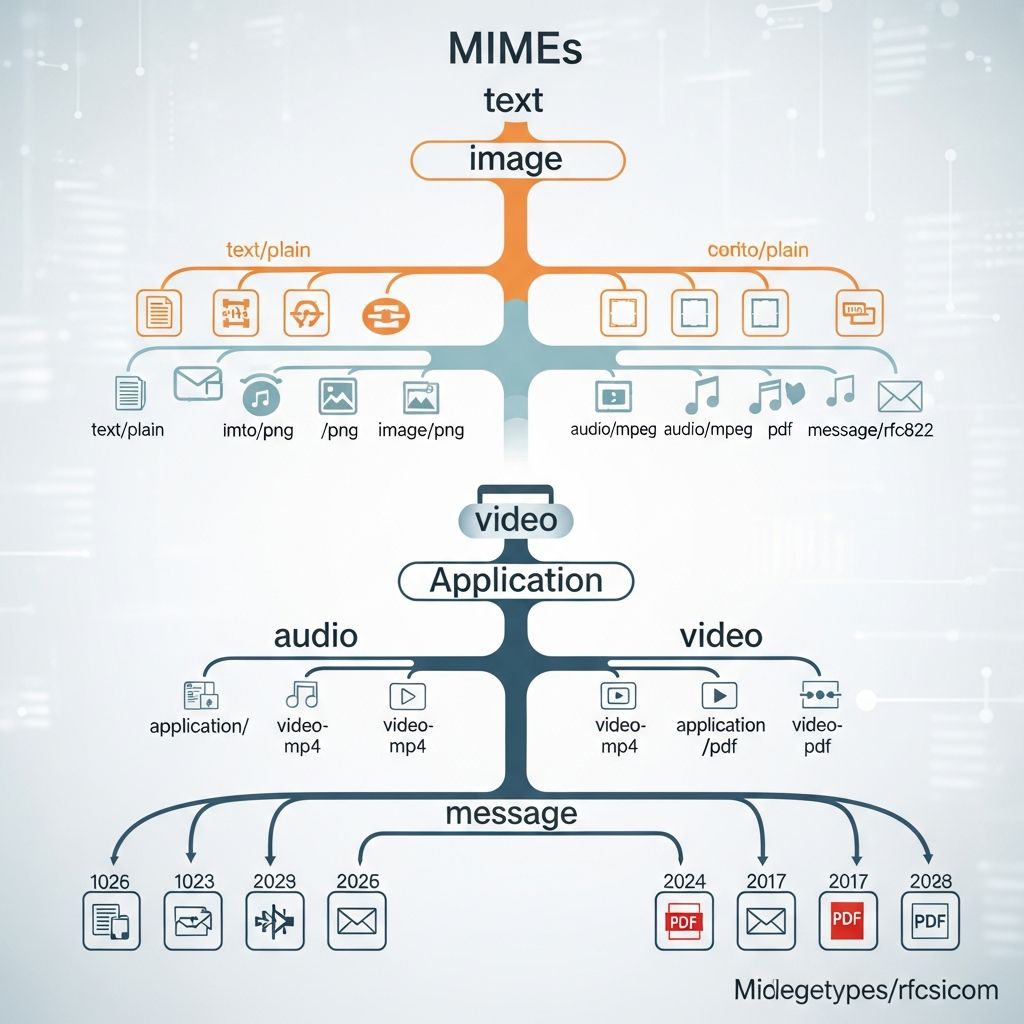
MIME types, also known as media types or content types, serve as standardized labels that identify the format and nature of digital content across networks. These identifiers enable web servers, browsers, and applications to process files correctly, ensuring seamless data exchange over HTTP and other protocols. Developed originally for email attachments in the MIME standard (Multipurpose Internet Mail Extensions), they have become fundamental to modern web architecture.
Each MIME type follows a structured format: a primary type (like text, image, or application) separated by a slash from a subtype (such as html or jpeg). Optional parameters like charset=utf-8 can provide additional details. The Internet Assigned Numbers Authority (IANA) maintains the official registry, guaranteeing consistency and preventing conflicts. This guide categorizes hundreds of MIME types for quick reference, drawing from authoritative sources to help developers implement proper Content-Type headers.
Understanding the Role of MIME Types in Web Protocols
In HTTP communications, the Content-Type header declares the MIME type, instructing clients on how to interpret the response body. For instance, Content-Type: text/html; charset=UTF-8 signals an HTML document encoded in UTF-8. Without accurate MIME types, browsers might misrender pages, download files unexpectedly, or fail to execute scripts.
MIME types extend beyond the web to email (RFC 2045/2046), APIs, and file uploads. They differ slightly from filename extensions, offering more precise identification. Tools like server configurations (e.g., Apache’s .htaccess or Nginx mime.types) map extensions to MIME types automatically. Common pitfalls include using outdated types like application/x-www-form-urlencoded instead of modern alternatives, leading to compatibility issues.
Text-Based MIME Types: Foundations of Web Content
Text MIME types handle human-readable content, often with character encoding parameters. They form the backbone of web pages, stylesheets, and scripts.
- text/plain: Unformatted text files (.txt). Default for generic content.
- text/html: Hypertext Markup Language documents (.html, .htm). Essential for web pages.
- text/css: Cascading Style Sheets (.css). Controls visual presentation.
- text/javascript or application/javascript: JavaScript code (.js). Powers interactivity (note: text/javascript is legacy; prefer application/javascript).
- text/xml: Extensible Markup Language (.xml). Structures data hierarchically.
- text/csv: Comma-separated values (.csv). Common for tabular data export.
- text/markdown: Markdown formatted text (.md). Popular for documentation.
Programming languages also have dedicated types: text/x-python (.py), text/x-c++src (.cpp), and text/x-java-source (.java). Always specify charset for text types to avoid garbled characters, as UTF-8 is the modern standard.
Image MIME Types: Visual Content Standards
Image types define raster, vector, and animated graphics, critical for web media. Browsers use these to determine rendering engines.
| MIME Type | Extensions | Use Case |
|---|---|---|
| image/jpeg or image/jpg | .jpg, .jpeg | Photographs; lossy compression for web optimization. |
| image/png | .png | Lossless images with transparency; logos and graphics. |
| image/gif | .gif | Animated images; limited colors (256 palette). |
| image/webp | .webp | Modern format with superior compression (lossy/lossless). |
| image/svg+xml | .svg | Scalable vector graphics; resolution-independent. |
| image/apng | .apng | Animated PNG with alpha transparency. |
Exotic types include image/x-icon (.ico) for favicons and image/bmp (.bmp) for uncompressed bitmaps. Serve responsive images with correct types to leverage browser caching and performance features.
Audio and Video MIME Types: Multimedia Delivery
Multimedia types enable streaming and playback. Codecs within containers (e.g., MP4 with H.264) are implied by the subtype.
- audio/mpeg or audio/mp3: MP3 audio (.mp3).
- audio/wav: Waveform Audio (.wav). Uncompressed, high fidelity.
- audio/ogg: Ogg Vorbis (.ogg). Open-source, efficient.
- video/mp4: MPEG-4 video (.mp4). Ubiquitous web video.
- video/webm: WebM container (VP8/VP9) (.webm). Royalty-free.
- video/ogg: Ogg Theora video (.ogv).
- video/3gpp: 3GPP mobile video (.3gp, .3g2).
For adaptive streaming, use application/dash+xml for MPEG-DASH manifests. Ensure server support via modules like Apache’s mod_mime to avoid fallback to application/octet-stream, which prompts downloads.
Application MIME Types: Documents and Data
The broadest category, application covers binaries, archives, executables, and structured data.
| MIME Type | Extensions | Description |
|---|---|---|
| application/json | .json | Data interchange format; APIs and configs. |
| application/xml | .xml | Structured documents; SOAP, RSS. |
| application/pdf | Portable documents. | |
| application/zip | .zip | Compressed archives. |
| application/msword | .doc | Legacy Word docs. |
| application/vnd.openxmlformats-officedocument.wordprocessingml.document | .docx | Modern OOXML Word. |
| application/octet-stream | * | Generic binary; fallback for unknown files. |
Other notables: application/epub+zip (.epub) for e-books, application/x-tar (.tar) for archives, and application/javascript as noted earlier. Vendor-specific types use vnd. prefixes, like application/vnd.ms-excel (.xls).
Specialized and Vendor MIME Types
Beyond basics, niche types handle fonts (font/woff2 .woff2), models (model/gltf-binary .glb), and more. Microsoft Office 2007+ uses long vnd.openxmlformats subtypes. Apple iOS favors application/x-apple-diskimage (.dmg).
Directories and system files have types like inode/directory in some contexts. Always check IANA for registrations to avoid inventing types, which can break interoperability.
Implementing MIME Types in Web Servers
Configure servers precisely:
- Apache: Edit mime.types or use
AddType application/json .jsonin .htaccess. - Nginx: include /etc/nginx/mime.types; add custom in server blocks.
- Node.js/Express:
res.type('application/json')or manual headers.
Test with browser dev tools or curl -I to verify headers. Use X-Content-Type-Options: nosniff to prevent MIME sniffing attacks.
Tools for Managing MIME Types
Libraries simplify detection:
- Perl’s MIME::Types: Functions like
by_suffix('image.gif')return type/encoding. - JavaScript:
new File(['content'], 'file.pdf', {type: 'application/pdf'}). - Python:
mimetypes.guess_type('file.jpg').
Online databases like mimetype.io list thousands for reference.
Frequently Asked Questions (FAQs)
What is the difference between MIME type and Content-Type?
MIME type identifies data format (e.g., image/png); Content-Type is the HTTP header using it (e.g., Content-Type: image/png).
What is the default MIME type for unknown files?
application/octet-stream, triggering a download.
How do I find the MIME type for a file extension?
Consult IANA registry or use server tools/libraries like MIME::Types.
Are MIME types case-sensitive?
No, they are case-insensitive per RFC, but subtypes may vary by convention.
Can I register a new MIME type?
Yes, via IANA application process for standards-track needs.
References
- All MIME types — Mimetype.io. Accessed 2026. https://mimetype.io/all-types
- Difference Between ContentType and MimeType — GeeksforGeeks. 2023-10-15. https://www.geeksforgeeks.org/python/difference-between-contenttype-and-mimetype/
- MIME-Types — followthemoney.tech. Accessed 2026. https://followthemoney.tech/explorer/types/mimetype/
- MIME Types — Oracle Documentation. 2007. https://docs.oracle.com/cd/E19683-01/817-2178-10/crmime.html
- MIME::Types — MetaCPAN. Accessed 2026. https://metacpan.org/pod/MIME::Types
- Common media types — MDN Web Docs. 2024-07-01. https://developer.mozilla.org/en-US/docs/Web/HTTP/Guides/MIME_types/Common_types
- Media type — Wikipedia. 2024-11-01. https://en.wikipedia.org/wiki/Media_type
- Media Types — IANA. Accessed 2026. https://www.iana.org/assignments/media-types/

- Integrated M.A. in Applied Linguistics, University of Hyderabad
- 5+ years in editorial, instructional, SEO, and research-based writing
Sneha is a relationships and lifestyle writer with a strong foundation in applied linguistics and certified training in relationship coaching. She brings over five years of writing experience to theskillvault, crafting thoughtful, research-driven content that empowers readers to build healthier relationships, boost emotional well-being, and embrace holistic living. Her writing and insights reflect the belief that beauty, happiness, and wellness…