
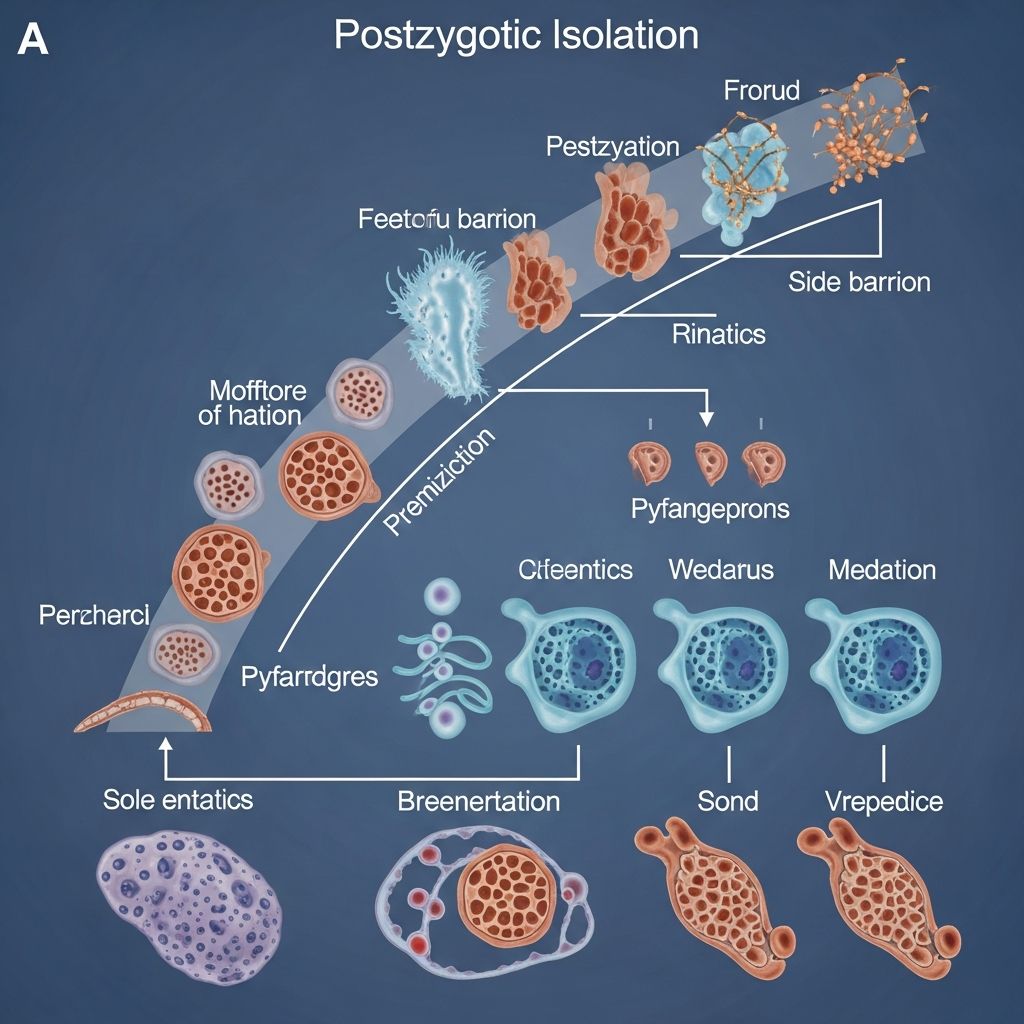
Postzygotic isolation represents a critical phase in reproductive barriers where, despite successful mating and fertilization, the resulting offspring face challenges in survival or reproduction. This mechanism ensures that gene flow between diverging populations remains restricted, paving the way for speciation.
Understanding Reproductive Isolation in Evolutionary Biology
Reproductive isolation encompasses all processes that hinder interbreeding between species or populations. It divides into prezygotic barriers, which prevent fertilization, and postzygotic barriers, which act post-fertilization. Prezygotic mechanisms include geographic separation, differing mating times, behavioral cues, habitat preferences, and mechanical mismatches in reproductive structures.
Postzygotic isolation, however, kicks in after zygote formation. Even if sperm fertilizes the egg, genetic incompatibilities arise, leading to inviable or infertile hybrids. This underscores the Dobzhansky-Muller model, where alleles evolve independently in isolated populations and become incompatible upon reunion.
Core Mechanisms of Postzygotic Isolation
Postzygotic barriers manifest primarily through two phenomena: hybrid inviability and hybrid sterility, with hybrid breakdown as a secondary effect.
Hybrid Inviability: Early Developmental Failure
Hybrid inviability occurs when the zygote forms but fails to develop into a viable organism. Embryos may arrest early or die before reaching maturity due to mismatched developmental genes from parental species.
For instance, crosses between certain frog species yield embryos that cease development or larvae unable to metamorphose into adults. In mammals like goats and sheep, hybrid zygotes often suffer mortality during gestation.
Hybrid Sterility: Viable but Non-Reproductive Offspring
Here, hybrids survive to adulthood but cannot produce viable gametes. The classic example is the mule, offspring of horse and donkey, which is strong and healthy yet sterile due to odd chromosome numbers preventing meiosis.
Sterility stems from disruptions in gametogenesis, where paternal and maternal chromosomes fail to pair properly.
Hybrid Breakdown: Issues in Later Generations
While first-generation (F1) hybrids may thrive, subsequent generations (F2) exhibit reduced fitness. Incompatibilities accumulate, causing inviability, sterility, or weakness. Rice genetics studies reveal loci triggering such breakdowns.
| Mechanism | Description | Example | Impact on Speciation |
|---|---|---|---|
| Hybrid Inviability | Zygote dies early | Frog crosses | Prevents hybrid survival |
| Hybrid Sterility | Survives but infertile | Mule (horse x donkey) | Blocks gene flow |
| Hybrid Breakdown | F2 generation weakens | Rice hybrids | Reinforces isolation |
Genetic Foundations Driving Postzygotic Barriers
At the molecular level, postzygotic isolation arises from epistatic interactions between diverged genomes. The Dobzhansky-Muller incompatibility posits that neutral mutations in isolated populations become deleterious in hybrids.
Studies in model organisms like Drosophila identify hybrid lethality genes, often involving sex chromosomes or rapidly evolving loci. In plants, chromosomal rearrangements contribute to sterility by disrupting meiosis.
Quantitative trait loci (QTL) analyses in rice pinpoint specific genes for F1 inviability and F2 breakdown, highlighting Dobzhansky-Muller effects. These findings affirm that postzygotic isolation evolves as a byproduct of genetic divergence.
Real-World Examples Across Taxa
- Animals: Lions and tigers produce ligers or tigons, often inviable or sterile. Sheep-goat hybrids rarely survive gestation.
- Plants: Many angiosperms show endosperm failure in interspecies crosses, a form of hybrid inviability unique to double-fertilization.
- Insects: Fruit fly species hybrids suffer embryonic arrest due to X-chromosome incompatibilities.
- Fish: Cichlids in African lakes form sterile hybrids despite overlapping habitats.
These cases illustrate postzygotic isolation’s ubiquity, reinforcing species integrity even when prezygotic barriers falter.
Role in Speciation Processes
Speciation requires complete reproductive isolation. Postzygotic barriers complement prezygotic ones, ensuring no gene flow. In allopatric speciation, physical separation fosters genetic drift and adaptation, culminating in postzygotic incompatibilities.
In sympatric speciation, like polyploidy in plants, immediate hybrid sterility arises from chromosome doubling mismatches. Reinforcement evolves when rare hybrids form, selecting against interbreeding traits.
Postzygotic isolation thus acts as a ‘one-way’ barrier: costly hybrids select for prezygotic avoidance, accelerating divergence.
Comparative Analysis: Prezygotic vs. Postzygotic Barriers
Prezygotic barriers conserve energy by averting matings, while postzygotic ones impose fitness costs on hybrids. Both evolve, but postzygotic often precedes in early divergence stages.
- Prezygotic: Proactive, prevents zygote formation (e.g., temporal mismatches).
- Postzygotic: Reactive, reduces hybrid success (e.g., sterility).
Species with strong postzygotic barriers may exhibit weaker prezygotic ones initially, evolving the latter via reinforcement.
Experimental Evidence and Research Insights
Lab crosses quantify isolation strength. In Drosophila, hybrid rescue mutations reveal underlying genes. QTL mapping in hybrids identifies incompatibility loci.
Field studies on Darwin’s finches show postzygotic selection against intermediates, maintaining clusters. Genomic sequencing traces Dobzhansky-Muller genes across taxa.
Frequently Asked Questions
What defines postzygotic isolation?
Mechanisms reducing hybrid viability or fertility after zygote formation.
How does hybrid inviability differ from sterility?
Inviability kills embryos; sterility allows survival but blocks reproduction.
Can postzygotic barriers evolve rapidly?
Yes, via genetic drift in small populations or sexual selection on chromosomes.
Why study postzygotic isolation?
It elucidates speciation genetics, aiding biodiversity conservation.
Are there plants with strong postzygotic isolation?
Yes, interspecies pollinations often fail at endosperm development.
Implications for Conservation and Evolution
Understanding these barriers informs hybridization risks in conservation. Invasive species hybrids may bypass barriers, threatening natives. Climate change could weaken isolation by shifting ranges, increasing maladaptive hybrids.
In agriculture, postzygotic barriers limit crop wild relative use for breeding. Yet, identifying rescue genes could enhance hybrid vigor.
Postzygotic isolation exemplifies evolution’s ingenuity in preserving diversity amid gene flow pressures.
References
- Reproductive Isolation – Free Sketchy MCAT Lesson — Sketchy.com. Accessed 2026. https://www.sketchy.com/mcat-lessons/reproductive-isolation
- Postzygotic Isolation: AP Biology Study Guide — Fiveable. Accessed 2026. https://fiveable.me/ap-bio/key-terms/postzygotic-isolation
- 18.2B: Reproductive Isolation — Biology LibreTexts. 2023-10-15. https://bio.libretexts.org/Bookshelves/Introductory_and_General_Biology/General_Biology_(Boundless)/18:_Evolution_and_the_Origin_of_Species/18.02:_Formation_of_New_Species/18.2B:_Reproductive_Isolation
- Postzygotic Reproductive Barriers | Overview & Examples — Study.com. Accessed 2026. https://study.com/academy/lesson/speciation-iii-postzygotic-barriers.html
- Reproductive Isolating Mechanisms — Wheaton College Open Press. Accessed 2026. https://openpress.wheatoncollege.edu/molecularecologyv1/chapter/reproductive-isolating-mechanisms/
- Reproductive Isolation: Prezygotic & Postzygotic Types (Full Lesson) — YouTube. Accessed 2026. https://www.youtube.com/watch?v=OzgbhRr23Tc
- Postzygotic reproductive isolating mechanism — Britannica. Accessed 2026. https://www.britannica.com/science/postzygotic-reproductive-isolating-mechanism
- Genetic mechanisms of postzygotic reproductive isolation — PMC – NIH. 2013-12-01. https://pmc.ncbi.nlm.nih.gov/articles/PMC3859346/

Medha Deb is an editor with a master's degree in Applied Linguistics from the University of Hyderabad. She believes that her qualification has helped her develop a deep understanding of language and its application in various contexts. Medha specializes in the areas of beauty, health, sports, and wellness and is committed to ensuring that the content on the website is…