
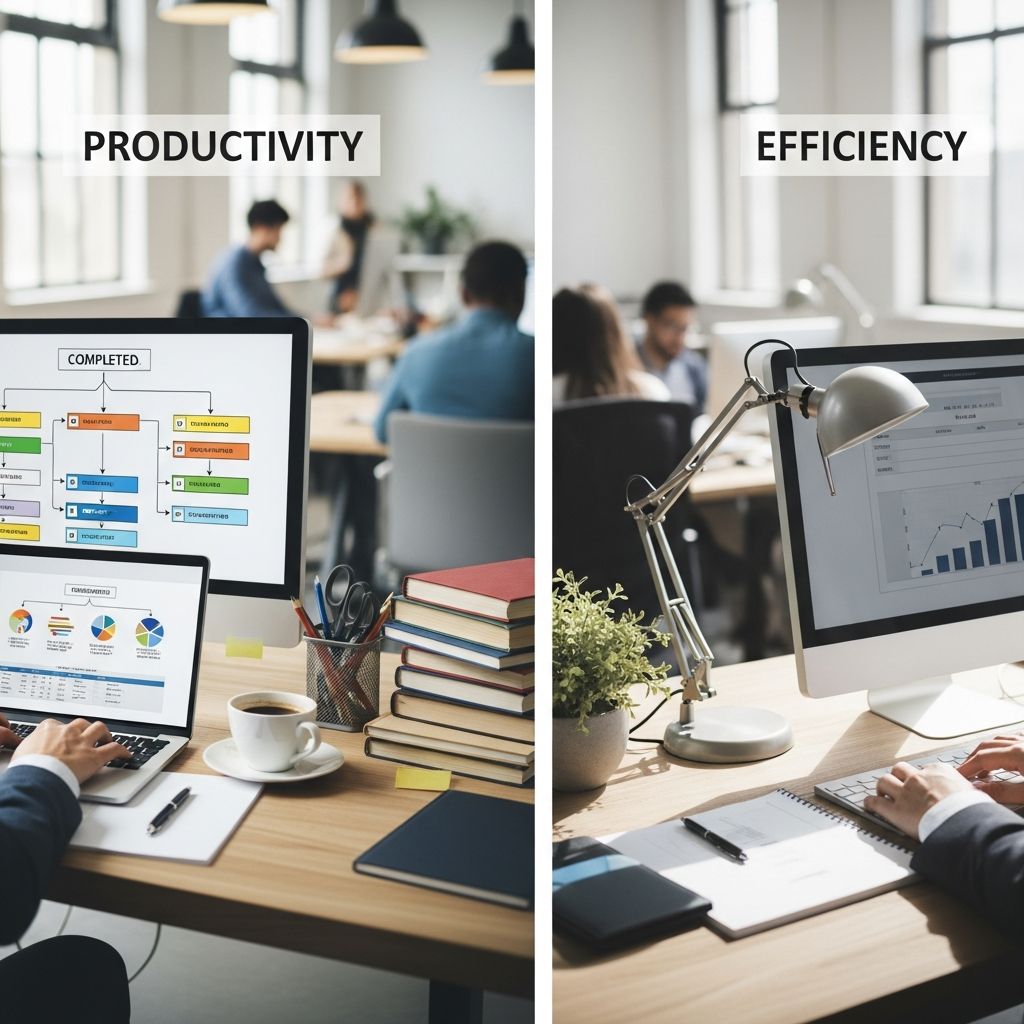
Understanding the nuanced difference between **productivity** and **efficiency** is essential for anyone aiming to excel in professional or personal endeavors. Productivity measures the volume of output achieved within a specific timeframe, while efficiency evaluates how optimally resources like time, effort, and materials are utilized to produce that output. Mastering both leads to sustainable high performance without unnecessary waste or burnout.
Defining the Fundamentals: What Sets Them Apart?
At its core, productivity quantifies achievement: how much work is completed in a given period. It answers the question, “How much did we accomplish?” Efficiency, however, scrutinizes the process: “How well were resources used to get there?” High productivity might mean churning out numerous tasks quickly, but if it involves excessive rework or resource drain, efficiency suffers.
Consider a simple analogy: A chef preparing 100 meals in an hour demonstrates strong productivity. Yet, if half the meals are discarded due to poor ingredient use or sloppy techniques, efficiency is low. Conversely, producing 70 flawless meals with minimal waste showcases balanced excellence.
Key Distinctions at a Glance
| Aspect | Productivity | Efficiency |
|---|---|---|
| Primary Focus | Quantity of output over time | Optimal resource utilization |
| Key Metric | Tasks completed, units produced | Waste reduction, cost per output |
| Potential Pitfall | Burnout from overwork | Stagnation from over-optimization |
| Long-term Goal | Scalable growth | Sustainable processes |
This table highlights how the two concepts complement rather than compete, forming the backbone of effective performance management.
Real-World Formulas for Measurement
To quantify these concepts objectively, use proven formulas. Productivity is often calculated as:
Productivity = Output / Input
For instance, if a team produces 50 widgets using 40 labor hours, productivity is 1.25 widgets per hour.
Efficiency employs a ratio comparing actual performance to ideal standards:
Efficiency (%) = (Standard Time / Actual Time) × 100
If a standard task takes 70 hours but is completed in 82, efficiency is (70/82) × 100 = 85.4%. This reveals opportunities for process refinement.
Industry-Specific Applications and Examples
The interplay of productivity and efficiency varies by sector, demanding tailored approaches.
Manufacturing: Streamlining Assembly Lines
In manufacturing, productivity tracks units produced per shift, while efficiency monitors material waste and machine uptime. Optimizing supply chains reduces defects, allowing the same workforce to yield higher-quality output with fewer resources.
- Productivity Win: Doubling machine speed to hit quotas.
- Efficiency Boost: Predictive maintenance to avoid downtime.
Sales Teams: Closing Deals Smarter
Sales productivity counts deals closed monthly, but efficiency examines cost per acquisition via CRM automation. Focusing on high-value leads ensures more revenue per effort expended.
Remote Work and Collaboration
For distributed teams, productivity involves hitting milestones amid flexible schedules, while efficiency leverages tools like shared docs to minimize miscommunication delays. Dedicated workspaces and clear goals prevent distractions that erode both.
Research and Development: Innovating Wisely
R&D productivity measures patents filed or prototypes built, with efficiency streamlining data analysis via automation. This balance fosters breakthroughs without redundant experiments.
Human Resources: Building Thriving Cultures
HR productivity tallies hires onboarded, while efficiency automates evaluations to cut administrative time. Engagement programs then amplify output through motivated teams.
Challenges Arising from Imbalance
Prioritizing productivity alone risks burnout and quality dips, as overworked teams accumulate errors requiring fixes—ironically reducing net output. Over-emphasizing efficiency can stifle innovation by trimming exploratory efforts.
Distractions compound issues: Regaining focus post-interruption averages 23 minutes, slashing efficiency. Uneven workloads exacerbate this, underscoring the need for balanced strategies.
Proven Strategies to Harmonize Both
Achieving synergy requires deliberate tactics across training, tools, and culture.
Invest in Skill Development
Cross-training equips teams for versatile roles, enhancing adaptability and reducing bottlenecks. Certifications in process optimization directly lift efficiency metrics.
Leverage Technology Thoughtfully
Tools like time trackers and AI schedulers automate routines, freeing capacity for high-value work. In sales, CRM dashboards pinpoint inefficient pipelines.
Cultivate Sustainable Habits
- Enforce focus blocks and mandatory breaks to combat fatigue.
- Monitor workloads to prevent overload.
- Set SMART goals aligning output with resource limits.
Regular audits using the formulas above ensure ongoing alignment.
Foster a Balanced Culture
Leaders modeling rest and reflection encourage teams to work smarter. Recognition for efficient innovations motivates sustained excellence.
Case Studies: Success in Action
A manufacturing firm boosted productivity 30% by adding shifts but saw efficiency plummet from maintenance neglect. Shifting to predictive analytics restored 92% efficiency while maintaining output—a 45% net gain.
In content creation, Writer A averaged 10,000 words weekly but needed heavy edits; Writer B’s 7,000 error-free words proved more efficient overall, saving agency time and costs.
Common Myths Debunked
- Myth: More hours always mean higher productivity. Reality: Diminishing returns kick in; efficiency-focused rest yields better results.
- Myth: Efficiency ignores output. Reality: It amplifies sustainable productivity.
Frequently Asked Questions (FAQs)
What is the main difference between productivity and efficiency?
Productivity focuses on output quantity over time; efficiency emphasizes resource optimization for that output.
Can you be productive but not efficient?
Yes—completing many tasks with high waste exemplifies this, like producing flawed products requiring rework.
How do you calculate workplace efficiency?
Use (Standard Hours / Actual Hours) × 100 for a percentage score.
Which is more important for long-term success?
Both, but balanced efficiency sustains productivity without burnout.
What tools improve efficiency in remote teams?
Collaboration platforms, time trackers, and focus apps minimize waste.
Steps to Implement Today
- Audit current processes with efficiency formulas.
- Prioritize high-impact tasks for productivity gains.
- Train on waste-reduction techniques.
- Track metrics weekly and adjust.
Integrating these elevates performance holistically. By distinguishing and blending productivity with efficiency, individuals and organizations unlock enduring success.
References
- Efficiency vs. Productivity: Understanding the Difference in Workplaces — Melp.us. 2023. https://www.melp.us/blog/efficiency-vs-productivity-understanding-the-difference-in-workplaces/
- Efficiency vs. Productivity: Understanding the Difference — Persona Talent. 2023. https://www.personatalent.com/productivity/efficiency-vs-productivity/
- Productivity vs. Efficiency: Differences and Formulas — ActivTrak. 2024-01-15. https://www.activtrak.com/solutions/productivity-management/productivity-vs-efficiency/
- Efficiency vs Productivity: The Key Difference Managers Need — Yourco.io. 2023. https://www.yourco.io/blog/efficiency-vs-productivity-managers-guide
- Productivity vs Efficiency – What’s the Difference? — TrackingTime.co. 2023. https://trackingtime.co/productivity/productivity-vs-efficiency.html
- Productivity vs Efficiency: Clearing Up the Confusion — Runn.io. 2023. https://www.runn.io/blog/productivity-vs-efficiency

- Integrated M.A. in Applied Linguistics, University of Hyderabad
- 5+ years in editorial, instructional, SEO, and research-based writing
Sneha is a relationships and lifestyle writer with a strong foundation in applied linguistics and certified training in relationship coaching. She brings over five years of writing experience to theskillvault, crafting thoughtful, research-driven content that empowers readers to build healthier relationships, boost emotional well-being, and embrace holistic living. Her writing and insights reflect the belief that beauty, happiness, and wellness…