
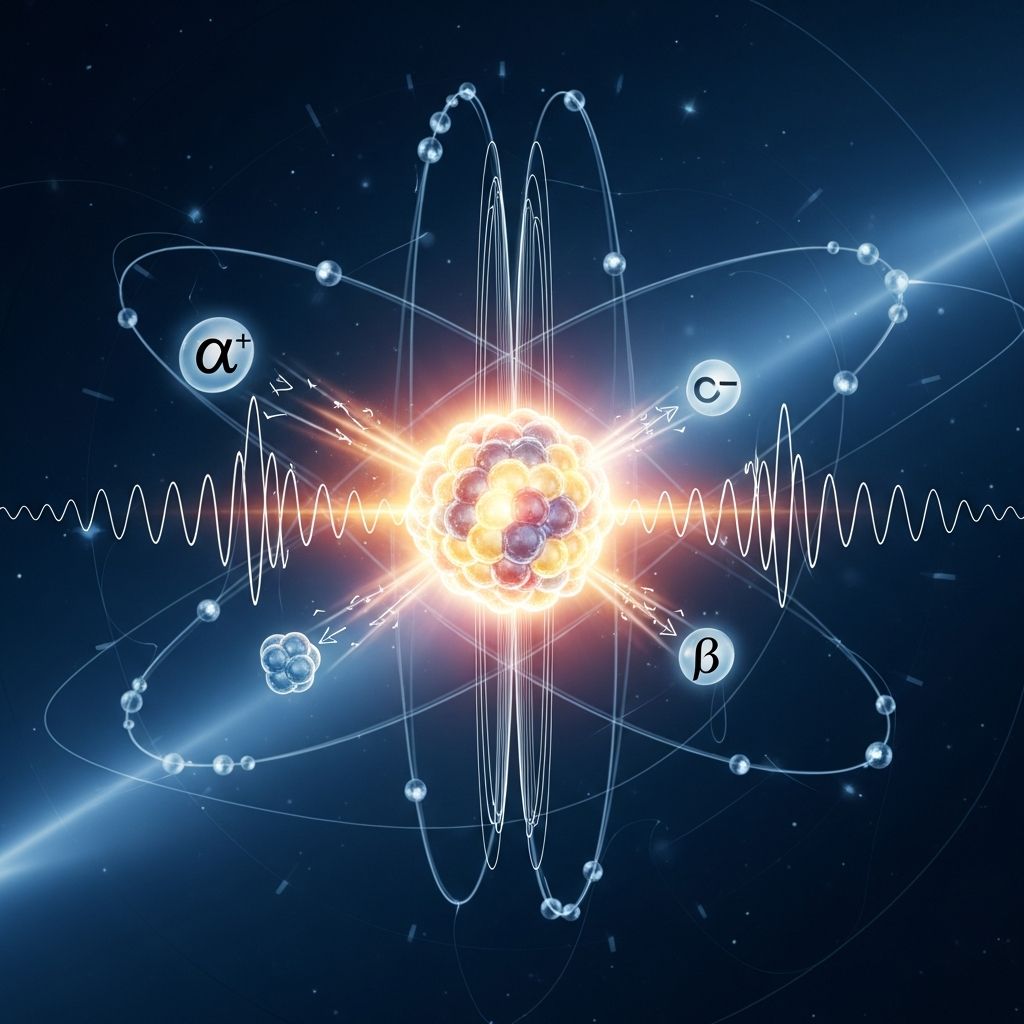
Radioactive decay represents a fundamental process in nuclear physics where unstable atomic nuclei spontaneously release energy in the form of radiation to achieve stability. This phenomenon occurs when the delicate balance of forces within the nucleus is disrupted, prompting it to reorganize into a more stable configuration.
The Instability at the Heart of Atoms
At the core of every atom lies the nucleus, a dense cluster of protons and neutrons bound together by powerful forces. Protons, being positively charged, naturally repel each other due to electromagnetic forces, while the strong nuclear force acts as a glue to hold them in place alongside neutrons. When this equilibrium falters—often due to an excess of protons or neutrons—the nucleus becomes unstable, setting the stage for decay.
Unstable nuclei, known as radionuclides, seek their lowest energy state. This drive toward stability is probabilistic and unpredictable for individual atoms but follows statistical patterns for large samples. Factors like neutron-to-proton ratios play a critical role; lighter elements favor roughly equal numbers, while heavier ones require more neutrons to counter proton repulsion.
Fundamental Forces Governing Decay
Four fundamental forces orchestrate nuclear behavior: gravity (negligible here), electromagnetism, the strong nuclear force, and the weak nuclear force. The strong force binds quarks into protons and neutrons and extends slightly to hold the nucleus together. However, its short range means it weakens beyond a certain distance, allowing imbalances to emerge.
The electromagnetic force drives protons apart, creating tension. The weak force intervenes in processes like beta decay, enabling proton-neutron transformations. Gamma decay, meanwhile, involves electromagnetic transitions as the nucleus sheds excess energy without altering particle numbers.
- Strong Nuclear Force: Provides binding energy but limited in range.
- Electromagnetic Force: Causes proton repulsion in proton-rich nuclei.
- Weak Nuclear Force: Facilitates particle changes in beta decay.
Primary Modes of Radioactive Decay
Decaying nuclei emit various particles or energy forms, categorized into alpha, beta, and gamma decay, each addressing specific instabilities.
Alpha Decay: Ejecting Helium Nuclei
In alpha decay, a nucleus expels an alpha particle—two protons and two neutrons, equivalent to a helium-4 nucleus. This reduces the atomic number by 2 and mass number by 4, often stabilizing heavy elements like uranium or thorium. The process lowers electrostatic repulsion by removing protons while shedding excess mass.
Alpha particles carry significant kinetic energy but have low penetration power, stopped by paper or skin. Despite this, they pose risks if ingested due to intense ionization.
Beta Decay: Transforming Particles
Beta decay occurs in neutron-rich nuclei, where a neutron converts to a proton (beta-minus), emitting an electron and antineutrino, or vice versa (beta-plus). This adjusts the neutron-proton balance without major mass change.
The weak force mediates these transformations, ensuring conservation of charge and lepton number. Daughter nuclei may still be unstable, continuing the decay sequence.
Gamma Decay: Pure Energy Release
Gamma decay follows alpha or beta events, where an excited nucleus emits high-energy photons (gamma rays) to drop to a lower energy state. No change in proton or neutron count occurs, but it completes the stabilization.
Gamma rays are highly penetrating, traversing the body and requiring dense shielding like lead. They pose widespread risks but are invaluable in medical imaging and therapy.
Decay Chains: A Journey to Stability
Rarely does a single decay suffice; most radionuclides form decay chains, sequential transformations ending in a stable isotope, often lead or bismuth. Uranium-238, for instance, undergoes 14 decays through thorium, radium, and radon to reach lead-206.
Each step releases radiation, with intermediate products like radon gas posing environmental hazards due to mobility. Decay chains illustrate nature’s path to equilibrium, powering phenomena like geothermal heat.
| Parent Nuclide | Daughter Product | Decay Type | Half-Life (approx.) |
|---|---|---|---|
| Uranium-238 | Thorium-234 | Alpha | 4.5 billion years |
| Thorium-234 | Protactinium-234 | Beta | 24 days |
| Radium-226 | Radon-222 | Alpha | 1,600 years |
| Lead-210 | Bismuth-210 | Beta | 22 years |
This table highlights key steps in the uranium-238 decay chain, showing diverse decay modes and timescales.
Quantum Tunneling: The Enigma of Spontaneity
Why does decay happen spontaneously? Quantum mechanics provides the answer through tunneling. Nuclei exist in potential energy wells created by the strong force. To emit an alpha particle, it must overcome the Coulomb barrier from proton repulsion—a classical impossibility without immense energy.
Quantum theory posits particles have wave-like properties, allowing a probability of ‘tunneling’ through barriers. This probabilistic escape explains decay’s randomness and exponential half-life laws.
Measuring and Predicting Decay
Decay rates are characterized by half-life, the time for half the nuclei to decay, ranging from fractions of seconds to billions of years. The decay law, N = N₀ e-λt (where λ is the decay constant), governs this, underpinning radiometric dating and reactor design.
Geiger counters and scintillation detectors quantify radiation, aiding safety protocols.
Applications and Risks in Modern Science
Controlled radioactivity fuels nuclear power, providing carbon-free energy via fission-induced chains. Medicine employs radioisotopes for diagnostics (technetium-99m scans) and therapy (iodine-131 for thyroid cancer).
Archaeology benefits from carbon-14 dating, while space missions use plutonium-238 for heat. Yet, risks abound: Chernobyl’s meltdown released chain products, necessitating exclusion zones due to long-lived isotopes.
Health effects stem from ionization damaging DNA, causing mutations or acute radiation syndrome. Shielding varies: alpha by skin, beta by plastic, gamma by lead.
Frequently Asked Questions (FAQs)
What triggers radioactive decay?
Instability from imbalanced protons/neutrons or excess energy prompts nuclei to decay via fundamental forces seeking stability.
Is radioactive decay predictable?
Individual events are random, but large ensembles follow exponential decay laws with precise half-lives.
How dangerous is radiation from decay?
Danger depends on type: alpha is low-penetration but hazardous internally; gamma is highly penetrating.
Can decay be stopped?
No, it’s spontaneous and irreversible, driven by quantum processes.
What are common radioactive elements?
Uranium, thorium, radium, and carbon-14 are prevalent in nature.
Future Frontiers in Nuclear Research
Advances in particle accelerators probe weak force intricacies, potentially unlocking new decay modes. Fusion research aims to harness decay-like processes safely. Understanding neutrino roles in beta decay refines models of supernovae and cosmology.
Environmental monitoring tracks decay chains in soil and water, informing policy on nuclear waste.
References
- Radioactive decay: Discovery, process and causes — Space.com. 2023-10-12. https://www.space.com/radioactive-decay
- Radioactive decay — Wikipedia. 2026-04-01. https://en.wikipedia.org/wiki/Radioactive_decay
- Radioactive Decay — U.S. Environmental Protection Agency (EPA). 2024-08-15. https://www.epa.gov/radiation/radioactive-decay
- Intro to radioactive decay — Khan Academy. 2023-05-20. https://www.khanacademy.org/science/ap-physics-2/x0e2f5a2c:modern-physics/x0e2f5a2c:nuclear-physics/v/intro-to-radioactive-decay
- How Does Radioactive Decay Work? — Science Education Resource Center (SERC), Carleton College. 2022-09-10. https://serc.carleton.edu/quantskills/methods/quantlit/RadDecay.html
- DOE Explains…Radioactivity — U.S. Department of Energy. 2024-03-05. https://www.energy.gov/science/doe-explainsradioactivity

- Integrated M.A. in Applied Linguistics, University of Hyderabad
- 5+ years in editorial, instructional, SEO, and research-based writing
Sneha is a relationships and lifestyle writer with a strong foundation in applied linguistics and certified training in relationship coaching. She brings over five years of writing experience to theskillvault, crafting thoughtful, research-driven content that empowers readers to build healthier relationships, boost emotional well-being, and embrace holistic living. Her writing and insights reflect the belief that beauty, happiness, and wellness…