
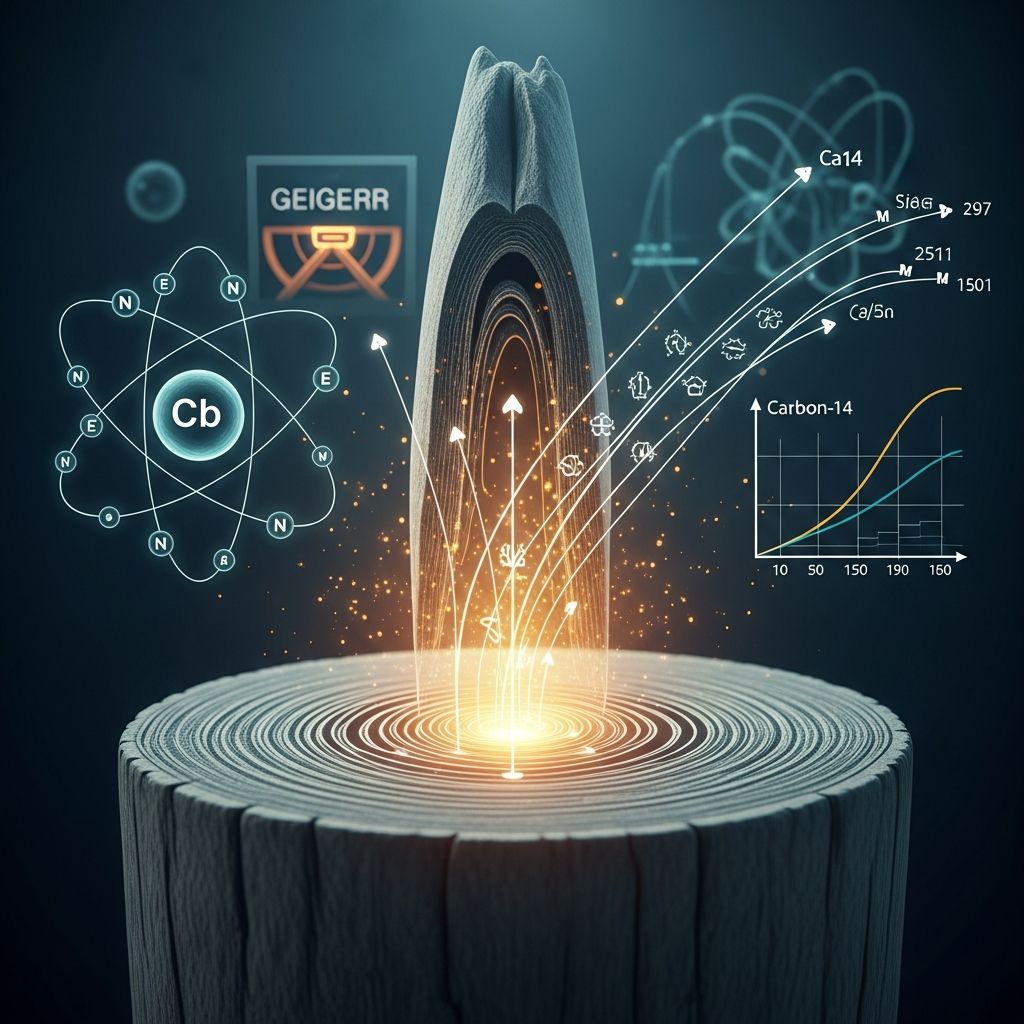
The Fundamentals of Radiocarbon Dating
Radiocarbon dating, commonly referred to as carbon-14 dating or carbon dating, represents one of the most significant scientific breakthroughs in determining the age of organic materials. This technique emerged in the late 1940s at the University of Chicago, developed by Willard Libby, revolutionizing the fields of archaeology, paleontology, and geology. The method fundamentally relies on understanding the behavior of a radioactive isotope of carbon that exists naturally in all living organisms.
At its core, radiocarbon dating operates on a straightforward but elegant principle: all living organisms maintain a relatively constant ratio of carbon-14 to carbon-12 throughout their lifespans. However, once an organism ceases to live, this equilibrium shifts dramatically, initiating a predictable decay process that scientists can measure and interpret to calculate how long ago death occurred. This discovery transformed our ability to construct timelines of human history and understand the chronology of archaeological discoveries.
The Origin of Carbon-14 in Our Atmosphere
To understand radiocarbon dating, one must first comprehend how carbon-14 enters Earth’s biosphere in the first place. The process begins high above our planet, in the upper atmosphere where cosmic rays—subatomic particles continuously bombarding Earth from space—interact with atmospheric molecules. These high-energy particles collide with nitrogen atoms, triggering nuclear reactions that transform nitrogen into carbon-14. This newly formed radioactive isotope combines with atmospheric oxygen to create radioactive carbon dioxide, which circulates throughout the atmosphere.
Plants absorb this radioactive carbon dioxide during photosynthesis, incorporating carbon-14 into their organic tissue. Animals subsequently acquire carbon-14 by consuming plants or other organisms, creating a chain of carbon-14 distribution throughout the food web. This means virtually every living creature on Earth contains a measurable amount of carbon-14 in its body, maintaining a consistent ratio that reflects the atmospheric concentration at the time of the organism’s life.
How Carbon-14 Decay Reveals Age
The key to radiocarbon dating lies in understanding radioactive decay—a natural process where unstable atomic nuclei lose energy and transform into more stable forms. Carbon-14, being a weakly radioactive isotope, continuously decays into nitrogen-14 through the emission of beta particles. Crucially, this decay occurs at a remarkably consistent and predictable rate that remains unaffected by external environmental conditions such as temperature, pressure, or chemical state.
Scientists characterize this decay rate using the concept of half-life, defined as the time required for exactly half of any given sample of radioactive material to decay. The half-life of carbon-14 measures approximately 5,730 years. This means that if a sample contained 100 atoms of carbon-14 at death, after 5,730 years it would contain roughly 50 atoms. After another 5,730 years (11,460 years total), only 25 atoms would remain, and so forth in a predictable geometric progression.
When organisms die, they cease absorbing new carbon from their environment, halting the replenishment of carbon-14 that living systems normally experience. The carbon-14 already present within the deceased organism’s remains begins its inexorable decay toward nitrogen-14. By measuring the current ratio of carbon-14 to carbon-12 (a stable isotope that does not decay), scientists can determine precisely how many half-lives have elapsed since the organism’s death, thereby calculating its age.
Measurement Techniques and Instrumentation
Scientists employ three principal methodologies to measure carbon-14 levels in archaeological and paleontological samples. The first approach, gas proportional counting, detects the faint radioactive emissions produced during beta decay. Instruments such as radiation detectors and counters measure these emissions, translating them into age estimates.
The second method, liquid scintillation counting, involves dissolving samples in specialized chemical solutions that produce light flashes when struck by beta particles. Sensitive photomultiplier tubes detect these flashes, providing quantitative measurements of carbon-14 activity.
The most modern and precise technique, accelerator mass spectrometry (AMS), bypasses radiation detection altogether. Instead, AMS physically separates and counts individual carbon-14 atoms, offering superior sensitivity and requiring much smaller sample sizes than traditional methods. This advancement has expanded radiocarbon dating capabilities and reduced the invasiveness of archaeological testing.
Calibration and Calendar Age Conversion
Raw radiocarbon measurements initially yield what scientists term “radiocarbon years,” a theoretical value assuming constant atmospheric carbon-14 concentrations throughout history. However, atmospheric carbon-14 levels have fluctuated over millennia due to variations in solar activity, Earth’s magnetic field strength, and industrial-era fossil fuel burning. To convert radiocarbon years into actual calendar years, researchers employ calibration curves, graphical representations derived from analyzing samples of known age.
The primary calibration standard used internationally consists of Oxalic Acid I, obtained from the National Institute of Standards and Technology in Maryland, derived from sugar beets harvested in 1955. This standard represents a reference point allowing laboratories worldwide to maintain consistency and comparability in their measurements. Calibration curves incorporate data from tree rings (dendrochronology), ice cores, coral records, and other independently dated materials, creating accurate conversion tools between radiocarbon and calendar ages.
Age Range and Limitations
While radiocarbon dating represents a powerful archaeological tool, it operates within defined parameters. The technique reliably measures organic materials ranging from approximately 300 to 50,000 years old. Some specialized preparation methods occasionally extend this range slightly, but fundamentally, materials older than approximately 60,000 years contain such minimal carbon-14 that accurate measurement becomes extremely challenging.
This limitation stems from the mathematical realities of exponential decay. After approximately 50,000 years, so little carbon-14 remains that background radiation from cosmic rays and potassium-40 decay overwhelms the weak signal from the sample itself, making reliable measurement impossible. For investigating older specimens, archaeologists and paleontologists must employ alternative dating methods such as potassium-argon dating or uranium-series dating, which exploit isotopes with longer half-lives.
What Materials Can Be Dated
Radiocarbon dating exclusively applies to materials that once formed part of a living organism. This includes wood, bone, leather, textiles, paper, and other biological materials containing carbon derived from photosynthetic or metabolic processes. Plant remains such as seeds, charcoal from ancient fires, and peat deposits all yield reliable dates.
Conversely, radiocarbon dating cannot date inorganic materials like rocks, minerals, or metals, as they never incorporated living carbon. Additionally, materials altered significantly by human processing or those contaminated with younger carbon sources may produce unreliable results. Careful sample selection and preparation remain critical for obtaining accurate archaeological dates.
Sources of Error and Contamination
Several factors can compromise radiocarbon dating accuracy. Contamination represents perhaps the most significant threat, occurring when younger carbon from soil, water, or handling procedures infiltrates the sample. Even minuscule amounts of modern carbon can substantially skew age estimates, particularly for older specimens already containing minimal carbon-14.
Laboratory errors in radiation or particle counting, stray radiation striking detection equipment, and improper sample preparation all introduce measurement uncertainty. Environmental factors such as groundwater percolation or microbial activity can alter samples after excavation. Professional archaeologists employ rigorous contamination prevention protocols, including use of sterile tools, protective equipment, and dedicated radiocarbon facilities maintaining controlled environments.
Applications Across Disciplines
Radiocarbon dating has transformed multiple scientific fields. In archaeology, it establishes chronologies for human settlements, artifact assemblages, and cultural transitions, fundamentally reshaping our understanding of prehistory. Paleontologists employ radiocarbon dating to understand recent evolutionary changes and megafauna extinctions. Geologists utilize the technique to date volcanic ash layers, paleosols, and other geological features containing organic material, refining understanding of Earth’s climate and environmental history.
Anthropologists studying human migration patterns, cultural development, and settlement expansion rely heavily on radiocarbon-dated evidence. In conservation, the technique helps authenticate historical documents, artwork, and manuscripts, distinguishing genuine artifacts from forgeries.
Historical Timeline: From Discovery to Modern Application
Willard Libby’s groundbreaking development of radiocarbon dating in 1947 earned him the Nobel Prize in Chemistry, reflecting the technique’s revolutionary impact. Initially, measurements employed beta counting methods requiring relatively large samples. The 1970s introduction of accelerator mass spectrometry dramatically enhanced precision while reducing sample size requirements from grams to milligrams.
Subsequent refinements in calibration standards, particularly the development of comprehensive calibration curves incorporating multiple independent dating methods, progressively improved accuracy. Contemporary radiocarbon laboratories integrate advanced computer modeling, statistical analysis, and quality assurance protocols, making the technique increasingly reliable for chronological reconstruction.
Comparing Radiocarbon with Alternative Dating Methods
| Dating Method | Age Range | Applicable Materials | Precision |
|---|---|---|---|
| Radiocarbon (C-14) | 300–60,000 years | Organic materials only | ±50–100 years typically |
| Potassium-Argon | 100,000+ years | Volcanic rocks, minerals | ±2–5% |
| Uranium-Series | 1,000–500,000 years | Coral, shells, speleothems | ±1–3% |
| Thermoluminescence | 100–100,000 years | Fired pottery, sediments | ±5–10% |
| Dendrochronology | 10,000 years | Tree rings only | ±1 year |
Frequently Asked Questions About Radiocarbon Dating
Q: How accurate is radiocarbon dating?
A: When properly executed with careful sample preparation and appropriate calibration, radiocarbon dating typically achieves accuracy within ±50 to 100 years for materials between 3,000 and 10,000 years old. Accuracy decreases for older materials as carbon-14 levels become increasingly depleted. Modern facilities using accelerator mass spectrometry generally achieve superior precision compared to traditional beta counting methods.
Q: Can radiocarbon dating be used on dinosaur fossils?
A: No. Dinosaurs disappeared approximately 66 million years ago, far exceeding the maximum dating range of radiocarbon methods. After approximately 50,000 years, insufficient carbon-14 remains for reliable measurement. Paleontologists studying dinosaurs employ radiometric dating techniques utilizing longer-lived isotopes such as potassium-40 or uranium-238.
Q: What does “radiocarbon years BP” mean?
A: BP stands for “years Before Present,” a standardized convention in radiocarbon dating where “Present” is defined as 1950. This standardization enables consistent communication among scientists worldwide and provides a fixed reference point for calibration. Dates reported as “BP” reflect the number of years prior to 1950.
Q: Why can’t we date all ancient materials?
A: Radiocarbon dating requires organic material containing carbon derived from living organisms. Inorganic materials like stone tools, metals, or minerals never incorporated living carbon, making radiocarbon dating impossible. Additionally, heavily contaminated or altered samples may yield unreliable results due to carbon exchange with surrounding environments.
Q: How do scientists account for changes in atmospheric carbon-14 levels?
A: Calibration curves, derived from independently dated materials like tree rings and ice cores, convert radiocarbon measurements into calendar years. These curves mathematically compensate for historical atmospheric carbon-14 fluctuations, enabling accurate age estimation despite past variations in cosmic ray intensity and other environmental factors.
References
- Radiocarbon dating — Wikipedia. https://en.wikipedia.org/wiki/Radiocarbon_dating
- Carbon-14 dating, explained — UChicago News. 2024. https://news.uchicago.edu/explainer/what-is-carbon-14-dating
- radiocarbon dating — Students | Britannica Kids. https://kids.britannica.com/students/article/radiocarbon-dating/276638
- Radiocarbon Dating — Museum of Anthropology, University of Missouri. https://anthromuseum.missouri.edu/radiocarbon-dating
- What is Carbon-14 (14C) Dating? — Radiocarbon.com. https://www.radiocarbon.com/about-carbon-dating.htm
- Answers to Creationist Attacks on Carbon-14 Dating — National Center for Science Education. https://ncse.ngo/answers-creationist-attacks-carbon-14-dating
- Radiocarbon Dating — Oxford Radiocarbon Accelerator Unit. https://c14.arch.ox.ac.uk/dating

Medha Deb is an editor with a master's degree in Applied Linguistics from the University of Hyderabad. She believes that her qualification has helped her develop a deep understanding of language and its application in various contexts. Medha specializes in the areas of beauty, health, sports, and wellness and is committed to ensuring that the content on the website is…