
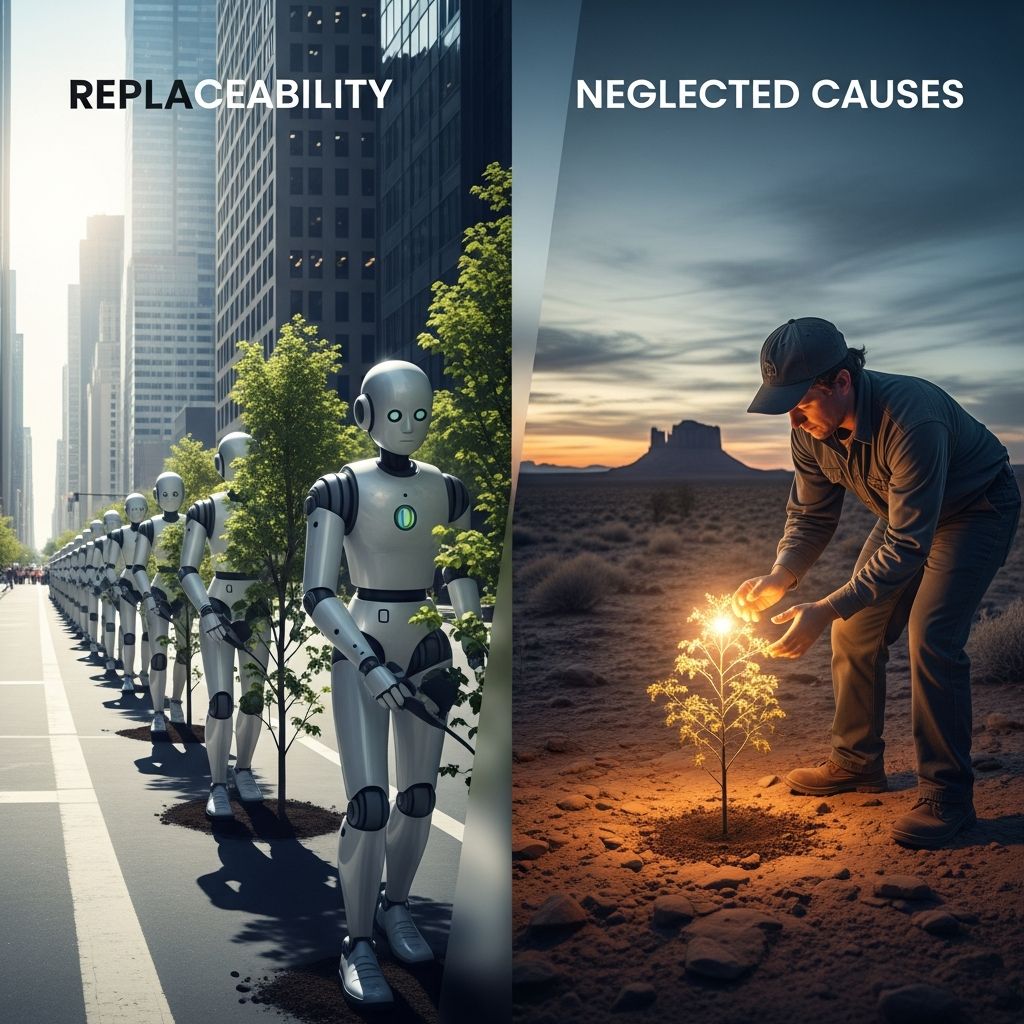
Most people judge their impact by what they see themselves doing: patients treated, students taught, or dollars donated. Effective altruism suggests a deeper question: what difference did you make compared to what would have happened without you? This idea, known as replaceability, radically changes how we think about careers, charity, and doing good in the world.
Why Visible Good Can Be Misleading
At first glance, career and charity decisions seem straightforward: choose the path where you help the greatest number of people directly. But this view overlooks two crucial ideas from economics and evaluation research:
- Counterfactual impact: your true impact is the difference between what happens with you and what would have happened otherwise.
- Marginal returns: extra resources added to a crowded field often do less good than the same resources in a neglected one.
These concepts are central to effective altruism, a movement that uses evidence and reason to figure out how individuals can do the most good with their time and money.
Understanding Replaceability
Replaceability in altruistic work is the degree to which the good you would do in a role would still happen if someone else took your place.
In more formal terms:
- Apparent impact: the good you directly produce (for example, vaccines administered or articles written).
- Counterfactual replacement: what the next most likely person would have done in your role.
- Actual impact: apparent impact minus the replacement’s impact.
This matters because many socially valued roles—like medicine, teaching, or law—are capacity constrained. If you do not take that place in medical school, another qualified applicant probably will; your personal effect is then the difference between your performance and theirs, not the full value of all the patients treated.
Replaceability as a Question, Not a Verdict
Replaceability is not an argument that socially beneficial careers are pointless. Instead, it is a tool that prompts you to ask:
- How competitive is this role or training path?
- How similar are the people who would be hired if I were not?
- Are there bottlenecks somewhere else in the system where I could be harder to replace?
Thinking this way can reveal surprisingly large differences in long-term impact between options that look equally virtuous on the surface.
Neglected Causes: Where Extra Effort Goes Furthest
A second key idea is neglectedness. A cause is neglected when it receives little money, talent, or attention relative to its importance and the tractability of progress.
Economic research on philanthropy and public goods shows that the marginal impact of an extra dollar or worker is typically higher in areas where few others are already working. This is closely related to the idea of diminishing returns: once the obvious and cheapest interventions are done, further gains become progressively more expensive.
Why Neglectedness Multiplies Impact
Choosing a neglected cause can increase your impact because:
- Few natural replacements: if you do not work on it, there may be no one else ready to step in.
- More low-hanging fruit: early efforts can identify and exploit high-return interventions.
- Shaping a new field: you can influence norms, standards, and research agendas in ways that many latecomers cannot.
Modern cause-prioritization work—such as evaluations of global health charities or policy interventions—explicitly uses neglectedness, alongside scale and tractability, to estimate where additional resources do the most good.
Replaceability and Neglectedness: How They Interact
Replaceability and neglectedness point in the same direction: you generally gain more impact by moving into areas where you can not easily be replaced and where few others are already working. We can summarize this interaction:
| Factor | High-Replaceability / Crowded | Low-Replaceability / Neglected |
|---|---|---|
| Typical roles | Common professions with oversubscribed training pipelines (e.g. popular clinical specialties) | Early-stage research, unusual policy niches, or new cause areas |
| Main effect of your entry | Displaces someone similar; net effect is modest difference in performance | Adds capacity that may not exist otherwise; creates new projects or institutions |
| Strategic benefit | Stability, prestige, clear contribution | Potential for outsized or field-shaping impact; more uncertainty |
Practical Framework for Career Decisions
When you evaluate a potential path, you can systematically consider total impact, replaceability, and neglectedness rather than only visible good or personal satisfaction.
Step 1: Map the Direct and Indirect Effects
For each option, distinguish between:
- Direct impact: who benefits from your day-to-day work (patients, readers, clients, policy beneficiaries).
- Indirect impact: what you can do with your income, skills, network, and credibility over time (donations, advocacy, mentoring).
For example, policy or research careers are often defended not only by their direct outputs, but also by the way they influence institutions and allocate large budgets.
Step 2: Ask the Replaceability Questions
Then ask:
- Is entry to this field constrained by limited training positions or funding, or is there slack capacity?
- What is the typical profile of the person I would displace if I take this role?
- In what ways would I be systematically better or worse than my likely replacement (skills, values, risk-tolerance, cause priorities)?
High replaceability is not a reason to dismiss a path entirely, but it should shift attention to where you differ from the average candidate and how that affects outcomes.
Step 3: Consider Neglectedness and Comparative Advantage
Next, look for intersections between:
- What the world lacks (neglected problems, geographies, or methods).
- What you are unusually good at or can become good at (language skills, quantitative analysis, communication, entrepreneurship).
Comparative advantage matters because highly neglected work is often demanding; you maximize impact by playing to your strengths while occupying a slot that few others can fill well.
Earning to Give vs Direct Work
Effective altruism discussions often contrast two stylized options:
- Direct work: spending your career inside an organization that directly addresses a pressing problem (for example, global health implementation or AI safety research).
- Earning to give: pursuing a high-earning career primarily to donate a large fraction of your income to effective organizations.
The Replaceability Angle
Replaceability affects both paths:
- In some sectors, one additional person in a standard direct-delivery role adds relatively little extra capacity because someone else would have filled the job.
- Meanwhile, in many high-earning roles, the counterfactual replacement would not donate nearly as much as a committed effective altruist, so your donation stream is much harder to replace.
Research on charitable cost-effectiveness shows that some global health and development interventions avert very large amounts of suffering per dollar when implemented well, which further amplifies the value of targeted donations from high earners.
Why Replaceability Is Not Everything
Replaceability is only one piece of the puzzle and by itself does not show that earning to give always wins. Other important considerations include:
- Flexibility: direct work can offer chances to change strategy, influence institutions, and identify new neglected problems that money alone cannot fix.
- Personal fit: some people are far better suited to research, management, or field implementation than to high-earning careers, which affects both performance and long-run motivation.
- Risk and time-scale: some direct work focuses on uncertain but potentially transformative long-run outcomes (for example, policy change or catastrophic risk reduction), which are hard to value purely through replaceability lenses.
Current writing in effective altruism treats replaceability as one important correction to naive impact estimates, not as a decisive argument for a single career strategy.
Common Misunderstandings
“If I’m Replaceable, My Work Doesn’t Matter”
Even in highly competitive fields, individual variation in performance and values can matter a great deal. Two people in the same role can differ on which projects they prioritize, how they respond to new evidence, and how they use their influence over colleagues and stakeholders. Evaluations of large institutions and health systems routinely find substantial variation in outcomes between apparently similar providers.
“Neglected Causes Must Be Obscure or Fringe”
A cause can be neglected even if it is widely known, as long as the resources devoted to the most effective interventions are small relative to the scale of the problem. For example, global health research has highlighted extremely cost-effective interventions—such as certain preventive measures in low-income countries—that historically received far less attention than domestic health spending in rich countries.
“Replaceability Encourages Cynical Career Choices”
Some worry that focusing on replaceability licenses people to ignore personal values or social norms. In practice, thoughtful applications:
- Emphasize avoiding serious ethical harms and conflicts of interest.
- Incorporate well-being, integrity, and community as constraints, not afterthoughts.
- Highlight benign or prosocial high-impact paths, such as transparent research, public-interest policy, and targeted philanthropy.
Designing a High-Impact Plan
You can integrate these ideas into a concrete medium-term plan rather than treating them as abstract philosophy.
1. Audit Your Current Path
- List your main professional activities and approximate who benefits.
- Estimate how easily someone similar could replace you in your core tasks.
- Note any parts of your work where you have unusual autonomy or leverage.
2. Identify Under-Served Problems You Could Work On
- Look for cause areas with large scale harms, limited funding, and promising interventions.
- Check whether your current skills could transfer to these problems with additional training.
- Consider both direct roles and support roles (operations, data, management) in such areas.
3. Build Re-Deployable Career Capital
Whether you aim for direct work or earning to give, it helps to accumulate career capital: skills, credentials, and networks that keep your options open.
- General analytical skills and quantitative literacy.
- Experience in project management, policy analysis, or research methods.
- Reputation for reliability, integrity, and thoughtful judgment.
This makes it easier to shift into neglected opportunities as they emerge, lowering your personal risk while enabling you to target your effort where replaceability is lowest.
Frequently Asked Questions
Q: How can I estimate my replaceability in a given career?
A: Start by asking how competitive entry is, how many qualified candidates are turned away, and how similar you are to the median successful applicant. If many equally qualified people are waiting for the same role, your presence probably displaces someone similar and reduces your counterfactual impact on that margin. You then look for ways you differ—values, specialization, willingness to focus on neglected problems—that might still give you substantial net impact.
Q: Does replaceability mean I should avoid socially valued professions?
A: No. Replaceability suggests you should compare those professions against alternatives using counterfactual reasoning, not that you should rule them out. In many cases, the combination of direct impact, opportunities for advocacy, and the ability to donate from a stable income will still make them excellent choices, especially if you can steer your work toward neglected issues.
Q: How do neglected causes relate to evidence and cost-effectiveness?
A: Neglectedness is only one criterion. Effective altruism typically evaluates causes and interventions based on scale (how big the problem is), tractability (how solvable it is), and neglectedness (how many resources are already there). Within a neglected area, high-quality evidence and careful cost-effectiveness analysis are still crucial for deciding exactly what to fund or work on.
Q: Should everyone pursue high-earning careers to donate more?
A: Not necessarily. Earning to give can be very impactful for people with a strong fit for high-earning roles and the psychological stability to sustain large, long-term giving commitments. Others may contribute more through research, entrepreneurship, or policy work in critical but under-resourced areas. The key is to compare realistic options using counterfactual impact, neglectedness, and personal fit rather than following a single template.
Q: How often should I revisit my impact-focused career plan?
A: It is sensible to re-evaluate your plan every few years or after major life changes. New research, shifting global risks, and evolving personal skills can all change where you are least replaceable and where additional work is most needed. Building flexible career capital makes these course corrections easier.
References
- GiveWell’s approach to charity evaluation — GiveWell. 2023-06-15. https://www.givewell.org/how-we-work
- Effective Altruism: Introduction — Centre for Effective Altruism. 2022-09-10. https://www.centreforeffectivealtruism.org/effective-altruism
- Effective altruism, dynamic effects, and coordination — Gustaf Arrhenius, Institute for Futures Studies. 2016-10-01. https://www.iffs.se/media/22052/effective-altruism-j-dynamic-effects-j-and-coordination-institute-for-futures-studies-october-2016-4.pdf
- Replaceability — Effective Altruism Forum (Topic Overview). 2020-03-05. https://forum.effectivealtruism.org/topics/replaceability
- ‘Replaceability’ isn’t as important as you might think — 80,000 Hours. 2015-07-23. https://80000hours.org/2015/07/replaceability-isnt-as-important-as-you-might-think-or-weve-suggested/
- Art is a waste of time – or so Effective Altruism claims — Rhys Southan, Aeon. 2015-11-24. https://aeon.co/essays/art-is-a-waste-of-time-or-so-effective-altruism-claims
- Effective altruism — Stanford Encyclopedia of Philosophy. 2019-04-30. https://plato.stanford.edu/entries/effective-altruism/

Medha Deb is an editor with a master's degree in Applied Linguistics from the University of Hyderabad. She believes that her qualification has helped her develop a deep understanding of language and its application in various contexts. Medha specializes in the areas of beauty, health, sports, and wellness and is committed to ensuring that the content on the website is…