
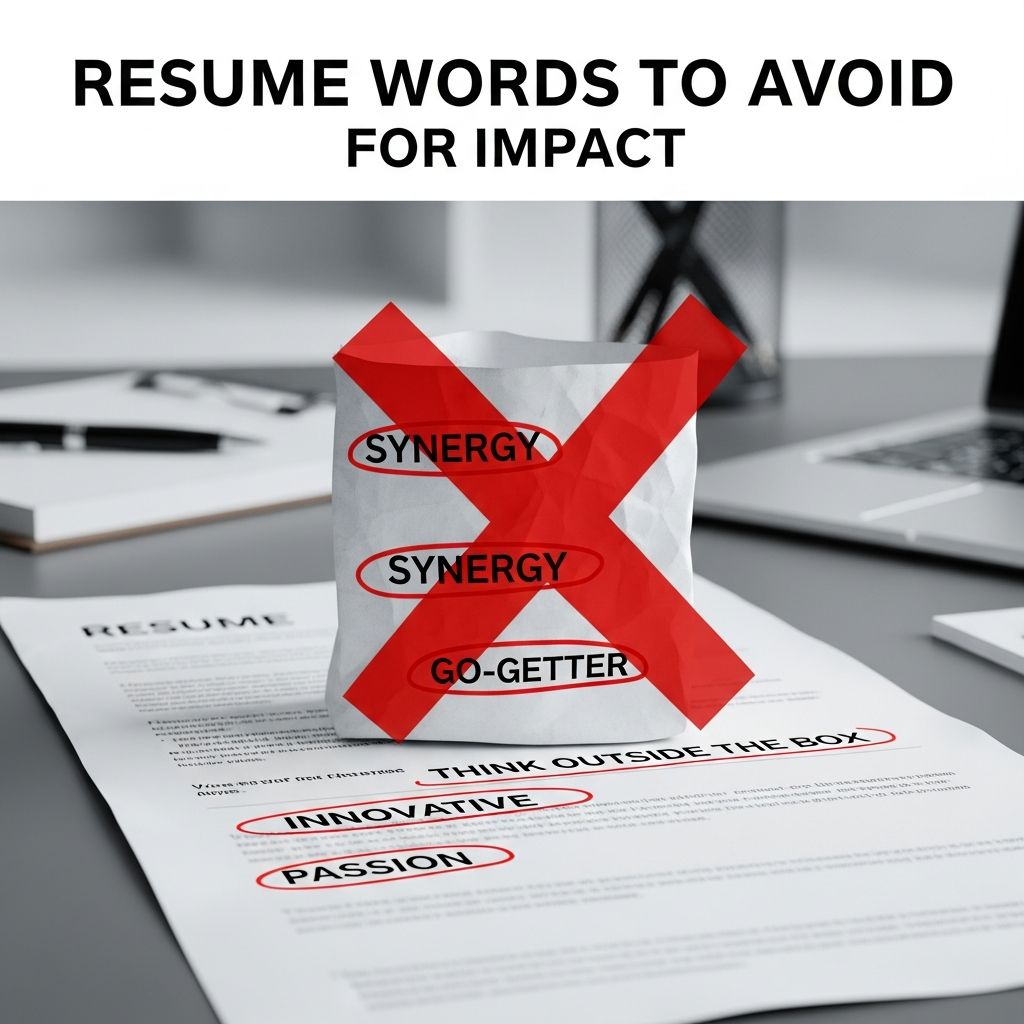
Resumes serve as your professional gateway, yet certain words can undermine their effectiveness by appearing generic or unsubstantiated. Hiring managers scan documents quickly, often in seconds, dismissing overused terms that fail to convey specific value. This article explores problematic language to eliminate, drawing from university career centers and job platforms, while providing strategies for stronger phrasing.
Why Certain Words Derail Your Resume
Recruiters receive hundreds of applications daily, leading them to prioritize concrete achievements over vague descriptors. Terms lacking evidence blend into the background, reducing your visibility. For instance, academic sources emphasize action-oriented language that quantifies impact, such as percentages or outcomes, over subjective adjectives.
Using precise verbs and metrics demonstrates fit for roles, aligning with employer needs. Avoiding filler words keeps content concise, typically one page, enhancing readability with 10-12 point fonts and 0.5-inch margins.
Common Culprits: Vague Adjectives That Dilute Strength
Adjectives promising traits without proof invite skepticism. Instead, integrate examples from experience to substantiate claims naturally.
- Dynamic: Implies energy but lacks detail. Replace with ‘Led cross-functional teams to deliver projects 15% under budget,’ focusing on results.
- Hardworking: Universally claimed, yet unprovable. Opt for ‘Managed 50+ client accounts daily, achieving 98% retention rate.’
- Creative: Subjective; specify ‘Developed innovative marketing campaign increasing engagement by 30%.’
- Passionate: Emotional without metrics. Use ‘Drove product launches resulting in $500K revenue growth over two quarters.’
These shifts transform abstracts into tangibles, mirroring advice from career services to vary verbs and avoid repetition.
Overused Action Terms Lacking Punch
Even verbs can weaken if clichéd. Strong alternatives propel narratives forward, emphasizing contributions.
| Weak Word | Why Avoid | Strong Alternative | Example |
|---|---|---|---|
| Responsible for | Passive; doesn’t show initiative | Achieved / Delivered | Achieved 20% sales increase through targeted outreach |
| Experienced | Vague tenure without impact | Proven / Specialized | Proven track record in optimizing supply chains for Fortune 500 clients |
| Team Player | Generic; assumed trait | Collaborated / Partnered | Partnered with engineering to streamline processes, saving 10 hours weekly |
Such replacements, recommended by Drexel University, use present tense for current roles and past for prior ones, incorporating keywords from job descriptions.
Building a Powerful Professional Summary
The opening summary, 3-4 lines, hooks readers by defining your edge without first-person pronouns like ‘I’ or ‘my’. It outlines title, skills, accomplishments, and goals tied to the role.
Steps for Effectiveness:
- State professional title or descriptor, e.g., ‘Results-driven Marketing Specialist.’
- Highlight 2-3 quantified achievements, e.g., ‘Boosted lead generation by 40% via data analytics.’
- Align career objectives, e.g., ‘Eager to leverage SEO expertise in fast-paced e-commerce environment.’
Example for Software Developer: ‘Full-stack developer with 5+ years optimizing applications for scalability. Engineered features adopted by 100K users, reducing load times by 25%. Seeking senior role to innovate cloud solutions.’ This format, per Indeed, personalizes without rambling.
Mastering Experience Descriptions
Under each role, list organization, location, dates, and title in reverse chronology. Follow with 3-4 bullet points starting with varied action verbs, avoiding ‘worked’ or passive structures.
- Quantify: ‘Increased revenue by 35%’ over ‘Handled sales.’
- Focus relevance: Tailor to job keywords like ‘agile methodology’ for tech roles.
- Show progression: Note multiple titles if applicable.
Georgetown Career Center advises against exaggeration, ensuring interview-ready claims. For entry-level, draw from education or volunteering.
Traits to Sidestep in Self-Descriptions
Words evoking unverified personality traits clutter resumes. Alberta’s career site lists descriptive adjectives but urges backing them.
- Detail-oriented: Common; prove via ‘Audited financials spotting $10K discrepancies.’
- Proactive: Replace with ‘Initiated process automation cutting errors 50%.’
- Flexible: Use ‘Adapted to remote workflows maintaining 100% deadline adherence during transitions.’
Harvard’s guidelines reinforce action words over pronouns, marketing your readiness.
Alternatives: Power Verbs and Phrases
Power verbs convey authority. Categorize for variety:
- Leadership: Orchestrated, Mentored, Directed.
- Achievement: Exceeded, Amplified, Generated.
- Technical: Engineered, Deployed, Analyzed.
- Communication: Articulated, Negotiated, Persuaded.
Incorporate industry terms, e.g., ‘Utilized CRM tools’ for sales.
Proofreading and Customization Tips
Read aloud to catch awkward phrasing; update regularly as experience evolves. Tie to job descriptions for ATS compatibility. Avoid flowery language; stay factual.
FAQs
Should I use first-person in resumes?
No, omit ‘I’ for objectivity, unlike cover letters.
How long should bullet points be?
One line ideally, focusing on impact.
Can I include soft skills?
Yes, but quantify, e.g., ‘Fostered team cohesion improving productivity 15%.’
What if I lack experience?
Highlight transferable skills from academics or projects.
Is a table useful for skills?
For comparisons yes, but keep simple; prioritize bullets for experiences.
Final Thoughts on Resume Language Precision
Refining word choice elevates your resume from ordinary to standout. Prioritize evidence-based statements, aligning with recruiter preferences for brevity and relevance. Regularly tailor and proofread to reflect your evolving career narrative effectively.
References
- How To Write an “About Me” Section in Your Resume — Indeed.com. 2025-08-01. https://www.indeed.com/career-advice/resumes-cover-letters/how-to-write-an-about-me-in-resume
- How to Describe Your Work Experience — Drexel University. n.d. https://drexel.edu/scdc/professional-resources/application-materials/resumes/experience-description
- Resume Content & Formatting — Georgetown University Cawley Career Education Center. n.d. https://careercenter.georgetown.edu/major-career-guides/resumes-cover-letters/resume-formatting-tips/
- What should I include in my professional summary in my resume — CareerVillage.org. n.d. https://www.careervillage.org/questions/47672/what-should-i-include-in-my-professional-summary-in-my-resume
- CREATE A STRONG RESUME — Harvard University Mignone Center for Career Success. n.d. https://careerservices.fas.harvard.edu/resources/create-a-strong-resume/
- Choose Power Words to Make Your Resumé Stand Out — ALIS Alberta.ca. n.d. https://alis.alberta.ca/look-for-work/resumes-and-references/choose-power-words-to-make-your-resume-stand-out/

Medha Deb is an editor with a master's degree in Applied Linguistics from the University of Hyderabad. She believes that her qualification has helped her develop a deep understanding of language and its application in various contexts. Medha specializes in the areas of beauty, health, sports, and wellness and is committed to ensuring that the content on the website is…