
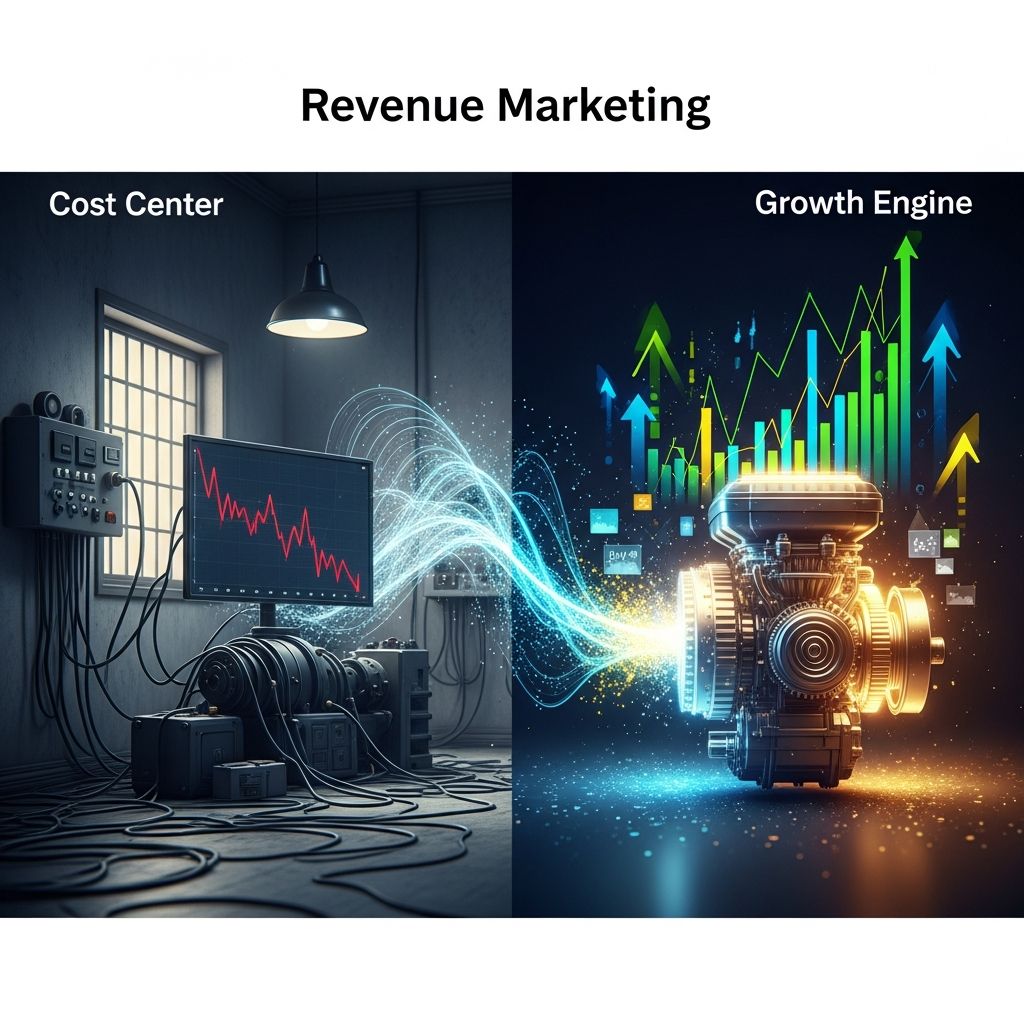
From Brand Awareness to Bottom-Line Impact
For decades, marketing was seen as a function focused on awareness, perception, and lead volume. Success was measured in impressions, clicks, and MQLs. But in today’s competitive landscape, that model is no longer enough. Companies now expect marketing to be a direct contributor to revenue, not just a support function.
This shift has given rise to what many now call revenue marketing: a strategic, data-driven approach where every campaign, channel, and initiative is designed and evaluated based on its measurable impact on revenue. It’s not about abandoning brand or demand generation; it’s about evolving them so they serve a clear business outcome.
What Revenue Marketing Actually Means
Revenue marketing is the practice of aligning marketing activities with specific revenue goals and measuring performance based on financial outcomes rather than vanity metrics. It’s a mindset shift—from asking “How many leads did we generate?” to “How much pipeline and revenue did we influence?”
At its core, revenue marketing is about:
- Setting clear, quantifiable revenue targets for marketing
- Aligning marketing and sales around shared KPIs
- Using data to attribute revenue to specific campaigns and channels
- Optimizing the entire customer journey, not just the top of the funnel
- Treating marketing as a revenue center, not a cost center
This doesn’t mean marketing abandons creativity or brand building. Instead, those efforts are intentionally tied to revenue outcomes—whether that’s accelerating deals, expanding existing accounts, or improving retention and expansion.
Why the Shift Is Happening Now
Several forces are driving the move toward revenue marketing:
- Increased pressure on ROI: With tighter budgets and higher scrutiny, marketing must prove its financial impact.
- More sophisticated buyers: B2B buyers are more informed and expect personalized, relevant experiences at every stage.
- Better data and tools: CRM, marketing automation, and analytics platforms now make it possible to track influence across the funnel.
- Expectations from leadership: CEOs and CFOs increasingly expect marketing to be a growth engine, not just a brand function.
As a result, marketing leaders are being asked to think like business leaders—focusing on pipeline, conversion, and customer lifetime value, not just traffic and leads.
Key Pillars of a Revenue Marketing Approach
Building a revenue marketing function requires more than just new KPIs. It requires a structural and cultural shift across several areas.
1. Strategic Alignment with Business Goals
Revenue marketing starts with alignment. Marketing must understand the company’s revenue targets, growth levers, and go-to-market strategy. This means:
- Participating in annual and quarterly planning cycles
- Understanding product roadmap and pricing strategy
- Defining how marketing will contribute to new logo acquisition, expansion, and retention
Without this alignment, marketing risks running campaigns that don’t move the needle on the metrics that matter most to the business.
2. Full-Funnel Ownership
Traditional marketing often stops at MQL. Revenue marketing, however, takes ownership of the entire funnel—from awareness through conversion, expansion, and advocacy.
This means:
- Investing in content and campaigns that support sales enablement
- Creating nurture streams that move prospects closer to a buying decision
- Developing programs that drive adoption, upsell, and cross-sell
- Measuring impact at each stage, not just at the top
By owning more of the funnel, marketing becomes a true growth partner, not just a lead source.
3. Data-Driven Decision Making
Revenue marketing is inherently data-driven. Gut feel and best practices are no longer sufficient. Instead, decisions are based on:
- Attribution models that show how marketing influences deals
- Funnel metrics like conversion rates, velocity, and win rates
- Customer lifetime value (LTV) and customer acquisition cost (CAC)
- Return on marketing investment (ROMI) by channel and campaign
This data allows marketing to double down on what’s working, optimize or kill what’s not, and continuously improve performance over time.
4. Deep Sales and RevOps Collaboration
Revenue marketing only works when marketing and sales are truly aligned. This requires:
- Shared definitions of leads, opportunities, and stages
- Regular syncs to review pipeline, conversion, and feedback
- Joint planning of campaigns and plays
- Collaboration with RevOps to ensure clean data, proper attribution, and a single source of truth
When marketing and sales operate in silos, revenue leaks occur. When they work together, they can create a predictable, scalable growth engine.
5. Customer-Centric Campaign Design
Revenue marketing is not about blasting generic messages. It’s about delivering the right message, to the right person, at the right time, based on their stage in the journey.
This requires:
- Strong buyer personas and ICPs
- Segmented messaging and offers
- Personalized email, ads, and content experiences
- Feedback loops from sales and customer success to refine messaging
By focusing on relevance and value, revenue marketing increases conversion rates, shortens sales cycles, and improves customer satisfaction.
How Revenue Marketing Changes What You Measure
One of the most visible shifts in revenue marketing is in the metrics. Instead of focusing on top-of-funnel vanity metrics, revenue marketers prioritize outcomes that directly tie to revenue.
Metrics That Matter in Revenue Marketing
| Traditional Marketing | Revenue Marketing |
|---|---|
| Website visits | Marketing-influenced pipeline |
| Leads generated | Marketing-sourced revenue |
| Email open rates | Deal velocity and win rates |
| Social media likes | Customer lifetime value (LTV) |
| Content downloads | Return on marketing investment (ROMI) |
These metrics force marketing to think in terms of business impact. For example:
- Instead of “We generated 1,000 leads,” the question becomes “How much pipeline and revenue did those leads generate?”
- Instead of “Our email campaign had a 40% open rate,” the focus shifts to “How many of those opens turned into opportunities and closed deals?”
Building a Revenue Marketing Strategy: A Practical Framework
Transitioning to revenue marketing doesn’t happen overnight. It requires a structured approach that balances strategy, execution, and measurement.
Step 1: Define Revenue Goals and Targets
Start by understanding the company’s revenue goals. Then, define how marketing will contribute:
- What percentage of pipeline should marketing own?
- What is the target for marketing-sourced revenue?
- What are the goals for new logo acquisition vs. expansion?
These targets should be specific, measurable, and time-bound.
Step 2: Map the Customer Journey
Revenue marketing requires a deep understanding of the buyer’s journey. Map out each stage:
- Awareness: How do prospects discover your brand?
- Consideration: What content and experiences help them evaluate your solution?
- Decision: What sales and marketing plays help them choose you?
- Retention & Expansion: How do you keep them happy and drive expansion?
For each stage, define the role of marketing and the desired outcomes.
Step 3: Align with Sales on Definitions and Processes
Work with sales to agree on:
- Lead and opportunity definitions
- Handoff processes and SLAs
- Shared KPIs (e.g., conversion rates, pipeline velocity)
- Feedback mechanisms (e.g., win/loss analysis, deal reviews)
This alignment ensures that marketing efforts are directly tied to sales outcomes.
Step 4: Implement Attribution and Measurement
Set up systems to track and attribute revenue to marketing activities. This typically involves:
- CRM and marketing automation integration
- Multi-touch attribution models (first touch, last touch, linear, U-shaped, etc.)
- Reporting dashboards that show pipeline, revenue, and ROMI by channel and campaign
Start simple if needed, but aim for a model that reflects how marketing actually influences deals.
Step 5: Optimize and Iterate
Revenue marketing is not a one-time project. It’s an ongoing process of testing, measuring, and improving. Regularly review:
- Which channels and campaigns are driving the most pipeline and revenue?
- Where are the bottlenecks in the funnel?
- How can messaging, targeting, and offers be improved?
Use these insights to reallocate budget, refine plays, and continuously improve performance.
Common Challenges and How to Overcome Them
Shifting to revenue marketing is not without its challenges. Here are some common ones and how to address them.
Challenge 1: Resistance to Change
Some marketers may resist moving away from traditional metrics and tactics. To overcome this:
- Communicate the “why” behind the shift
- Provide training on new tools and metrics
- Start with pilot programs to demonstrate success
Challenge 2: Poor Data Quality
Revenue marketing relies on clean, accurate data. If CRM and marketing data are inconsistent:
- Work with RevOps to standardize processes and fields
- Implement data hygiene routines
- Start with a small, well-defined segment to prove the model
Challenge 3: Lack of Sales Alignment
If sales and marketing are misaligned, revenue marketing will struggle. To improve alignment:
- Establish regular cross-functional meetings
- Create shared dashboards and KPIs
- Involve sales in campaign planning and messaging
Challenge 4: Attribution Complexity
Attribution can be complex, especially in long B2B sales cycles. To manage this:
- Start with a simple model (e.g., first or last touch) and evolve over time
- Use multi-touch models to understand influence, not just credit
- Combine attribution with qualitative feedback from sales
FAQs About Revenue Marketing
Q: Is revenue marketing only for B2B companies?
A: While revenue marketing is often discussed in B2B contexts, the principles apply to any business that wants to tie marketing efforts directly to revenue. B2C companies can also adopt revenue marketing by focusing on customer lifetime value, repeat purchases, and ROI by channel.
Q: Does revenue marketing mean abandoning brand marketing?
A: No. Brand marketing is still important for long-term growth and differentiation. Revenue marketing simply ensures that brand efforts are aligned with revenue goals and that their impact is measured in terms of pipeline and revenue influence, not just awareness.
Q: How do I get started with revenue marketing?
A: Start by aligning with leadership on revenue goals, then work with sales and RevOps to define shared KPIs, improve data quality, and implement basic attribution. Focus on a few key campaigns first, measure their impact, and scale what works.
Q: What tools do I need for revenue marketing?
A: Core tools include a CRM (e.g., Salesforce, HubSpot), marketing automation platform, analytics tools, and ideally a revenue operations or attribution platform. The key is integration and data consistency across systems.
Q: How do I prove marketing’s impact on revenue?
A: Use attribution models to show how marketing influences deals, track marketing-sourced and influenced pipeline and revenue, and calculate ROMI. Combine this with qualitative feedback from sales and customer success to tell a complete story.
References
- Marketing Metrics: The Definitive Guide to Measuring Marketing Performance — Paul W. Farris et al., 2010. https://www.hbs.edu/faculty/Pages/item.aspx?num=39044
- Marketing Accountability Standards Board (MASB) Common Industry Definitions — Marketing Accountability Standards Board. https://www.marketingaccountability.org/common-industry-definitions
- Customer Lifetime Value: What It Is and How to Calculate It — Harvard Business Review, 2020. https://hbr.org/2020/01/customer-lifetime-value-what-it-is-and-how-to-calculate-it

- Integrated M.A. in Applied Linguistics, University of Hyderabad
- 5+ years in editorial, instructional, SEO, and research-based writing
Sneha is a relationships and lifestyle writer with a strong foundation in applied linguistics and certified training in relationship coaching. She brings over five years of writing experience to theskillvault, crafting thoughtful, research-driven content that empowers readers to build healthier relationships, boost emotional well-being, and embrace holistic living. Her writing and insights reflect the belief that beauty, happiness, and wellness…