
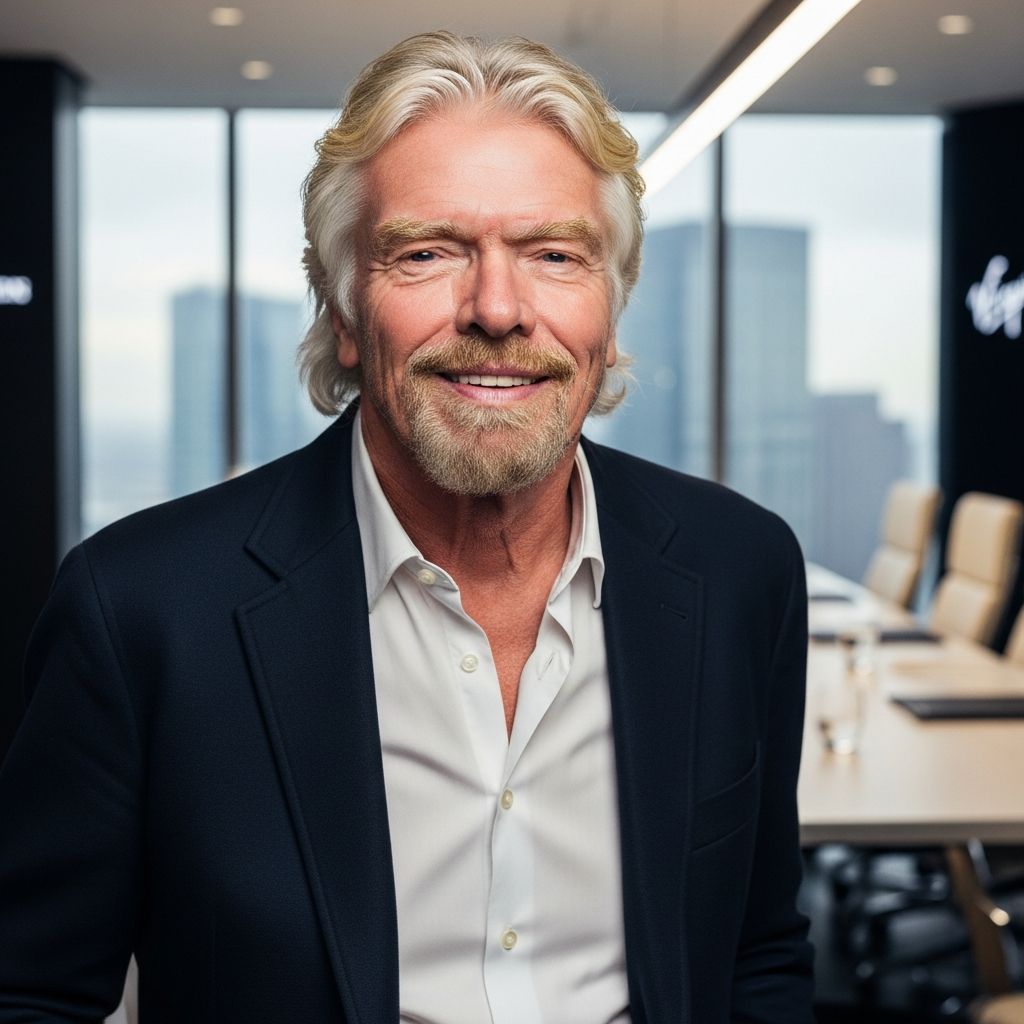
From Music to Mogul: Understanding Richard Branson’s Entrepreneurial Evolution
Richard Branson stands as one of the most recognizable figures in modern business, having transformed himself from a young entrepreneur selling records through the mail into the founder of a global conglomerate that operates in over 30 countries. His journey represents a masterclass in identifying opportunities, taking calculated risks, and maintaining an unwavering commitment to customer satisfaction. Unlike traditional business leaders who confine themselves to a single industry, Branson has demonstrated remarkable versatility in expanding the Virgin Group into sectors as varied as aviation, telecommunications, financial services, and space exploration. This multifaceted approach has not only generated substantial wealth but also redefined what it means to be an entrepreneur in the modern era.
The Genesis: Building the Virgin Empire From Ground Up
The foundation of Branson’s empire began in 1970 when he initiated a mail-order record business as a way to offset the costs of running a student magazine called Student. This humble beginning, launched under the name Virgin, would eventually grow into one of the world’s most recognizable brands. By 1971, Branson had opened his first physical record shop on Oxford Street in London, marking a significant expansion of his original concept. The following year, he established Virgin Recording Studio in 1972, and in 1973, he formally created Virgin Records, which quickly became the dominant label for punk and new wave music during the industry’s transformative period.
What set Branson apart from his contemporaries was his understanding that successful businesses required more than financial acumen—they demanded genuine engagement with customers and a willingness to challenge industry conventions. This philosophy would become the cornerstone of every venture he undertook, regardless of the sector. His early success in the music industry provided both the capital and the confidence necessary to expand into entirely new business domains.
Strategic Diversification: The Virgin Group Expansion Timeline
Throughout the 1980s and 1990s, Branson systematically expanded the Virgin brand into new sectors. In 1984, he became the majority backer of an airline that he renamed Virgin Atlantic Airways. This decision proved transformative, as the airline succeeded despite intense competition from established carriers. By 1992, Branson had made the strategic decision to sell Virgin Records to raise additional capital for Virgin Atlantic’s expansion, demonstrating his ability to prioritize growth opportunities over maintaining his original business.
The diversification accelerated dramatically during the 1990s. The Virgin conglomerate, which had emerged as one of the United Kingdom’s largest privately held companies, comprised approximately 100 distinct businesses by this period, including Virgin Megastores. In 1996, Virgin.Net launched as the company’s internet venture, while Virgin Brides and Virgin Cosmetics expanded the brand’s reach into lifestyle sectors. The year 1997 saw the commencement of Virgin Trains operations, marking the company’s entrance into the transportation infrastructure market.
By 1999, Virgin had launched Virgin Mobile, establishing itself as a competitor in the telecommunications industry. This period demonstrated Branson’s conviction that the Virgin brand could succeed in virtually any market where customer service and innovation mattered. His approach of applying the same customer-centric philosophy across diverse industries became a defining characteristic of the Virgin Group’s strategy.
Expansion Into New Frontiers During the 2000s
The new millennium brought ambitious expansion into sectors that seemed far removed from Branson’s original music business. In 2000, Virgin Australia (originally known as Virgin Blue) commenced operations, establishing Branson’s presence in one of the world’s most competitive airline markets. Simultaneously, Virgin Energy launched in 2000, providing gas and electricity to residential households across the United Kingdom, while Virgin Cars entered the automotive services sector.
The most visionary expansion during this period came with the formation of Virgin Galactic in 2004, a space tourism company that would eventually work toward offering commercial suborbital passenger flights. This venture represented Branson’s ultimate expression of entrepreneurial ambition—transforming the romantic notion of space travel from the exclusive domain of government programs into a commercial enterprise accessible to civilians. The creation of Virgin Galactic signaled that Branson’s entrepreneurial vision extended beyond earthly markets.
During the 2000s, Branson also established Virgin America in 2007, continuing his airline expansion strategy in the United States. Virgin Media emerged as a quadplay company, offering television, broadband, phone, and mobile services from a single provider. Additionally, Virgin Money became a significant player in financial services, acquiring the struggling Northern Rock bank and establishing itself as a wealth management firm.
Philanthropy and Legacy-Building Initiatives
Beyond commercial ventures, Branson established Virgin Unite in the early 2000s as the Virgin Group’s non-profit foundation dedicated to supporting smaller charities in gaining recognition and funding. This initiative reflected his understanding that business success should contribute to broader social good. The Branson Centre of Entrepreneurship, opened in Jamaica, provided educational resources and support for aspiring entrepreneurs in developing regions, extending his entrepreneurial philosophy beyond corporate boundaries.
Virgin Money Giving exemplified Branson’s commitment to social causes, allowing individuals to fundraise for charitable organizations. This platform surpassed $100 million in donations within just two and a half years of its launch, demonstrating both the effectiveness of the initiative and the public’s enthusiasm for supporting causes through accessible digital platforms.
Record-Breaking Adventures and Personal Achievements
Alongside his business accomplishments, Branson became internationally renowned for his participation in record-breaking adventures. In 1986, he was part of a two-man team that set a record for a powerboat crossing of the Atlantic Ocean. Building on this success, Branson and Swedish aeronaut Per Lindstrand became the first team to cross the Atlantic in a hot-air balloon in 1987 and subsequently the first to cross the Pacific Ocean in 1991. These achievements transcended mere entertainment value; they served as powerful marketing tools that reinforced Branson’s image as an adventurous, boundary-pushing visionary willing to take extraordinary risks.
In 2021, Branson achieved what many considered the pinnacle of his personal adventures when he made a suborbital spaceflight in a Virgin Galactic spacecraft, fulfilling a decades-long vision of participating in commercial space tourism. This achievement, occurring at an age when most entrepreneurs had long since retired, exemplified his commitment to living by the principles that had guided his business ventures.
The Virgin Business Model: Core Principles and Execution
Branson’s success across such diverse industries stemmed from adherence to several core principles. The Virgin brand itself became a promise of quality, innovation, and customer-centric service rather than being tied to any particular product category. This approach allowed the company to enter new markets with the backing of an established reputation, reducing customer acquisition costs and accelerating market penetration.
The company’s structure remained relatively decentralized, with individual Virgin companies operating with significant autonomy while benefiting from the corporate brand and shared resources. This structure encouraged innovation within each subsidiary while maintaining alignment with group-wide values. Additionally, Branson’s personal involvement in most ventures, combined with his high public profile, provided valuable publicity that smaller, competing firms could not match.
Navigating Challenges and Market Adjustments
Not every Virgin venture succeeded spectacularly. The company divested from certain sectors when market conditions changed or competitive pressures intensified. Virgin Digital in the United Kingdom closed in 2007, with the company redirecting its music distribution efforts through Virgin Media’s digital platform. Virgin Megastores were sold to Zavvi in 2007 as the retail landscape transformed. These decisions reflected pragmatic acceptance that even well-managed companies must adjust when market fundamentals shift.
Similarly, some railway franchises were lost to competing operators, and various partnerships were restructured as business conditions evolved. Rather than viewing these as failures, Branson demonstrated the adaptive capacity essential for long-term business success. The willingness to exit underperforming ventures while maintaining commitment to core businesses became a hallmark of Virgin Group management.
Recognition and Business Impact
Branson’s contributions to entrepreneurship and business were formally recognized when he was knighted by Prince Charles of Wales, earning the formal title of Sir Richard Branson. This honor acknowledged not merely his financial success but his broader influence on entrepreneurial culture and business innovation. By the 2020s, the Virgin Group had grown to encompass more than 400 companies across multiple continents, making it one of the world’s most significant privately held business conglomerates.
The scale of this achievement cannot be overstated. Building a single successful company requires exceptional skill, luck, and persistence. Developing over 400 companies across industries as varied as airlines, banking, renewable energy, space technology, and health services demonstrates a rare combination of business acumen, strategic vision, and organizational capability. Each venture carries the Virgin name, meaning that the reputation of the entire group depends on consistent delivery of quality and innovation across all operations.
Lessons for Contemporary Entrepreneurs
Branson’s career offers several critical insights for aspiring business leaders. First, successful entrepreneurs need not confine themselves to a single industry; the principles of customer service, innovation, and operational excellence apply broadly across sectors. Second, personal branding and public visibility can substantially accelerate business success when combined with genuine achievement and authentic values. Third, the ability to take calculated risks while learning from failures distinguishes transformative entrepreneurs from merely competent business managers.
Additionally, Branson’s approach demonstrates that business success and social responsibility are not mutually exclusive. His ventures in renewable energy, his commitment to charitable giving through Virgin Unite, and his educational initiatives in developing regions show that profitable enterprises can simultaneously contribute to broader social objectives. This integration of purpose and profit has become increasingly important to modern consumers and investors evaluating companies.
Frequently Asked Questions About Richard Branson’s Career
Q: What was Richard Branson’s first business venture?
A: Branson’s first business was a mail-order record service launched in 1970 under the name Virgin, initially created to help offset the costs of his student magazine. He opened his first physical record shop on Oxford Street in London in 1971 and formally established Virgin Records in 1973.
Q: How many companies does the Virgin Group operate?
A: By the 2020s, Branson had founded or acquired more than 400 companies operating under the Virgin Group banner across various industries worldwide, making it one of the largest privately held business conglomerates.
Q: What is Virgin Galactic and why did Branson create it?
A: Virgin Galactic, formed in 2004, is a space tourism company working to offer commercial suborbital passenger flights. Branson created this venture as part of his vision to open space exploration to civilians, eventually making a suborbital spaceflight himself in 2021.
Q: Did Virgin Records remain part of the Virgin Group?
A: No, Branson sold Virgin Records in 1992 to raise capital for Virgin Atlantic Airways’ expansion, demonstrating his strategic prioritization of growth opportunities. Despite selling the company that launched his empire, he recognized that capital could be deployed more effectively in the airline venture.
Q: How did Branson’s personal adventures impact his business reputation?
A: Branson’s record-breaking achievements, including Atlantic and Pacific crossings in hot-air balloons and a suborbital spaceflight, reinforced his image as a visionary willing to take calculated risks. These adventures provided powerful publicity and aligned perfectly with the Virgin brand’s association with innovation and pushing boundaries.
References
- Timeline of Richard Branson’s business ventures — Wikipedia. Accessed December 2025. https://en.wikipedia.org/wiki/Timeline_of_Richard_Branson%27s_business_ventures
- Timeline: Life of Richard Branson & Virgin — Timetoast. https://www.timetoast.com/timelines/life-of-richard-branson-virgin
- Richard Branson: Biography & Facts — Britannica Money. https://www.britannica.com/money/Richard-Branson

- Integrated M.A. in Applied Linguistics, University of Hyderabad
- 5+ years in editorial, instructional, SEO, and research-based writing
Sneha is a relationships and lifestyle writer with a strong foundation in applied linguistics and certified training in relationship coaching. She brings over five years of writing experience to theskillvault, crafting thoughtful, research-driven content that empowers readers to build healthier relationships, boost emotional well-being, and embrace holistic living. Her writing and insights reflect the belief that beauty, happiness, and wellness…