
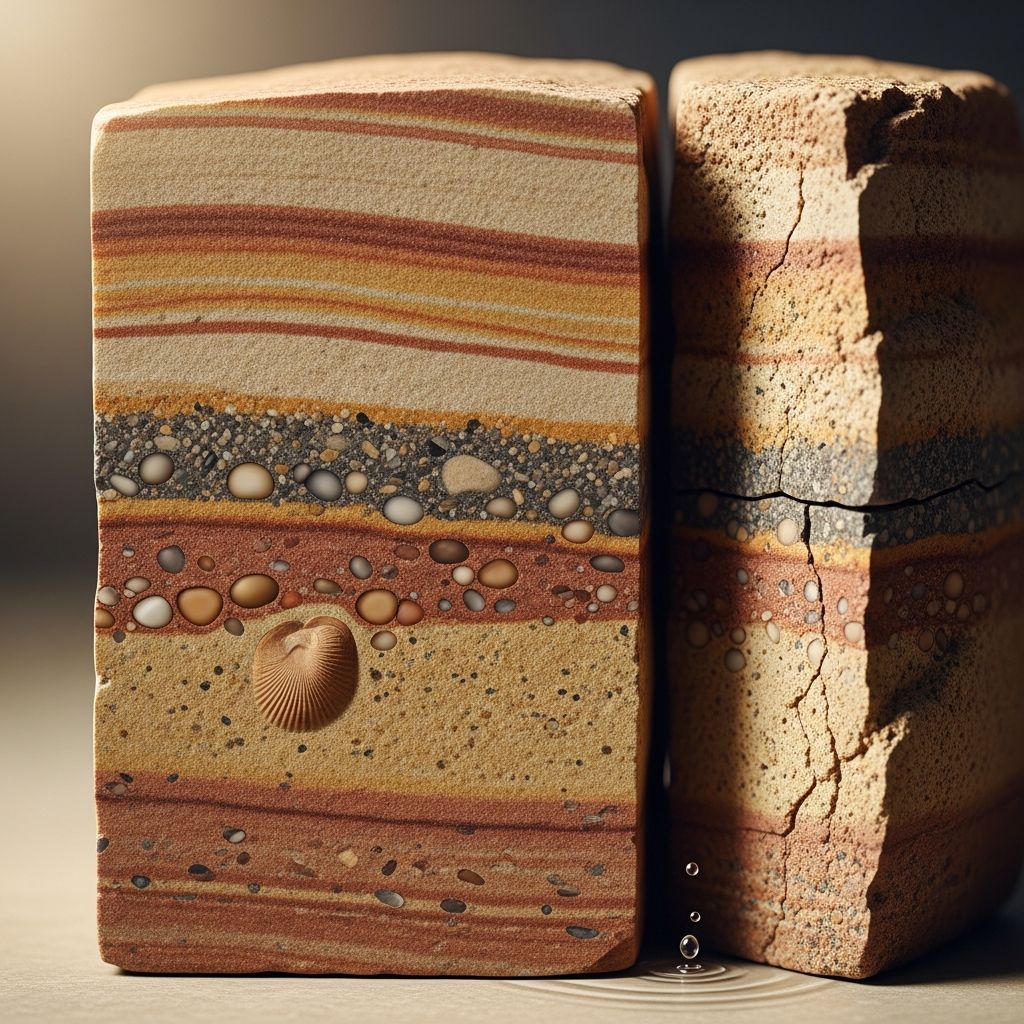
Sandstone represents one of the most abundant sedimentary rocks on Earth, primarily composed of sand-sized mineral particles and rock fragments cemented together over geological time. Its versatility stems from distinctive physical traits like porosity and durability, enabling applications from architectural elements to energy resource storage.
Geological Origins of Sandstone
The creation of sandstone begins with the erosion of pre-existing rocks, producing vast quantities of sand grains mainly consisting of quartz and feldspar. These grains transport via rivers, wind, or ocean currents to depositional sites such as riverbeds, beaches, and deltas.
Once deposited, layers of sand accumulate under water or wind influence. Compaction from overlying sediments squeezes out water, while chemical processes precipitate binding minerals like silica, calcite, or iron oxides, solidifying the material into rock. This diagenesis phase can span millions of years, influenced by environmental conditions.
Key depositional environments include:
- River deltas and alluvial fans, yielding coarser grains.
- Beaches and shallow marine settings, producing well-sorted, rounded particles.
- Deserts, forming aeolian sandstones with uniform, wind-polished grains.
- Deep marine turbidite flows, depositing finer, layered sequences.
Such varied origins contribute to sandstone’s diversity, with formation depths ranging from surface sands to buried layers thousands of meters deep.
Physical and Chemical Characteristics
Sandstone exhibits a hardness of 6-7 on the Mohs scale, attributed to its quartz content, alongside moderate toughness (2.6) and specific gravity between 2.2 and 2.8. Its grain size varies from fine (0.06 mm) to coarse (2 mm), often displaying visible bedding or cross-stratification from original flow patterns.
Porosity, typically 5-30%, arises from intergranular spaces, enabling fluid storage and flow—critical for aquifers and reservoirs. Permeability measures this flow efficiency, enhanced by well-connected pores. Weather resistance varies; quartz-rich types endure harsh climates, while calcareous variants may dissolve in acidic conditions.
Chemically, sandstone comprises 70-90% quartz (SiO2), with feldspar, micas, clays, and cements like calcite or hematite. Compressive strength reaches 95 N/mm², supporting structural loads. These traits make it workable for carving yet robust for engineering.
| Property | Typical Range | Significance |
|---|---|---|
| Hardness (Mohs) | 6-7 | Durable for tools and buildings |
| Porosity | 5-30% | Fluid storage in reservoirs |
| Compressive Strength | Up to 95 N/mm² | Load-bearing capacity |
| Grain Size | 0.06-2 mm | Affects texture and permeability |
Classifying Sandstone Varieties
Sandstones classify by grain composition, texture, and cement type. Quartz arenites, over 90% quartz, offer superior durability for monuments. Arkoses, feldspar-rich (25%+), indicate rapid deposition in continental settings. Lithic sandstones contain rock fragments, common in turbidites.
Texture-based groups include:
- Orthoquartzite: Highly sorted, silica-cemented, resembling quartzite.
- Greywacke: Poorly sorted, clay-matrix rich, from deep-sea sources.
- Calcarenite: Carbonate-cemented, softer and more porous.
Color derives from impurities: red from iron oxides, white from pure quartz, yellow from limonite. Famous examples include India’s red sandstones in Taj Mahal facades and Australia’s Uluru (Ayers Rock), a massive quartz sandstone.
Applications in Construction and Architecture
Sandstone’s aesthetic appeal, ease of cutting, and longevity position it as a premier building material. Used for facades, walls, flooring, and paving, its anti-skid texture suits driveways and pool decks.
Historical significance shines in structures like England’s Dover Cliffs (chalky limestone-sandstone hybrid) and U.S. Indiana Limestone buildings. Modern quarries, such as those yielding Brinscall’s fine-grained stone, supply projects demanding both beauty and strength.
Advantages include fire resistance—ideal for fireplaces—and resilience to heavy loads without cracking. Pink and red varieties provide natural slip resistance when wet.
Industrial and Manufacturing Roles
Beyond construction, sandstone powers industries. Crushed for glassmaking, it supplies silica for clarity and strength. As aggregates in cement and concrete, it enhances texture and durability.
Abrasives from friable types serve sandblasting, polishing, and grindstones for blades or grain milling. Golf course bunkers use its angular grains, while furnace liners leverage heat resistance. In ceramics and paint production, fine powders contribute body and pigment.
Critical Role in Energy and Water Resources
Sandstone’s porosity and permeability make it a prime petroleum reservoir rock, storing oil and gas in pore spaces. Formations in Texas and global basins facilitate extraction via drilling and fracking.
As aquifers, it supplies groundwater; filtration uses exploit its natural sieving. In petroleum ops, sandstone cores test reservoir potential, and aggregates aid well tools.
Artistic and Landscaping Applications
Artists favor sandstone for sculptures due to carvability—think ancient Egyptian obelisks or modern installations. Landscaping employs it for walls, paths, and features, improving soil via mineral release.
Coquina, a soft shell-fragment sandstone, adds delicate textures in gardens.
Environmental and Economic Impact
Quarrying sandstone supports jobs but requires sustainable practices to minimize habitat disruption. Its recyclability in aggregates reduces waste. Economically, it bolsters regions like Ohio’s Devonian deposits.
Frequently Asked Questions (FAQs)
What makes sandstone porous?
Sandstone’s intergranular spaces between sand grains create porosity, typically 5-30%, allowing fluid flow.
Is sandstone suitable for outdoor use?
Yes, its weather resistance and durability make it ideal for facades, paving, and landscapes, especially quartz-rich types.
How does sandstone form reservoirs?
High porosity and permeability trap hydrocarbons; it’s a key rock in oil/gas extraction.
What are common sandstone colors?
Colors range from white and yellow to red and brown, influenced by iron oxides and cements.
Can sandstone be used in glass production?
Absolutely, crushed quartz sandstone provides essential silica for glass strength and clarity.
References
- Sandstone: Types, Formation, Classification, Uses — Geology In. 2023-12-01. https://www.geologyin.com/2023/12/sandstone-sedimentary-rock.html
- What is Sandstone and What is it Used For? — Armstrongs Group. 2023-01-15. https://www.armstrongsgroup.com/what-is-sandstone-and-what-is-it-used-for/
- Various Uses of Sandstones — Sevenn Seas Stone. 2023-01-01. https://www.sevennseas.com/blog/uses-of-sandstones
- Sandstone — Ohio Department of Natural Resources (.gov). 2024-01-10. https://ohiodnr.gov/discover-and-learn/rock-minerals-fossils/common-rocks/sandstone
- How Sandstone Is Formed And Utilized in Petroleum Industry — Kocurek Industries. 2023-05-20. https://kocurekindustries.com/how-sandstone-is-formed-and-utilized-in-petroleum-industry
- Sandstone — Wikipedia (for background; primary sources cited). 2026-04-01. https://en.wikipedia.org/wiki/Sandstone
- Sandstone – Meaning, Uses, Facts, Properties & Color — World of Stones USA. 2023-08-15. https://worldofstonesusa.com/blogs/all/sandstone

- Integrated M.A. in Applied Linguistics, University of Hyderabad
- 5+ years in editorial, instructional, SEO, and research-based writing
Sneha is a relationships and lifestyle writer with a strong foundation in applied linguistics and certified training in relationship coaching. She brings over five years of writing experience to theskillvault, crafting thoughtful, research-driven content that empowers readers to build healthier relationships, boost emotional well-being, and embrace holistic living. Her writing and insights reflect the belief that beauty, happiness, and wellness…