
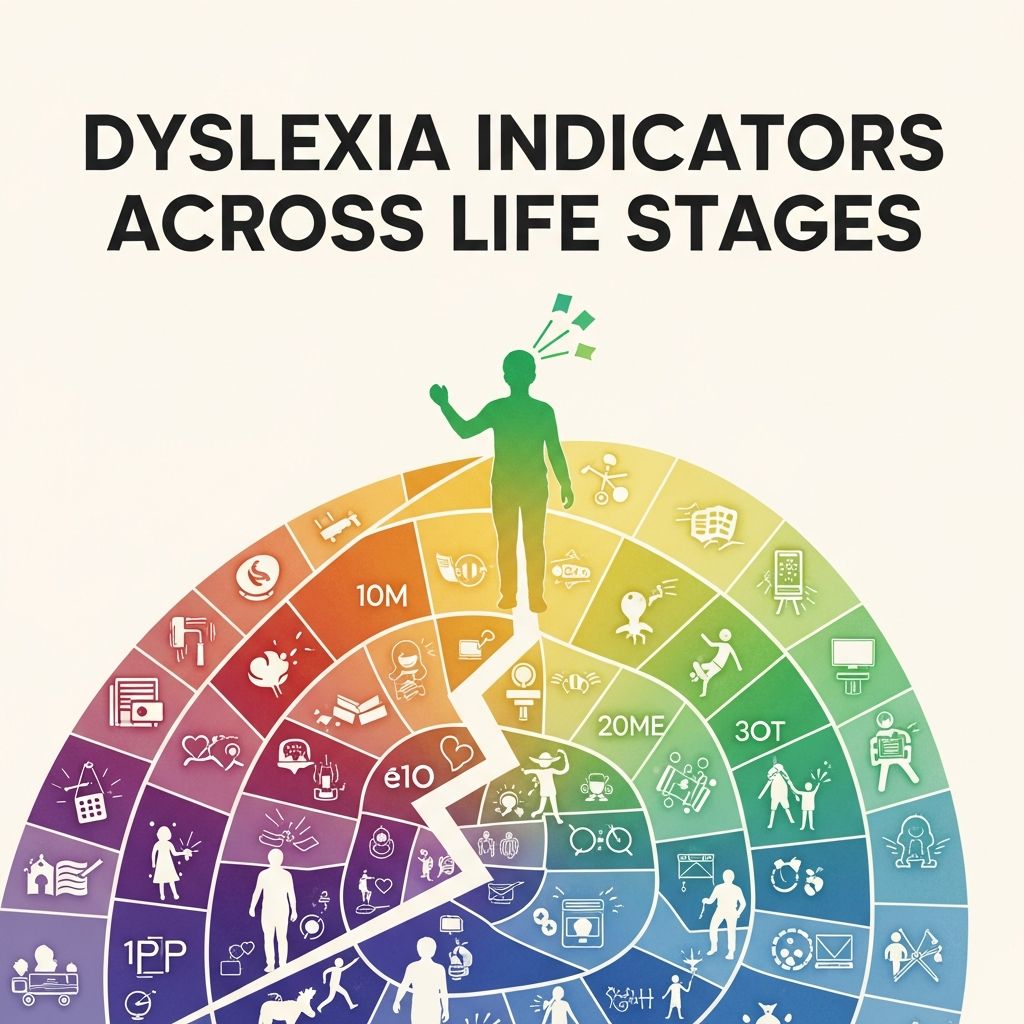
Dyslexia is a common learning difference that affects reading, writing, and spelling skills due to challenges in processing language sounds. It manifests differently as individuals grow, making early recognition crucial for effective support. This article outlines key indicators from early childhood to adulthood, drawing on established patterns to help parents, teachers, and adults identify potential signs.
Understanding Dyslexia’s Core Nature
At its heart, dyslexia involves difficulties with phonological awareness—the ability to recognize and manipulate sounds in spoken words. This leads to struggles in connecting sounds to letters, impacting literacy development. Despite average or above-average intelligence, people with dyslexia often expend extra effort on basic reading tasks. Family history increases risk, with genetic factors playing a significant role. Early intervention, such as structured literacy programs, can significantly improve outcomes.
Preschool Years: First Hints in Language Play (Ages 2-5)
Before formal schooling, dyslexia often appears in subtle language milestones. Toddlers and preschoolers may show delays that differ from typical development.
- Speech and Pronunciation Challenges: Persistent mispronunciation of familiar words, like turning ‘spaghetti’ into ‘pasghetti,’ or baby talk beyond age 3.
- Rhyming Difficulties: Trouble identifying rhymes in games or songs, such as not linking ‘cat’ with ‘hat.’ This is a strong predictor of later reading issues.
- Memory for Basics: Forgetting names of colors, numbers, letters, or even their own name’s letters.
- Attention and Word Learning: Short attention spans during stories and slow acquisition of new vocabulary.
These signs warrant monitoring, especially with family history. Engage in rhyme games and letter play to build skills early.
Early School Years: Reading Foundations Tested (Ages 5-7)
As children enter kindergarten and first grade, reading instruction reveals more pronounced indicators. Peers begin decoding simple words, but those with dyslexia lag.
| Common Indicator | Description | Examples |
|---|---|---|
| Sound Awareness | Struggles segmenting words into sounds or blending them | Can’t break ‘cat’ into /k/ /æ/ /t/; confuses ‘b’ and ‘d’ sounds |
| Decoding Errors | Guesses words from pictures or reverses letters | Reads ‘was’ as ‘saw’; mixes ‘p’ and ‘b’ |
| Reading Fatigue | Quick tiredness after short sessions | Complains reading is hard; avoids books |
| Time Concepts | Confuses days, months, sequences | Mixes yesterday/tomorrow |
Children may resist school or reading aloud, signaling frustration. Teachers should note if errors persist despite instruction.
Middle Elementary: Fluency and Comprehension Gaps (Ages 8-12)
By grades 3-5, fluent reading is expected. Dyslexia signs shift to stamina and accuracy issues.
- Slow, Laborious Reading: Decodes word-by-word, lacking smooth flow; skips small words like ‘the’ or ‘of’.
- Spelling Inconsistencies: Same word spelled differently in one piece; phonetic but illogical errors.
- Comprehension Struggles: Recalls plot but misses details; retells stories inaccurately.
- Writing and Speaking: Messy handwriting, pauses with ‘um,’ vague terms like ‘stuff’.
- Attitude Shift: Avoids reading; low confidence despite strengths elsewhere.
These students excel orally but falter in written tasks. Accommodations like audiobooks help maintain engagement.
Adolescence: Academic Pressures Amplify Challenges (Ages 13-18)
Teens face denser texts and multitasking, exposing deeper impacts.
- Persistent Slow Reading: Requires extra time for assignments; avoids heavy reading classes.
- Organization Difficulties: Poor time management, note-taking issues; inconsistent performance.
- Language Nuances: Misses idioms, puns, or jokes; confuses similar words.
- Spelling and Writing: Errors in essays; strong ideas but weak execution.
- Emotional Toll: Frustration, low self-esteem; may mask with humor or disengagement.
Foreign languages prove especially tough. Tech tools like text-to-speech support independence.
Adulthood: Hidden Struggles in Daily Life
Dyslexia persists lifelong but strategies compensate. Adults often succeed in careers leveraging strengths like creativity.
- Reading Habits: Avoids leisure reading; slow with forms or manuals.
- Verbal Patterns: Frequent ‘ums,’ vague language; trouble summarizing.
- Memory and Direction: Forgets names, sequences; math or time estimation issues.
- Work Impacts: Proofreading challenges; prefers oral communication.
Many report time blindness or direction confusion. Self-advocacy and apps aid management.
Diagnostic Steps and Support Strategies
Suspected dyslexia requires professional evaluation by psychologists or specialists using tools assessing phonology, fluency, and IQ. No single test exists; it’s a profile.
Support Options:
- Multisensory phonics programs (e.g., Orton-Gillingham based).
- Accommodations: extra time, audiobooks, speech-to-text.
- Build strengths: puzzles, big-picture thinking.
Early action prevents cascading effects on confidence and achievement.
Frequently Asked Questions (FAQs)
Can dyslexia be outgrown?
No, but with intervention, individuals develop effective coping strategies, leading to success.
Is dyslexia linked to intelligence?
Dyslexia affects reading, not overall IQ. Many dyslexics excel in visual-spatial or innovative fields.
How do I get my child tested?
Consult school psychologists or private specialists for comprehensive assessments.
Are there medications for dyslexia?
No, it’s addressed through targeted education, not drugs.
Does family history guarantee dyslexia?
It raises risk, but monitoring and screening are key.
References
- Dyslexia Symptoms Checklist By Age and Type — Gemm Learning. 2023. https://www.gemmlearning.com/can-help/dyslexia/info/symptoms/
- Dyslexia Symptoms by Age — Healthline. 2024-01-15. https://www.healthline.com/health/dyslexia-symptoms-by-age
- Signs of dyslexia at different ages — Understood.org. 2024. https://www.understood.org/en/articles/checklist-signs-of-dyslexia-at-different-ages
- Signs of Dyslexia at Different Ages — SF Mind Matters. 2023-05-10. https://www.sfmindmatters.com/blog/signs-of-dyslexia-at-different-ages
- Dyslexia at Different Ages: Signs and Symptoms — Oxford Learning. 2024. https://oxfordlearning.com/dyslexia-at-different-ages-signs-and-symptoms/
- Signs of dyslexia (Primary school age) — British Dyslexia Association. 2023. https://www.bdadyslexia.org.uk/advice/children/is-my-child-dyslexic/signs-of-dyslexia-primary-age
- Signs of Dyslexia — Yale Center for Dyslexia & Creativity. 2022. http://dyslexia.yale.edu/dyslexia/signs-of-dyslexia/

Medha Deb is an editor with a master's degree in Applied Linguistics from the University of Hyderabad. She believes that her qualification has helped her develop a deep understanding of language and its application in various contexts. Medha specializes in the areas of beauty, health, sports, and wellness and is committed to ensuring that the content on the website is…