
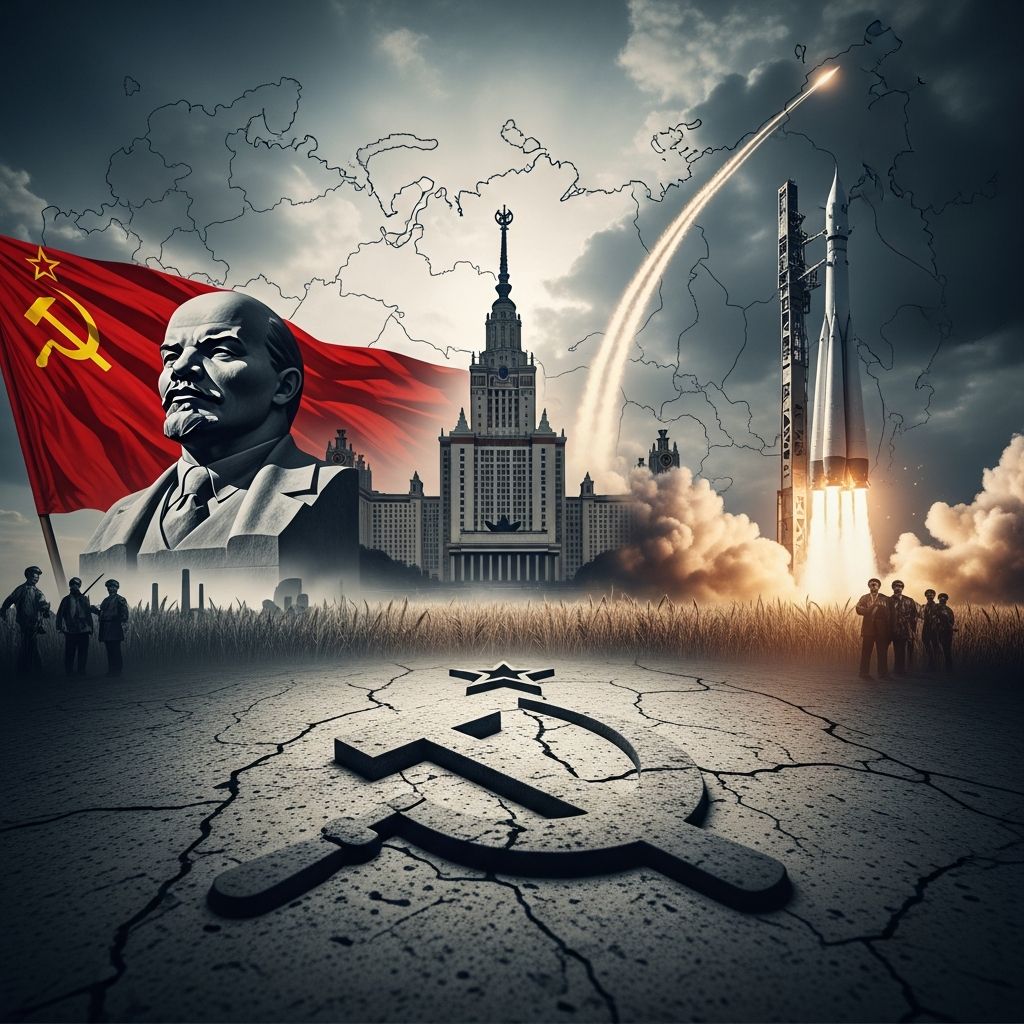
The Soviet Union, officially the Union of Soviet Socialist Republics (USSR), existed from 1922 to 1991 as a vast communist superpower that profoundly influenced global politics, economics, and ideology. Spanning one-sixth of the Earth’s landmass, it united 15 republics under a centralized communist government, emerging from the ashes of the Russian Empire through revolutionary upheaval and enduring through wars, purges, and ideological battles until economic stagnation and political reforms led to its dissolution.
Roots in Revolution: The Path to Soviet Formation
The story of the Soviet Union begins with the turmoil of early 20th-century Russia. World War I weakened Tsar Nicholas II’s regime, sparking widespread discontent among workers, peasants, and soldiers. In February 1917, mass protests in Petrograd forced the tsar’s abdication, leading to a Provisional Government. However, this interim body struggled with ongoing war efforts and land reforms, paving the way for radical change.
The pivotal October Revolution of 1917 saw Vladimir Lenin’s Bolshevik Party seize power in a nearly bloodless coup. The Bolsheviks, advocating ‘peace, land, and bread,’ established the Russian Soviet Federative Socialist Republic (RSFSR), the world’s first communist state. This sparked the Russian Civil War (1918-1922), pitting the Red Army against anti-communist White forces and foreign interventions. By 1922, the Reds’ victory allowed the formal creation of the USSR, incorporating Russia, Ukraine, Belarus, and Transcaucasia.
- Key Events in Formation: October Revolution overthrows Provisional Government; Civil War consolidates Bolshevik control; 1922 Treaty unites republics into USSR.
- Lenin’s New Economic Policy (NEP, 1921) introduced limited market reforms to recover from war communism’s famines and industrial collapse.
Stalin’s Ascendancy: Centralization and Terror
Lenin’s death in 1924 triggered a power struggle, culminating in Joseph Stalin’s dominance by 1929. Stalin abandoned NEP for aggressive Five-Year Plans, enforcing rapid industrialization through state control of resources. Heavy industry boomed—steel production soared from 4 million tons in 1928 to 18 million by 1937—but at immense human cost.
Forced collectivization of agriculture dismantled private farms into state-run collectives, aiming for food security and exports to fund industry. Resistance led to the Holodomor famine (1932-1933), killing millions in Ukraine and Kazakhstan. Stalin’s Great Purge (1936-1938) targeted ‘enemies of the people,’ executing or imprisoning party officials, military leaders, and intellectuals via show trials and the Gulag labor camp system.
| Period | Policy | Impact |
|---|---|---|
| 1928-1932 | First Five-Year Plan | Industrial growth; urban migration surges |
| 1932-1933 | Collectivization | Famines kill 5-10 million; peasant revolts crushed |
| 1936-1938 | Great Purge | 700,000 executed; millions in Gulags |
Stalin’s totalitarian regime transformed the USSR into an industrial power but entrenched repression, with the NKVD secret police enforcing loyalty.
World War II: The Great Patriotic War
Adolf Hitler’s 1941 invasion caught the USSR unprepared, despite the 1939 Molotov-Ribbentrop Pact. Operation Barbarossa devastated Soviet forces, but resilience turned the tide at Stalingrad (1942-1943). The USSR’s Red Army, bolstered by Lend-Lease aid, pushed back, capturing Berlin in 1945. As a Big Four Allied power, the USSR suffered 27 million deaths—more than any other nation—but emerged as a global superpower, occupying Eastern Europe.
- Turning points: Battle of Moscow (1941), Stalingrad victory, Kursk offensive (1943).
- Postwar: Yalta and Potsdam conferences divide Europe, sowing Cold War seeds.
Cold War Dynamics: Superpower Rivalry
Post-1945, the USSR and USA entered ideological conflict. Stalin imposed communist regimes in Eastern Europe, forming the Warsaw Pact (1955) against NATO. The 1949 atomic bomb test and space triumphs—like Sputnik (1957)—matched U.S. capabilities.
Nikita Khrushchev’s 1956 ‘Secret Speech’ denounced Stalin, initiating de-Stalinization. Yet, crises persisted: Berlin Wall (1961), Cuban Missile Crisis (1962). Leonid Brezhnev’s era (1964-1982) saw stagnation—’Era of Stagnation’—with military spending draining the economy amid Afghan War (1979-1989).
Reform and Collapse: Gorbachev’s Legacy
Mikhail Gorbachev’s 1985 leadership introduced glasnost (openness) and perestroika (restructuring) to revive the system. Glasnost exposed historical abuses, fueling nationalism in republics like the Baltics and Ukraine. Perestroika’s market experiments caused shortages and inflation.
The 1991 August Coup by hardliners failed, empowering Boris Yeltsin. Republics declared independence; on December 26, 1991, the Soviet flag lowered over the Kremlin, birthing 15 nations with Russia as successor.
Social and Cultural Transformations
The USSR promised equality, achieving universal literacy (near 100% by 1950s), free healthcare, and women’s workforce participation. Yet, ethnic tensions simmered under Russification policies. Space achievements—Gagarin’s 1961 flight—and cultural exports like ballet masked domestic hardships.
Propaganda glorified the state, but samizdat underground literature critiqued the regime. Post-Stalin thaw allowed limited artistic freedom under Khrushchev.
Economic Model: Achievements and Failures
Central planning prioritized heavy industry and defense, making the USSR second-largest economy by 1970. However, consumer goods lagged; agriculture inefficiencies persisted despite mechanization. By 1980s, oil price drops exposed systemic flaws.
| Sector | Strengths | Weaknesses |
|---|---|---|
| Industry | Rapid growth; military tech | Consumer neglect; inefficiency |
| Agriculture | Collectives fed cities | Famines; low productivity |
| Science | Space/nuclear leads | Brain drain post-collapse |
Global Influence and Legacy
The USSR supported communist movements worldwide—Korea, Vietnam, Cuba—exporting revolution via Comintern. The Sino-Soviet split (1960s) fractured alliances. Its end ended the Cold War, enabling German reunification and Eastern Bloc democracy.
Today, the USSR’s legacy endures in Russia’s assertiveness, Central Asian states, and debates over communism’s viability. It industrialized a backward empire but at freedom’s expense.
Frequently Asked Questions (FAQs)
What caused the Soviet Union’s collapse?
Economic stagnation, Gorbachev’s reforms sparking nationalism, and the failed 1991 coup led to republics’ secession and formal dissolution on December 26, 1991.
How many republics were in the USSR?
15 republics, including Russia, Ukraine, Belarus, and others from the Baltics to Central Asia, united under Moscow’s control.
Was the Soviet Union involved in World War II?
Yes, fighting Nazi Germany in the Great Patriotic War (1941-1945), contributing decisively to Allied victory despite 27 million losses.
What was Stalin’s Great Purge?
A 1936-1938 campaign eliminating perceived threats through executions, Gulags, and trials, purging 700,000+ people.
Did the USSR achieve communism?
No, it remained in ‘socialist’ transition phase; full communism was a deferred ideal never realized.
References
- History of the Soviet Union — Wikipedia. 2023-10-15. https://en.wikipedia.org/wiki/History_of_the_Soviet_Union
- Soviet Union — Wikipedia. 2023-11-20. https://en.wikipedia.org/wiki/Soviet_Union
- Formation of the Soviet Union — Lumen Learning (SUNY). 2022-08-10. https://courses.lumenlearning.com/suny-hccc-worldhistory2/chapter/formation-of-the-soviet-union/
- The Birth of the Soviet Union and the Death of the Russian Revolution — JSTOR Daily. 2022-12-30. https://daily.jstor.org/the-birth-of-the-soviet-union-and-the-death-of-the-russian-revolution/
- Soviet Union — Encyclopædia Britannica. 2023-09-05. https://www.britannica.com/place/Soviet-Union

Medha Deb is an editor with a master's degree in Applied Linguistics from the University of Hyderabad. She believes that her qualification has helped her develop a deep understanding of language and its application in various contexts. Medha specializes in the areas of beauty, health, sports, and wellness and is committed to ensuring that the content on the website is…