
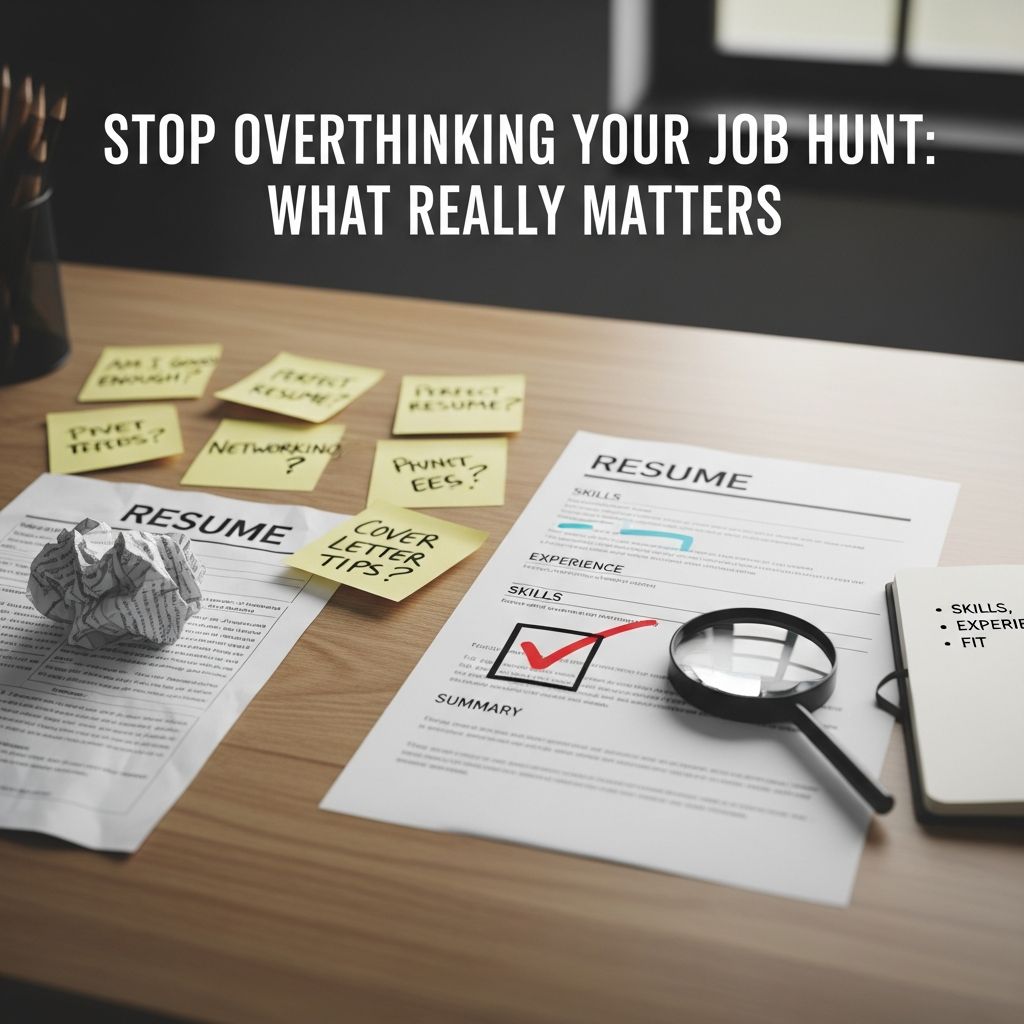
Job searching can feel like a full-time job: dozens of applications, countless edits to your resume, and endless refreshing of your email. Yet a large portion of this stress comes not from the tasks themselves, but from overthinking the wrong things. Research shows that unemployment and job transitions are strongly associated with increased stress, anxiety, and lower life satisfaction, especially when people feel a lack of control over the process. Instead of trying to perfect every tiny detail, you can reduce anxiety and improve your results by focusing on what truly moves the needle.
This guide breaks down the parts of the job search you can stop obsessing over, what to do instead, and how to keep your confidence intact along the way.
Why the Job Search Feels So Overwhelming
Before you can change your approach, it helps to understand why the process feels so heavy. Career and mental health experts point to several predictable stressors:
- Uncertainty: You rarely get clear timelines or feedback, which fuels constant worry and rumination.
- Rejection: Even highly qualified candidates are rejected often, and repeated “no” responses can affect self-esteem.
- Lack of structure: Without a schedule, job searching can feel endless, which increases anxiety and burnout.
- Comparison: Social media and peer updates make it easy to feel behind or inadequate.
The good news: much of this stress can be reduced by focusing on controllable actions and letting go of perfection in areas that don’t matter as much as you think.
Three Job Search Areas You Can Stop Stressing About
Not every step in the job hunt deserves equal attention. Here are three areas where people typically waste energy—and what to do differently.
1. Obsessing Over a 100% Perfect Resume
Many job seekers spend hours agonizing over every word and bullet point on their resume. While a clear, professional resume matters, small cosmetic tweaks rarely make the difference between getting an interview and being ignored.
Career centers and hiring experts consistently emphasize a few fundamentals over perfectionism:
- Clarity about your target role
- Evidence of impact (numbers, outcomes, achievements)
- Alignment with the job description’s key requirements
What matters more than perfection
- Relevance over completeness: You don’t need to list every job you’ve ever held. Focus on roles and projects most relevant to the position you want.
- Impact over tasks: Replace generic duties (“responsible for…”) with measurable outcomes (“increased sales by 18%…”).
- Keywords over clever phrasing: Many employers use applicant tracking systems (ATS). Using wording similar to the job description can help your resume get seen.
Where you can relax
- Minor formatting differences between one-page and slightly longer resumes (as long as it’s easy to read).
- Whether you chose the absolute “perfect” font or exact margin size.
- Having every single bullet point feel equally impressive.
Instead of endlessly reformatting, set a time limit (for example, one focused afternoon), get a second opinion from a mentor or career center, then move on to networking and applications.
2. Treating Every Single Application Like a High-Stakes Exam
Another common trap: pouring hours into each application and feeling crushed when you never hear back. While you should customize core materials, you do not need to reinvent your entire application for every posting.
| Where to Invest Energy | Where to Stop Overthinking |
|---|---|
|
|
Career consultants often recommend setting realistic application goals (for example, 5–10 targeted applications per week), instead of trying to apply to every possible opening or perfecting fewer than you ever send.
Smart application habits
- Batch your work: Spend one block of time finding roles and another block tailoring materials.
- Use templates: Maintain a base resume and cover letter you can adjust quickly.
- Track your efforts: Use a simple spreadsheet to record companies, roles, dates applied, and outcomes. Staying organized is strongly linked to lower job-search stress.
3. Reading Too Much Into Silence or Rejection
Perhaps the most emotionally draining part of the job search is not hearing back—or receiving a polite rejection after getting your hopes up. Mental health experts note that rumination (replaying events repeatedly) is a major driver of anxiety during career transitions.
But a lack of response often says more about the company’s systems than your worth or potential.
Why silence doesn’t mean failure
- Many roles receive hundreds of applications, and not all companies send updates.
- Internal candidates, frozen budgets, or shifting priorities can affect decisions.
- You might be an excellent fit for a different role at the same company later.
Instead of replaying every interview answer in your head, focus on actions within your control:
- Send a brief, professional follow-up after a reasonable timeframe (usually 1–2 weeks).
- Note what you learned from the process (questions asked, new skills needed).
- Adjust your search strategy if you notice consistent feedback patterns.
Where Your Effort Has the Biggest Payoff
Letting go of perfection in some areas gives you more time for the activities most strongly linked to job-search success and lower stress.
Prioritizing High-Impact Activities
- Networking and referrals: A large share of roles are filled through connections or referrals rather than cold applications. Building relationships—online and offline—often yields more interviews than tweaking your resume alone.
- Skill-building: Short courses, projects, or volunteer work can quickly strengthen your profile and confidence, which research links to better mental health during job transitions.
- Informational conversations: Brief chats with people in your field can uncover unposted roles, improve your understanding of the market, and give insight into how employers actually hire.
Creating a Job Search Routine (Instead of Constant Hustle)
Mental health professionals often suggest creating a structured routine to regain a sense of control during a job search. Universities and career centers echo this, noting that a consistent schedule and realistic goals reduce overwhelm and improve follow-through.
Here’s an example of a balanced weekly structure:
- 3–4 days per week: Focused time for searching roles and sending applications.
- 1–2 days per week: Networking outreach, informational interviews, or industry events.
- Daily: Short blocks for learning (articles, short course videos, portfolio work).
- Daily: Non-job activities that support your mental health (exercise, hobbies, time with others).
Managing Stress So the Search Doesn’t Take Over Your Life
Job search stress is valid, but it doesn’t have to dominate every waking moment. Mental health organizations and career services consistently recommend combining job-search efforts with basic self-care practices to protect your well-being.
Practical Stress-Management Strategies
- Set work hours: Treat your job search like a job—start and end at set times to avoid endless scrolling and burnout.
- Define daily goals: For example, “Apply to 2 roles, message 1 person, spend 30 minutes learning.” Specific, attainable goals are linked to higher motivation and lower stress.
- Take tech breaks: Step away from job boards and social media regularly to avoid constant comparison.
- Move your body: Physical activity is shown to reduce symptoms of anxiety and depression and improve sleep, which supports resilience during stressful periods.
Building a Support System
Feeling alone intensifies job search anxiety. Universities, mental health providers, and executive education programs encourage job seekers to intentionally seek support:
- Share your goals with trusted friends or family and ask for accountability check-ins.
- Connect with alumni networks, professional associations, or online groups in your field.
- Use career center or community resources for resume reviews, mock interviews, and coaching.
- Consider speaking with a mental health professional if the stress feels unmanageable or affects your sleep, mood, or relationships.
Mindset Shifts That Make the Job Search Easier
Beyond strategy and structure, your mindset shapes how you experience the process. Here are three shifts that can help you stay grounded.
From “I Must Get This One Job” to “I’m Exploring Multiple Paths”
Pinning all your hopes on one role or company magnifies every rejection. A more sustainable mindset is to treat each opportunity as one of many possibilities. This flexibility can also open you up to roles or industries you hadn’t previously considered—but that still align with your skills and values.
From “Rejection Means I’m Not Good Enough” to “Data for My Strategy”
Instead of viewing each “no” as a verdict on your worth, treat it as information:
- If you never hear back, you may need to refine your resume or target different roles.
- If you consistently reach final rounds, your approach is working—even if the offers aren’t landing yet.
- If feedback mentions specific skills, you’ve identified a concrete area for development.
From “I Have to Do Everything Perfectly” to “Done Is Better Than Perfect”
Perfectionism often leads to procrastination. A healthier goal is consistent, good-enough action:
- A solid resume sent to five positions is more powerful than a flawless resume sent to none.
- A short networking message is better than endlessly drafting one you never send.
- One hour of focused effort beats three hours of distracted, anxious scrolling.
Frequently Asked Questions (FAQs)
Q: How many hours per week should I spend on my job search?
A: There is no universal number, but many career experts suggest treating job searching like a part-time or full-time commitment depending on your situation. The key is setting a predictable weekly schedule and realistic goals so you feel productive without burning out.
Q: How do I know if my resume is “good enough” to stop editing?
A: If your resume clearly targets your desired roles, highlights measurable achievements, is free of obvious errors, and has been reviewed by at least one knowledgeable person or a career center, it is usually good enough to start sending. At that point, your time is better spent on applications and networking.
Q: What should I do if I feel anxious every time I check my email for responses?
A: Limit how often you check (for example, twice per day) and plan something specific to do immediately afterward, such as applying to a role or going for a brief walk. If anxiety feels intense or persistent, consider speaking with a mental health professional or counselor for additional support.
Q: Is it still worth applying if I don’t meet all of the qualifications?
A: In many cases, yes. Job descriptions often list an ideal candidate, not a strict checklist. If you match most core requirements and can show relevant achievements, it is often worth applying—especially if you are also networking with people at the organization.
Q: How can I stay motivated during a long job search?
A: Break your goals into small, achievable steps, track your progress, celebrate milestones, and maintain activities that support your well-being—such as exercise, hobbies, time with others, and learning opportunities. Remember that a challenging search does not reflect your long-term potential.
References
- Finding a Job Is Stressful. Here’s How to Get Through It. — Harvard Business Review. 2021-09-22. https://hbr.org/2021/09/finding-a-job-is-stressful-heres-how-to-get-through-it
- How to Cope With the Stress of Looking for a New Job — PrairieCare. 2023-06-09. https://prairie-care.com/press-stress-of-looking-for-job/
- 4 Strategies to Stay Motivated During a Prolonged or Challenging Job Search — University of Virginia Darden School of Business. 2025-03-03. https://blogs.darden.virginia.edu/executive-education/2025/03/03/4-strategies-to-stay-motivated-during-a-prolonged-or-challenging-job-search/
- How to Manage Stress During Your Job Search — University of Missouri Career Center. 2024-02-15. https://career.missouri.edu/career-scoop/how-to-manage-stress-during-your-job-search/
- Managing Job Search Stress — UC Davis Career Center. 2023-10-01. https://careercenter.ucdavis.edu/job-and-internship-search/managing-job-search-stress
- Unemployment and Mental Health: Understanding the Interactions — OECD Policy Responses on the Economic Impact of COVID-19. 2021-07-07. https://www.oecd.org/coronavirus/policy-responses/unemployment-and-mental-health-understanding-the-interactions-b3cdbbca/

- Integrated M.A. in Applied Linguistics, University of Hyderabad
- 5+ years in editorial, instructional, SEO, and research-based writing
Sneha is a relationships and lifestyle writer with a strong foundation in applied linguistics and certified training in relationship coaching. She brings over five years of writing experience to theskillvault, crafting thoughtful, research-driven content that empowers readers to build healthier relationships, boost emotional well-being, and embrace holistic living. Her writing and insights reflect the belief that beauty, happiness, and wellness…