
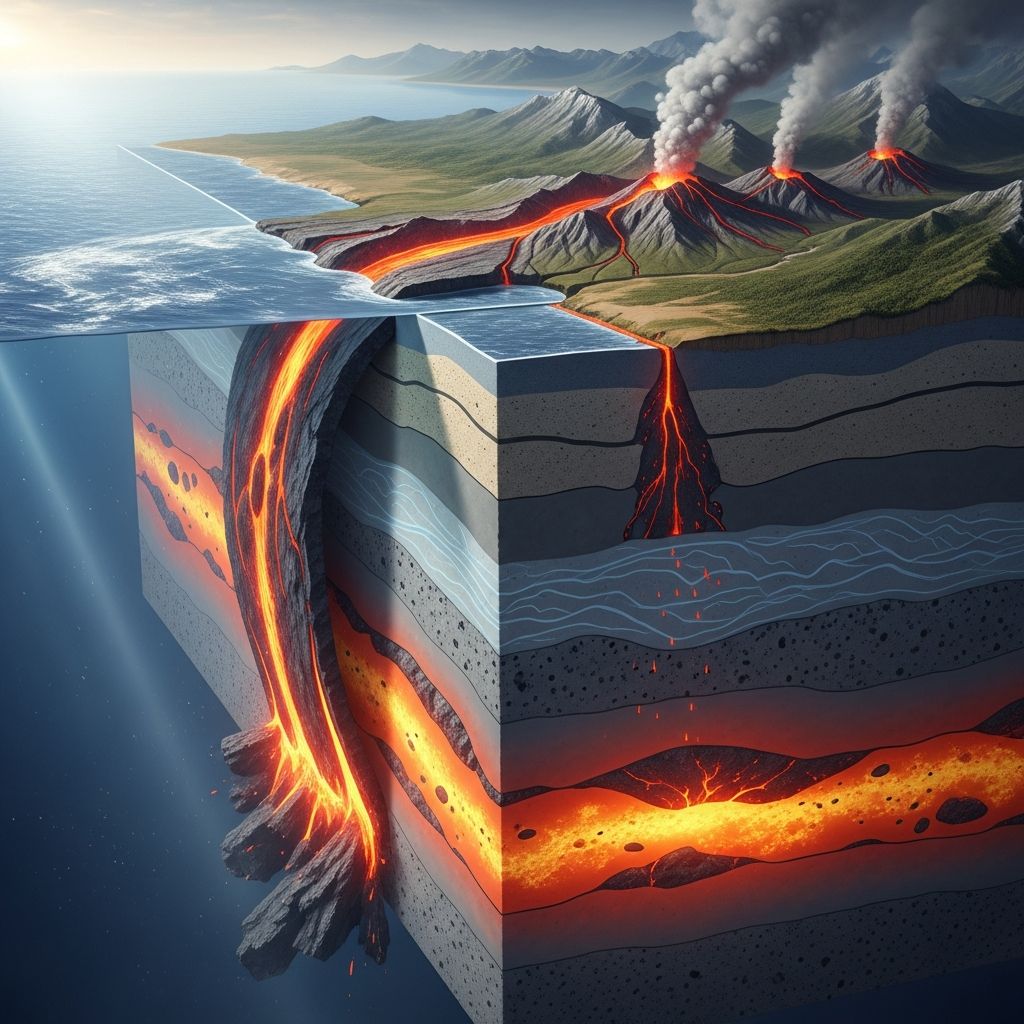
Subduction zones represent one of the most dramatic and influential processes on our planet, where tectonic plates converge and the denser oceanic lithosphere plunges into the Earth’s mantle. This recycling mechanism not only reshapes the seafloor but also fuels volcanic activity, generates colossal earthquakes, and builds towering mountain chains.
Foundations of Plate Convergence
At convergent boundaries, two lithospheric plates collide, but subduction occurs specifically when an oceanic plate meets either another oceanic plate or a continental plate. The oceanic crust, being thinner and denser due to its basaltic composition, sinks beneath the thicker, more buoyant continental crust or younger oceanic crust. This descent creates linear zones of intense geological activity stretching thousands of kilometers, such as the Pacific Ring of Fire.
The subducting slab penetrates the mantle while retaining much of its rigidity, as evidenced by seismic tomography imaging slabs down to 600-700 km depths before they disintegrate into the surrounding convection currents. These zones mark the end of oceanic plates formed at distant mid-ocean ridges, completing the crustal lifecycle through seafloor spreading and subduction.
Driving Mechanisms Behind Slab Descent
Several forces propel this relentless subduction. The dominant force is slab pull, where the cold, dense subducting plate’s weight generates gravitational traction, dragging the plate toward the mantle. Supporting this is ridge push, a secondary force from the elevated mid-ocean ridges where new crust forms and cools, exerting downward pressure.
Additionally, mantle convection currents and a suction effect from the sinking slab contribute by creating low-pressure zones that draw the overriding plate closer, sometimes leading to back-arc spreading. These combined dynamics explain varying plate speeds and the persistence of subduction over millions of years.
Anatomy of a Subduction System
A typical subduction zone features distinct features:
- Oceanic Trenches: The deepest points on Earth, like the Mariana Trench at over 11 km, form where the bending plate creates a depression.
- Accretionary Wedge: Sediments scraped from the subducting plate pile up, forming thrust-and-fold belts that grow seaward at 1-10 km per million years.
- Forearc Basin: A sediment-filled depression between the wedge and volcanic arc.
- Volcanic Arc: Magma rises through the overriding plate, forming chains like the Andes.
- Back-Arc Basin: Extension behind the arc, potentially creating new ocean floor.
Deeper, the slab undergoes high-pressure metamorphism, forming duplex structures and enabling exhumation of rocks at rates up to 2 mm/year.
Geochemical Transformations and Magma Genesis
As the slab descends, rising temperatures trigger dehydration reactions in hydrous minerals, releasing water into the overlying mantle wedge starting at shallow depths (0-30 km). This fluid flux lowers the mantle’s melting point, generating partial melts that ascend as magma, producing calc-alkaline magmas characteristic of continental crust formation.
These processes not only build volcanic arcs but also concentrate ore deposits, contributing to Earth’s mineral wealth. The interaction of subducted sediments and crust with the asthenosphere further enriches these melts.
Depth-Zone Reactions Table
| Depth Range | Key Processes | Outcomes |
|---|---|---|
| 0-30 km | Sediment scraping, initial dehydration | Accretionary wedge growth, fluid release |
| 30-100 km | High-P metamorphism, duplex formation | Thrust stacking, rock exhumation |
| >100 km | Slab breakoff, deep melting | Magmatism cessation, rapid uplift |
Hazards Unleashed by Subduction
Subduction zones concentrate Earth’s most devastating natural hazards. The megathrust interface between plates builds strain, releasing in magnitude 9+ earthquakes, like the 2011 Tohoku event. These trigger tsunamis via seafloor displacement.
Volcanic eruptions from arc magmatism pose threats, while landslides abound due to steep, evolving topography. River systems suffer outburst floods and channel avulsions from earthquake-induced sediment surges, impacting communities for decades. Climate change exacerbates these by intensifying storms on altered landscapes.
Global Distribution and Iconic Examples
Encircling the Pacific, the Ring of Fire hosts 80% of the world’s largest earthquakes and active volcanoes. Notable zones include:
- Cascadia (USA/Canada): Juan de Fuca plate under North America, potential for M9 quakes.
- Andean Margin: Nazca plate subducting under South America, forming the Andes.
- Japan/Tonga: Pacific plate descent creating island arcs and deep trenches.
- Alaska: Ongoing subduction with volcanic remnants in Sierra Nevada.
These regions demonstrate varying slab angles: shallow dips thicken crust and build mountains, steep ones form back-arc basins.
Long-Term Geological Evolution
Over millions of years, subduction accretes material to continents, fostering growth. Collision phases follow: slab breakoff after 1-5 Ma triggers rapid exhumation and magmatism; post-collision (10-50 Ma) sees extension and basin formation. Full margin transformation spans ~4 Ma, with mountains rising and eroding concurrently.
Indigenous oral histories often record these cataclysmic events, linking cultural narratives to subduction dynamics.
Scientific Exploration and Monitoring
Modern studies use seismic tomography, GPS, and seafloor observatories to map slab paths and predict hazards. USGS initiatives focus on subduction science to mitigate risks. Understanding fore-arc deformation, magma ascent, and sediment dynamics reveals how these zones build topography and alter climates.
Frequently Asked Questions (FAQs)
What causes a subduction zone to form?
Oceanic plates, denser due to cooling basalt, sink beneath continental or younger oceanic plates at convergent boundaries.
How deep do subducting slabs reach?
Slabs maintain integrity to 600-700 km, then assimilate into mantle convection.
Why are subduction zones so hazardous?
They host megathrust quakes, tsunamis, volcanoes, and landslides from strained, steep terrains.
What is slab pull?
The primary driver: gravitational pull of the dense sinking slab drags the plate downward.
Do subduction zones build continents?
Yes, via accretion, magmatism, and arc volcanism adding crust over geological time.
This comprehensive look at subduction zones highlights their role as Earth’s geological powerhouses, perpetually recycling crust while posing profound risks and opportunities for study. (Word count: 1678)
References
- Subduction Zone Dynamics: Forces & Earthquake Hazards — Discovery Alert. 2025. https://discoveryalert.com.au/tectonic-plates-subduction-boundaries-plate-convergence-2025/
- Subduction — Wikipedia. Accessed 2026. https://en.wikipedia.org/wiki/Subduction
- The Subduction Zone Process in Plate Tectonics — TR Toms Geo Insights. Recent. https://www.trtomsgeoinsights.com/post/the-subduction-zone-process-in-plate-tectonics
- Exploring Subduction Zone Geohazards on Land and at Sea — Eos.org (AGU). 2018-2023 updates. https://eos.org/features/exploring-subduction-zone-geohazards-on-land-and-at-sea
- Convergent Plate Boundaries—Subduction Zones — U.S. National Park Service (NPS.gov). Ongoing. https://www.nps.gov/subjects/geology/plate-tectonics-subduction-zones.htm
- Subduction Zone Science — U.S. Geological Survey (USGS.gov). Ongoing. https://www.usgs.gov/special-topics/subduction-zone-science
- Introduction to Subduction Zones: Amazing Events — U.S. Geological Survey (USGS.gov). Ongoing. https://www.usgs.gov/special-topics/subduction-zone-science/science/introduction-subduction-zones-amazing-events

Medha Deb is an editor with a master's degree in Applied Linguistics from the University of Hyderabad. She believes that her qualification has helped her develop a deep understanding of language and its application in various contexts. Medha specializes in the areas of beauty, health, sports, and wellness and is committed to ensuring that the content on the website is…