
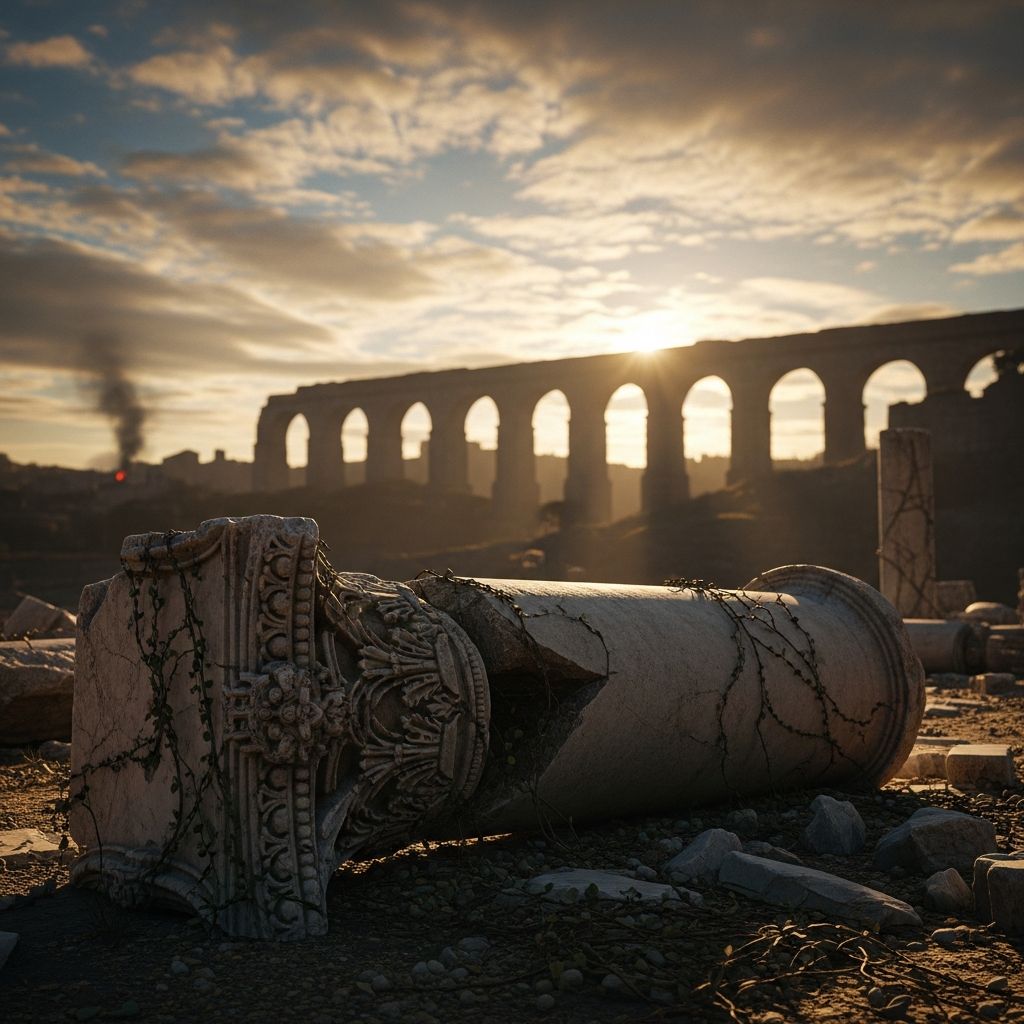
The downfall of the Western Roman Empire in 476 CE stands as one of history’s most transformative events, marking the end of ancient Rome’s dominance in the West while the Eastern half persisted for centuries. This collapse resulted from a confluence of internal weaknesses and external pressures that eroded the empire’s foundations over generations.
Early Signs of Instability in the Imperial Structure
From the late 2nd century CE, the Roman Empire exhibited clear symptoms of strain under Emperor Marcus Aurelius (r. 161-180 CE). His reign faced relentless border incursions and domestic uprisings, compounded by his harsh policies toward early Christians. Aurelius’s successor, Commodus (r. 180-192 CE), exacerbated these issues through erratic governance and megalomania, setting a precedent for leadership failures that plagued subsequent rulers.
In the ensuing decades, the empire endured the Crisis of the Third Century, characterized by over 20 emperors in rapid succession, most meeting violent ends at the hands of their own troops. This era saw rampant civil wars, hyperinflation from excessive military spending, and territorial losses to Germanic tribes along the Rhine and Danube frontiers, as well as Persian advances in the East.
Reform Attempts and the Dawn of Division
Emperor Diocletian (r. 284-305 CE) introduced critical reforms to stabilize the crumbling state. He established the Tetrarchy, a system dividing authority among two senior Augusti and two junior Caesars, aiming to manage the vast territories more effectively. Despite initial successes in quelling rebellions and fortifying borders, infighting resumed after his abdication, leading to Constantine the Great’s (r. 306-337 CE) unification.
Constantine legalized Christianity via the Edict of Milan in 313 CE, shifting the empire’s religious landscape and founding Constantinople as the new eastern capital in 330 CE. This move bolstered the wealthier, more urbanized East but highlighted growing disparities with the West, where child emperors and overreliant generals undermined central authority.
Economic Breakdown and Societal Shifts
The Roman economy, once fueled by conquests and trade, faltered amid declining international commerce. The Vandal conquest of North Africa under Genseric (r. 428-477 CE) severed grain supplies vital to the West, forcing localized markets and crippling tax revenues needed for defense.
- Hyperinflation: Debased currency and heavy taxation fueled price surges, eroding public trust and military pay.
- Agricultural Decline: Plagues, soil exhaustion, and labor shortages reduced food production.
- Trade Disruptions: Barbarian raids fragmented supply chains across the Mediterranean.
These factors created a vicious cycle: impoverished citizens evaded taxes, weakening the state’s ability to fund armies, which in turn invited more invasions.
Military Vulnerabilities and Barbarian Pressures
Rome’s legions, stretched thin across expansive borders, increasingly depended on barbarian mercenaries, many of whom harbored loyalties to their tribal origins. The Huns, under Attila (d. 453 CE), terrorized Europe, pressuring Germanic groups like the Visigoths and Vandals to seek refuge within Roman borders.
| Year | Tribe/Leader | Event | Impact |
|---|---|---|---|
| 376 CE | Visigoths | Mass migration across Danube | Battle of Adrianople defeat; loss of legions |
| 410 CE | Visigoths/Alaric | Sack of Rome | Symbolic blow to imperial prestige |
| 455 CE | Vandals/Genseric | Sack of Rome | Loss of naval power and African provinces |
| 476 CE | Heruli/Odoacer | Deposition of Romulus Augustulus | End of Western Empire |
The sack of Rome by Alaric’s Visigoths in 410 CE shocked the Roman world, exposing defensive frailties, while the Vandals’ 455 CE plunder further diminished resources.
The Final Days: From Orestes to Odoacer
By the mid-5th century, puppet emperors like Romulus Augustulus (r. 475-476 CE) held nominal power under generals such as Orestes. Tensions boiled over when Orestes refused land grants to his barbarian troops, led by the Herulian chieftain Odoacer. Executing Orestes, Odoacer deposed the boy-emperor on September 4, 476 CE, sending the imperial regalia to Constantinople and declaring himself King of Italy.
This event conventionally marks the Western Empire’s end, though Roman administrative traditions lingered in successor kingdoms.
Why the East Endured: A Tale of Two Empires
The Eastern Roman Empire, evolving into the Byzantine Empire, thrived until 1453 CE due to superior economic vitality, defensible geography, and cohesive administration. Constantinople’s walls and naval dominance repelled invaders, while a robust tax system sustained larger armies.
- Stronger urban centers and trade networks.
- Less exposure to mass Germanic migrations.
- Effective bureaucratic reforms under Justinian I (r. 527-565 CE).
In contrast, the West’s fragmented provinces and reliance on unreliable foederati (allied barbarians) sealed its fate.
Debating the Fall: Catastrophe or Transformation?
Historians diverge on the collapse’s nature. Traditional views, like Edward Gibbon’s, emphasize moral decay and Christianity’s enervating influence. Modern scholars such as Peter Heather argue external migrations overwhelmed a resilient empire, rejecting notions of prolonged internal rot.
Others, including Bryan Ward-Perkins, highlight archaeological evidence of economic regression and violence, countering ‘continuity’ theories that portray a seamless transition to medieval Europe. The fall fragmented imperial monopolies, fostering diverse kingdoms and innovation, arguably Europe’s ‘lucky break.’
Lasting Legacies in Law, Culture, and Power
Rome’s collapse birthed medieval Europe, with Germanic kingdoms adopting Roman law, infrastructure, and Christianity. The Catholic Church preserved Latin literacy, while Byzantine survival bridged antiquity and the Renaissance.
Attempts to revive Roman unity—Justinian’s reconquests, Charlemagne’s coronation in 800 CE, and the Holy Roman Empire—failed to replicate the original’s scale, underscoring the permanence of 476 CE’s shift.
Frequently Asked Questions
What exactly marked the ‘Fall of Rome’?
The deposition of Romulus Augustulus by Odoacer on September 4, 476 CE, symbolizing the end of centralized Western imperial rule.
Did the entire Roman Empire collapse in 476?
No, only the Western half; the Eastern (Byzantine) Empire continued until 1453 CE.
Were barbarian invasions the sole cause?
No, they interacted with internal issues like economic decline, political instability, and military overextension.
How did Christianity factor into the decline?
Debated; some claim it softened martial spirit, but evidence shows Christian emperors like Constantine strengthened the state.
What lessons does Rome’s fall offer today?
It warns of overreliance on mercenaries, economic mismanagement, and ignoring border security amid internal divisions.
References
- Fall of Rome | Military History and Science | Research Starters — EBSCO. N/A. https://www.ebsco.com/research-starters/military-history-and-science/fall-rome
- Fall of Rome – OER Project — OER Project. N/A. https://www.oerproject.com/OER-Materials/OER-Media/HTML-Articles/Origins/Unit5/The-Fall-of-Rome
- The Fall of Rome Explained In 13 Minutes — The Life Guide (YouTube). N/A. https://www.youtube.com/watch?v=KJz15Y6hKMM
- Roman Empire – Expansion, Decline, Legacy | Britannica — Britannica. N/A. https://www.britannica.com/place/Roman-Empire/Height-and-decline-of-imperial-Rome
- Review Article: The Return of the Fall of Rome — Texas Lutheran University. N/A. https://my.tlu.edu/ICS/icsfs/RomeReviewArticleRutenburgEckstein16pg.pdf?target=7674ad0f-84bd-4226-bcba-d4c598cd5f03
- The Fall of the Roman Empire | History Today — History Today. N/A. https://www.historytoday.com/archive/history-matters/fall-roman-empire
- The fall of Rome was Europe’s lucky break – Stanford Report — Stanford News. 2019-10-03. https://news.stanford.edu/stories/2019/10/fall-rome-europes-lucky-break

Medha Deb is an editor with a master's degree in Applied Linguistics from the University of Hyderabad. She believes that her qualification has helped her develop a deep understanding of language and its application in various contexts. Medha specializes in the areas of beauty, health, sports, and wellness and is committed to ensuring that the content on the website is…