
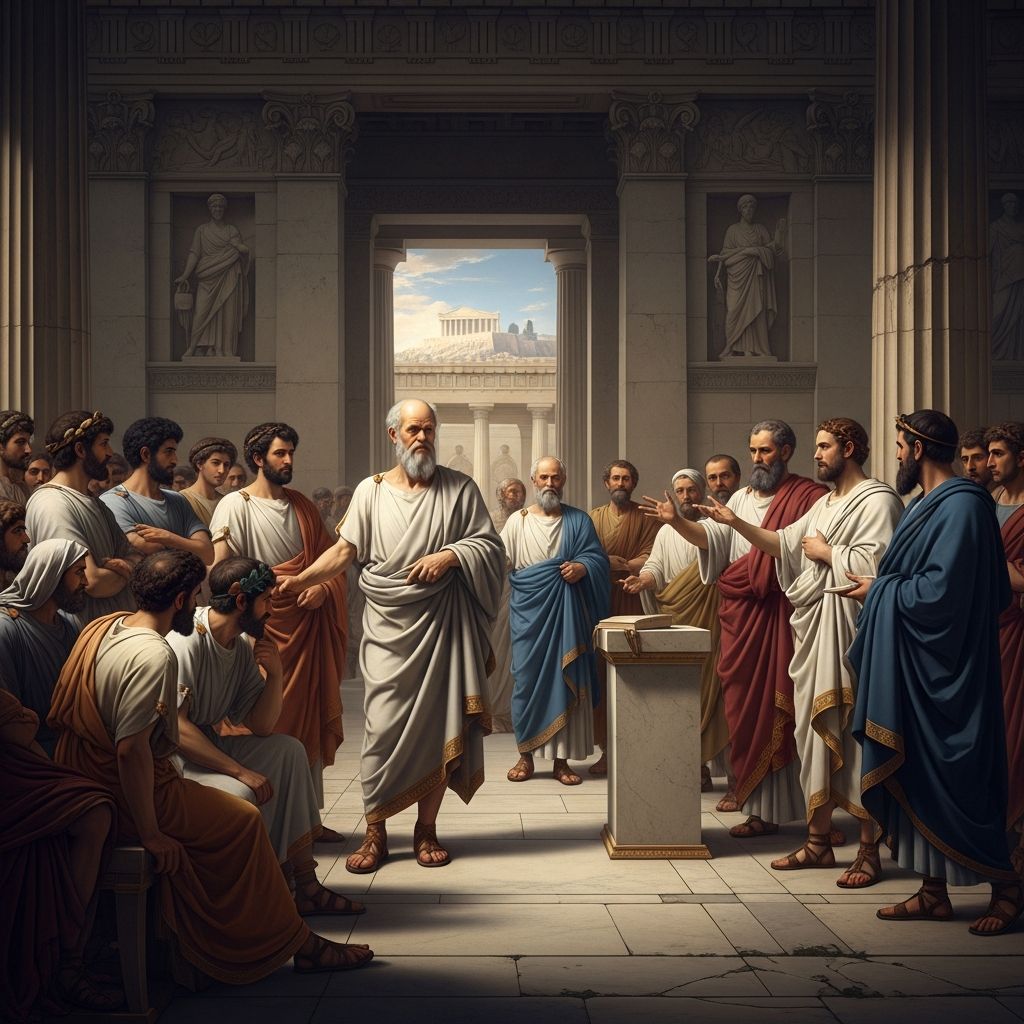
The trial of Socrates in 399 BC stands as one of the most scrutinized events in Western history, marking the clash between individual philosophical inquiry and state-sanctioned orthodoxy. Accused of impiety and corrupting the youth of Athens, Socrates faced a jury of 500 citizens in a proceeding that ended with his death by hemlock. This event not only ended the life of Athens’ most famous philosopher but also raised enduring questions about free speech, religious tolerance, and the role of dissent in democracy.
Historical Context of Athenian Society
Athens in the late 5th century BC was recovering from profound turmoil. The devastating defeat in the Peloponnesian War against Sparta in 404 BC had shattered Athenian confidence. The subsequent rule of the Thirty Tyrants, a brutal oligarchy, further destabilized the city before democracy was restored. Superstitions about divine wrath ran high, as military losses and plagues were often interpreted as signs of offended gods. In this atmosphere of fear and resentment, Socrates became a lightning rod for public anxieties.
Socrates, a stonemason’s son turned gadfly, spent decades questioning Athenians in the marketplace about virtue, justice, and knowledge. His method, known as the elenchus or Socratic method, involved relentless cross-examination to expose contradictions in beliefs. While he attracted devoted followers like Plato and Xenophon, he also alienated powerful figures. Critics viewed him as a subversive influence, linking him indirectly to controversial students like Alcibiades, whose betrayals and the tyrannical Critias fueled anti-Socratic sentiment.
Formal Accusations Against Socrates
The charges were formally presented by Meletus, a minor poet, with support from Anytus, a prominent politician and tanner, and Lycon, a rhetorician. The indictment, as preserved in ancient sources, read: ‘Socrates is guilty of refusing to recognize the gods recognized by the state, and of introducing new divinities. He is also guilty of corrupting the youth. The penalty demanded is death.’
- Impiety (Asebeia): This encompassed two sub-charges: failing to acknowledge Athens’ traditional gods and introducing novel spiritual entities, such as his ‘daimonion’—a personal divine sign that warned him against wrongdoing.
- Corrupting the Youth: Prosecutors claimed Socrates’ teachings encouraged young Athenians to question authority, traditional values, and civic duties, potentially leading to moral decay.
These ‘new’ accusations were distinct from earlier informal gripes about Socrates’ unconventional lifestyle and probing questions, which had circulated for years.
Legal Framework and Trial Procedures
Athenian trials differed markedly from modern ones. Any citizen could initiate proceedings by swearing an affidavit before the King Archon at the Royal Stoa. Meletus did so, summoning Socrates to a preliminary hearing. The magistrate reviewed arguments, questioned both sides, and, finding probable cause, forwarded formal charges to the People’s Court in the Agora.
The trial lasted about 9-10 hours before a jury of 500 male citizens over 30, selected by lot—mostly farmers unaccustomed to philosophical debates. Jurors voted by dropping ballots into urns, with no deliberation or majority needed beyond a simple tally. Prosecutors and defense each had three hours, timed by a water clock, excluding breaks for major speeches.
| Phase | Description | Key Participants |
|---|---|---|
| Preliminary Hearing | Charge reading and initial questioning at Royal Stoa | Meletus, Socrates, King Archon |
| Guilt Phase | Prosecution speeches, Socrates’ response, jury vote | Meletus, Anytus, Lycon |
| Penalty Phase | Competing punishment proposals, final jury vote | Socrates, Prosecutors |
Socrates’ Defense Strategy
Our primary sources are Plato’s Apology and Xenophon’s accounts, both sympathetic but valuable. Socrates began by refuting ‘old’ accusations of being a sophist or natural philosopher, insisting he pursued truth, not pay or showmanship.
Addressing impiety, Socrates cross-examined Meletus: If he introduced new gods, didn’t that imply belief in gods? He likened his daimonion to the prophetic bird signs revered in Athens, arguing consistency with civic religion. On corrupting youth, he flipped the charge: ‘Meletus, do you think I deliberately corrupt them? If so, why wouldn’t the corrupted harm me in return?’ Meletus couldn’t name harmed youths, undermining his case.
Socrates framed his mission as divinely ordained—Apollo’s oracle at Delphi declared him wisest for knowing his ignorance. He saw his questioning as a service to Athens, awakening citizens from unexamined lives. Far from arrogant, he portrayed accusers as motivated by envy and political grudge.
Verdict and Punishment Deliberation
Despite his eloquence, the jury convicted Socrates by a narrow margin—about 280 to 220 guilty votes. In the penalty phase, prosecutors demanded death. Socrates jested he deserved free meals as Athens’ benefactor, then proposed a modest fine of 30 minae, backed by Plato and friends. The jury opted for death, perhaps irritated by his defiance.
Post-verdict, Socrates refused escape, as detailed in Plato’s Crito. He argued laws must be obeyed, even unjust ones, to preserve social order. On his final day, surrounded by disciples, he drank hemlock calmly, discoursing on the soul’s immortality in the Phaedo.
Underlying Motivations and Scholarly Debates
Scholars debate if the charges masked deeper grievances. Anytus resented Socrates’ criticism of democracy and association with aristocrats like Critias. Amid post-war religious fervor, impiety charges resonated, especially after events like Alcibiades’ mutilation of Herms statues, seen as omens of defeat.
Some, like Cambridge’s Michael Scott, argue Socrates was ‘guilty as charged’—his ironic punishment proposal and public persona invited condemnation in a superstitious era. Others see mob justice stifling philosophy.
Legacy on Philosophy and Justice
Socrates left no writings; his ideas survive through Plato and Aristophanes’ satirical Clouds. The trial birthed the Socratic method, foundational to dialectic and critical thinking. It exemplifies tensions between individualism and collectivism, influencing later trials from Galileo to modern free speech cases.
In Athens, it highlighted democracy’s perils—passionate juries swayed by rhetoric over evidence. Yet Socrates’ acceptance of the verdict modeled principled citizenship.
Frequently Asked Questions
What were the exact charges against Socrates?
Socrates was charged with impiety—not recognizing state gods and introducing new divinities—and corrupting the youth of Athens.
Who were the main accusers?
Meletus (poet), Anytus (politician), and Lycon (rhetorician) prosecuted him.
How did Socrates die?
He drank a potion of hemlock as his death sentence, maintaining composure.
Was the trial fair by modern standards?
No—lacked lawyers, evidence rules, and appeals; relied on popular vote.
Why didn’t Socrates flee?
He believed in upholding laws, even unjust ones, to honor his social contract with Athens.
Key Figures in the Trial
- Meletus: Primary accuser, focused on religious charges.
- Anytus: Influential democrat, resented Socrates’ elite ties.
- Plato: Student, present at trial; authored Apology.
- Xenophon: Another pupil, provided alternative account.
The trial’s drama underscores philosophy’s power and peril. Socrates’ final words—’Crito, we owe a cock to Asclepius; pay it and do not forget’—symbolize his pursuit of truth unto death.
References
- What Happened at the Trial of Socrates? — History Hit. 2023-05-15. https://www.historyhit.com/trial-of-socrates/
- The Trial of Socrates — Famous Trials (University of Missouri-Kansas City School of Law). 2022-01-10. https://www.famous-trials.com/socrates/833-h
- Trial of Socrates — Wikipedia (sourced from primary texts like Plato). 2026-04-01. https://en.wikipedia.org/wiki/Trial_of_Socrates
- Socrates was guilty as charged — University of Cambridge. 2012-06-07. https://www.cam.ac.uk/news/socrates-was-guilty-as-charged
- Chapter 2: The Greeks – Socrates’ Trial — Queensborough Community College, CUNY. 2020-08-20. https://www.qcc.cuny.edu/socialSciences/ppecorino/INTRO_TEXT/Chapter%202%20GREEKS/Socrates_Trial.htm

Medha Deb is an editor with a master's degree in Applied Linguistics from the University of Hyderabad. She believes that her qualification has helped her develop a deep understanding of language and its application in various contexts. Medha specializes in the areas of beauty, health, sports, and wellness and is committed to ensuring that the content on the website is…