
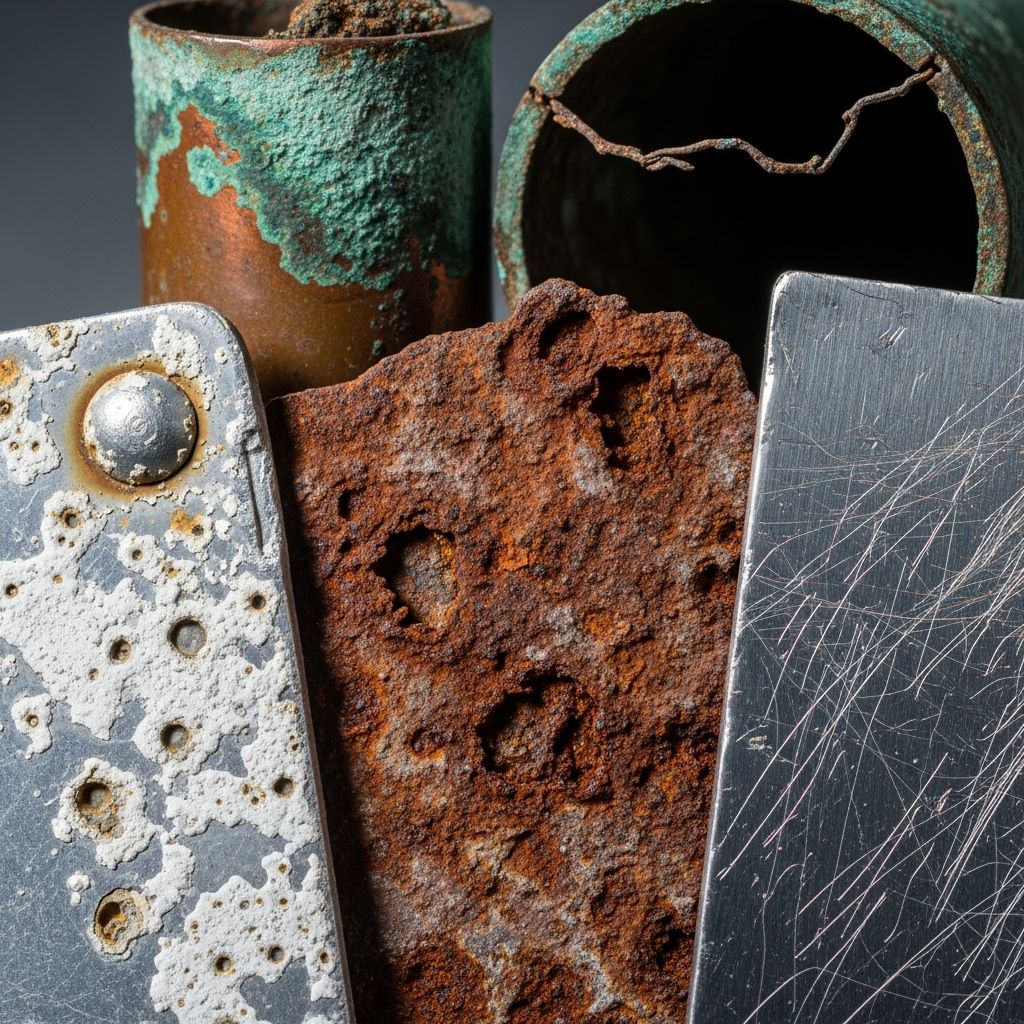
Corrosion represents a fundamental challenge in materials engineering, gradually deteriorating metals through chemical or electrochemical reactions with their surroundings. This process not only shortens the lifespan of structures but also incurs massive economic costs across industries like aerospace, maritime, and infrastructure. By dissecting the primary categories of corrosion, professionals can implement targeted defenses to extend material durability and enhance safety.
Fundamentals of Metal Corrosion Processes
At its core, corrosion arises from the interaction between metals and environmental factors such as moisture, oxygen, salts, and temperature fluctuations. Electrochemical reactions drive most instances, where oxidation at anodic sites releases metal ions, while reduction at cathodic sites consumes electrons. This creates a flow that accelerates breakdown unless interrupted by protective measures.
Environmental conditions play a pivotal role; aggressive atmospheres, like marine settings with high salinity, amplify rates, while controlled industrial setups demand vigilant monitoring. Understanding these basics equips engineers to predict and counteract degradation early.
Uniform Surface Attack: The Most Predictable Form
Uniform corrosion, often termed general corrosion, evenly thins metal surfaces over time as the entire exposed area undergoes oxidation. This type dominates in open-air exposures, soils, and natural waters, converting protective metal layers into stable oxides or hydroxides.
Though predictable via rate calculations, it demands regular maintenance. Carbon steel in humid atmospheres exemplifies this, losing thickness uniformly until perforation risks emerge. Prevention hinges on barriers like paints or alloys with inherent resistance, such as stainless steels.
Localized Breakdown: Pitting and Its Dangers
Pitting stands out as a highly destructive localized corrosion, forming deep cavities from tiny surface initiation points. These pits penetrate inward, often undetected until structural failure looms, making it insidious for pipelines, tanks, and aircraft components.
Triggers include chloride ions breaching passive oxide films on metals like stainless steel or aluminum. Pits evolve into shapes like narrow trenches or subsurface undercuts, fostering further autocatalytic reactions. Polished surfaces resist better due to uniformity, but contaminants swiftly undermine this.
- Narrow, deep pits: Accelerate fatigue cracks.
- Shallow, wide pits: Weaken surface integrity broadly.
- Vertical grain attacks: Follow material microstructure.
Crevice and Concentration Cell Effects
Crevice corrosion thrives in shielded zones where stagnant solutions build aggressive chemistries, such as under gaskets, bolt heads, or lap joints. Differential concentrations—metal ions, oxygen, or pH—drive cells that intensify attack.
Three subtypes prevail: metal ion cells from varying electrolyte strengths, oxygen cells in low-flow areas, and active-passive cells where protective films break. In aircraft, this manifests as ‘pillowing’ under coatings, bulging surfaces before rupture. Mitigation involves design changes to eliminate crevices and use of inhibitors.
Galvanic Interactions Between Dissimilar Metals
Galvanic corrosion activates when two different metals contact in an electrolyte, with the anodic (less noble) member corroding rapidly to protect the cathodic one. Common in marine propellers pairing bronze shafts with steel blades.
The galvanic series ranks nobility; aluminum paired with copper in seawater suffers severe attack. Passivity alters behavior, but electrical isolation via insulators or sacrificial anodes (e.g., zinc) effectively counters it. Pumps often witness this between casings and impellers.
Mechanically Accelerated Erosion Corrosion
Erosion-corrosion combines chemical dissolution with physical abrasion from fluid flow, slurries, or particulates. High-velocity streams erode protective layers, exposing fresh metal to renewed attack, prevalent in pipelines carrying corrosive fluids.
Incubation periods precede acceleration, with damage manifesting as grooves or pits. Turbulent flow exacerbates it; solutions include velocity limits, harder alloys like Hastelloy, or linings. Turbomachinery and ship hulls frequently encounter this hybrid threat.
Stress-Induced Cracking Phenomena
Stress corrosion cracking (SCC) merges tensile stresses with specific corrosives, propagating brittle fractures intergranularly or transgranularly. Austenitic stainless steels in chloride-rich, high-temperature, oxygenated environments are notorious, as in nuclear plants.
Chromium carbide precipitation sensitizes grain boundaries, inviting attack. Control demands low-chloride coolants and low-carbon variants. Combined with fatigue, it poses catastrophic risks to bridges and pressure vessels.
Intergranular Boundary Vulnerabilities
Intergranular corrosion selectively dissolves grain boundaries, often from heat treatments depleting alloying elements. Welding stainless steels at 800–1650°F forms chromium carbides, dropping local Cr below 11%, shattering passivity.
This ‘sensitization’ weakens welds; stabilized grades with titanium or niobium prevent it. Knife-line attack near welds mimics this, demanding post-weld annealing.
Filiform Underfilm Tracking
Filiform corrosion threads beneath coatings from coating defects, driven by oxygen concentration cells. Moisture ingress under lacquers or quick-dry paints spawns filament-like tracks, disbonding protection.
Aviation aluminum structures suffer aesthetically and structurally. Low-permeability, adherent coatings or zinc-rich primers provide cathodic shielding, proven in field tests.
Microbial and Biological Influences
Microbiologically influenced corrosion (MIC) involves bacteria, fungi, or algae metabolizing to produce acids, sulfides, or biofilms that stifle oxygen, accelerating pits or tubercles. Oil tanks and marine pilings host sulfate-reducing bacteria creating anaerobic crevices.
Macrofoulers like barnacles add mechanical stress. Biocides, pigging, and coatings mitigate; wastewater and offshore sectors invest heavily in monitoring.
High-Temperature Oxidation Challenges
High-temperature corrosion assaults metals above 400°C with gases, salts, or ash deposits in furnaces and turbines. Sulfidation or carburization forms brittle scales; heat-resistant alloys like nickel superalloys and cooling fins resist.
Ash-melting fluxes intensify; ceramic barriers offer longevity.
Prevention Techniques Across Corrosion Types
| Corrosion Type | Primary Causes | Prevention Methods |
|---|---|---|
| Uniform | Even exposure to atmosphere | Coatings, inhibitors, alloy selection |
| Pitting | Chlorides, defects | Passivators, polishing, alloys |
| Galvanic | Dissimilar metals | Isolation, sacrificial anodes |
| MIC | Microorganisms | Biocides, hygiene, barriers |
Design eliminates vulnerabilities; cathodic protection impresses current to stifle anodes. Regular inspections via ultrasonics or coupons predict rates.
Frequently Asked Questions (FAQs)
What causes the most common corrosion type?
Uniform corrosion arises from broad exposure to oxygen and moisture, predictably thinning metals in everyday atmospheres.
How can pitting corrosion be detected early?
Small white/gray spots signal onset; non-destructive testing like dye penetrants reveals subsurface pits.
Is galvanic corrosion preventable in marine settings?
Yes, via the galvanic series, using compatible metals or zinc anodes to protect steel hulls.
What role do microbes play in corrosion?
They form biofilms producing corrosives, leading to pits in pipelines; regular cleaning counters this.
Can stress corrosion cracking be reversed?
No, but low-alloy steels and stress relief via annealing prevent propagation.
References
- Forms of Corrosion — AMPP (Association for Materials Protection & Performance). 2023. https://www.ampp.org/technical-research/what-is-corrosion/forms-of-corrosion
- Five Main Types of Corrosion — Corroserve. 2022-10-15. https://www.corroserve.com/five-main-types-of-corrosion/
- Forms of Corrosion — NASA Kennedy Space Center. 2024. https://public.ksc.nasa.gov/corrosion/forms-of-corrosion/
- What Is Corrosion & the 10 Most Common Types — Fractory. 2023-05-20. https://fractory.com/types-of-corrosion/
- Corrosion Types and Prevention — Gibson Stainless & Specialty Inc. 2023. https://www.gibsonstainless.com/types-of-corrosion/
- CHAPTER 5 CORROSION TYPES — U.S. Naval Academy. 2020. https://www.usna.edu/NAOE/_files/documents/Courses/EN380/Course_Notes/Ch05_Corrosion_Types.pdf

- Integrated M.A. in Applied Linguistics, University of Hyderabad
- 5+ years in editorial, instructional, SEO, and research-based writing
Sneha is a relationships and lifestyle writer with a strong foundation in applied linguistics and certified training in relationship coaching. She brings over five years of writing experience to theskillvault, crafting thoughtful, research-driven content that empowers readers to build healthier relationships, boost emotional well-being, and embrace holistic living. Her writing and insights reflect the belief that beauty, happiness, and wellness…